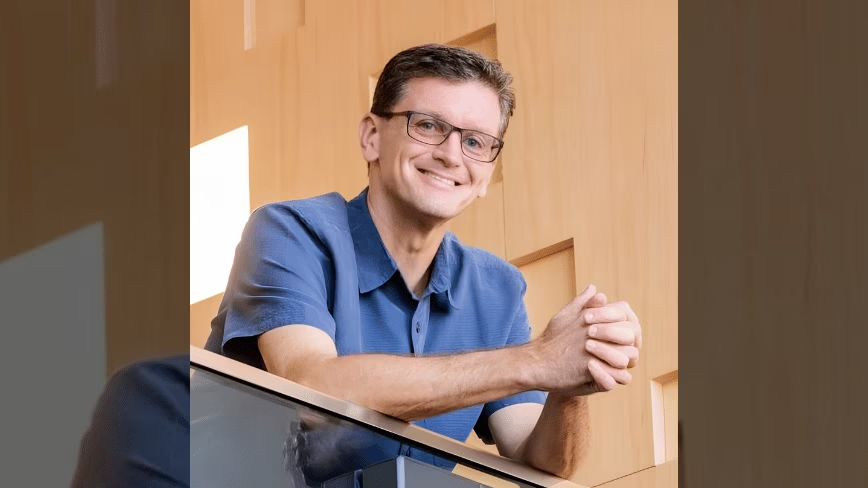
Chris Malone, Head of Data Centers at OpenAI.
 Credit: Chris Malone / LinkedIn
OpenAI has confirmed that the executive running its data centre buildout has left, and it has already broken up the job he was doing.
Chris Malone, its head of data centers, is no longer with the company, an OpenAI spokesperson told Dina Bass at Bloomberg on Monday. Anissa Gardizy broke the story earlier that day for The Wall Street Journal.
Malone joined in March 2025, shortly after OpenAI announced Stargate. That is the programme it runs with Oracle and SoftBank to build the computing capacity its models need, and its flagship site is still going up in Abilene, Texas.
The job did not stay as one job
OpenAI has made leadership changes inside its infrastructure team and appointed a chief technology officer to lead computing capacity, the Journal reported.
The company is also reviving some data centre initiatives, specifically projects that would involve leasing entire facilities. Other people are leading that effort in Malone’s place.
That is the part worth reading twice. This is not a vacancy waiting to be filled. The brief has been split, and the piece of it that is growing fastest now sits with someone else.
Leasing is a different strategy from building
Stargate is a construction programme. Leasing whole facilities is a procurement one, and it moves the risk, the timetable and the counterparties.
Building means land, permits, grid connections and a decade of commitments. Leasing means taking capacity somebody else has already financed, faster and at a price.
A company that is reviving the leasing route while its head of construction leaves is telling you something about which route it now favours.
The run of departures started in April
Kevin Weil, the former product chief, left in April. Fidji Simo, who oversaw much of the core business, stepped down last month after taking medical leave.
Brad Lightcap, the chief operating officer, announced this month that he was leaving for a new project after eight years. The head of safety went in July, after the company folded safety back into research.
Two weeks ago OpenAI named its second chief revenue officer in under a year, hiring Dali Rajic, president and chief operating officer of the Alphabet-owned security firm Wiz. He succeeds Denise Dresser, the former Slack chief executive, who took the job only last December.
Counting Malone, that is seven senior names gone or replaced since April.
The frame is the listing
OpenAI’s chief financial officer Sarah Friar told staff last week that the company will go public in 2027, or sooner.
Companies remake their leadership before a listing, and some of this is that. A public company needs the executives Wall Street expects to see, and it needs them in post long enough to sign things.
The simpler reading also holds. People who survive a build of this intensity tend to leave once the equity vests, particularly when the next phase looks like procurement rather than construction.
What the job had become
Running data centres for an AI lab is no longer a property function. It is a power function, and OpenAI has said as much through its hiring.
The company advertised for a power trading lead in August. That makes electricity a position on its books rather than a line on a utility bill.
That is a different job from the one Malone took in March 2025. It changed underneath him inside 18 months.
The scale involved
OpenAI is planning a $30bn data centre in Georgia. It has also been pushing into Ohio, where Nvidia has discussed guaranteeing $250bn of financing for the buildings that will house its chips.
Oracle has said a single AI data centre could expose it to a $7bn power guarantee. SoftBank has raised a $60bn bond partly to keep the OpenAI bet funded.
Each of those is a different counterparty on different terms. Somebody has to hold all of them in one plan.
What is still not known
OpenAI confirmed the departure but gave no reason for it. No source names where Malone is going.
Bloomberg sent him a message on LinkedIn and he did not immediately respond. The company has not named the chief technology officer for computing capacity in either account.
Departures at this level rarely come with a stated reason, and the absence of one proves nothing either way.
Why this is not like the sales exits
A company can replace a revenue chief inside a quarter and the pipeline survives. OpenAI has now done it twice in a year.
A data centre programme runs on relationships with utilities, planning authorities, construction firms and grid operators. Those relationships sit with individuals, interconnection queues run for years, and so do the contracts.
It is also the function where a mistake costs most. A site that cannot get power on schedule strands capital the company has already committed.
Europe is running the same race differently
Everything named here is American. Stargate, Abilene, Georgia, Ohio.
OpenAI has built its compute programme almost entirely in the United States, where land is cheaper and permitting faster than in most of Europe.
Europe’s constraint is not executive turnover but connection. Operators here queue for grid capacity rather than compete for it, and the buildout has been drifting to markets where the queue is shorter.
The leasing pivot matters here too. European colocation operators sell exactly the product OpenAI is now reported to want, which is finished capacity somebody else has already connected.
What to watch next
The first signal is the name. OpenAI has appointed a chief technology officer for computing capacity and has not said who it is.
The second is whether any announced site slips. Abilene, Georgia and Ohio all carry public timelines, and those timelines are the only public measure of whether this mattered.
The third is the prospectus. A company heading for a listing in 2027 will have to describe its compute commitments in writing, to regulators, and name the risks attached to them.
Key-person risk is a standard disclosure. OpenAI is about to find out how many of its own it has to list.
Get the TNW newsletter
Get the most important tech news in your inbox each week.


