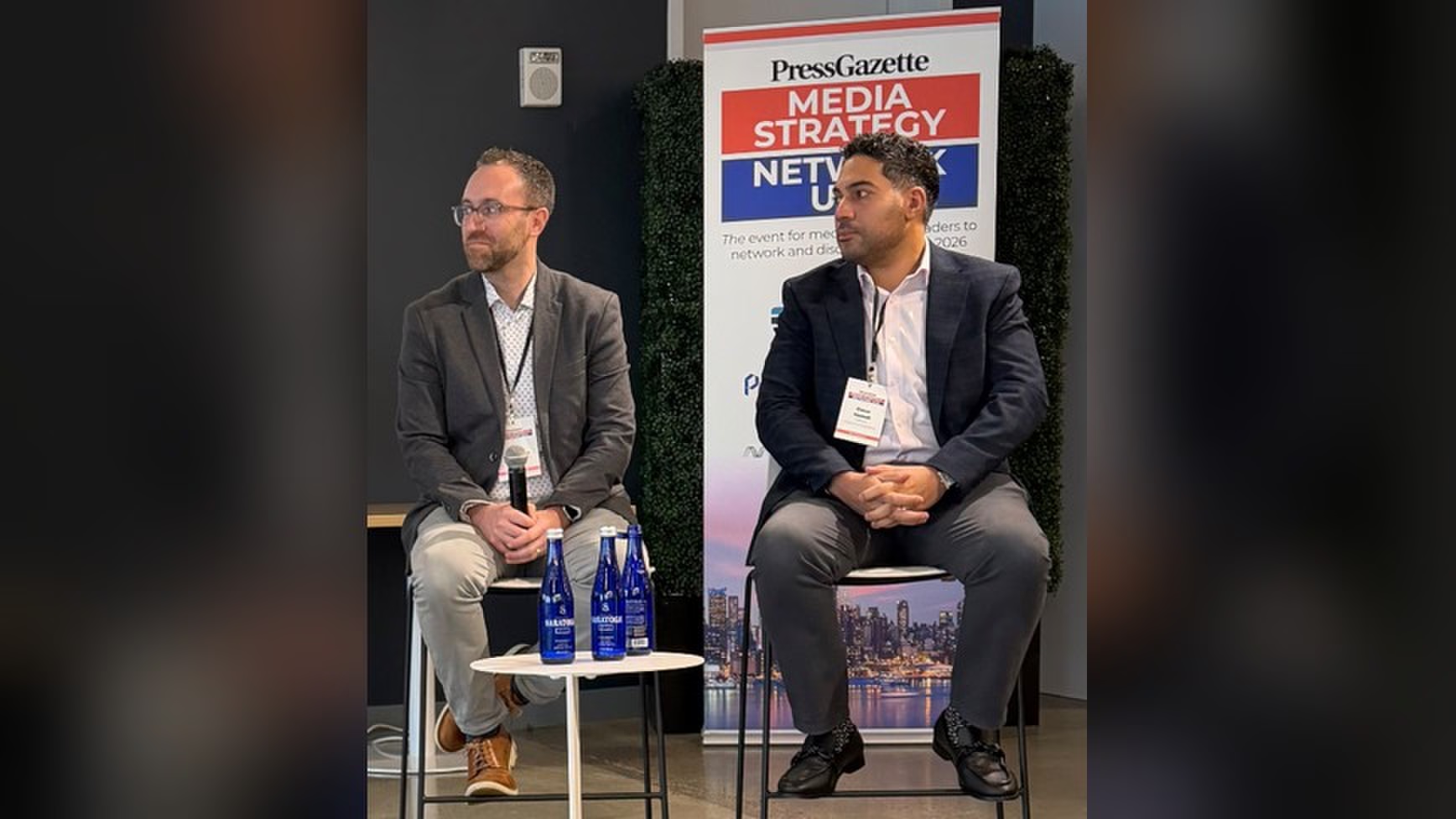
Omar Hamdi, founder and CEO of Pathos Communications, right, on a panel at Press Gazette’s Media Strategy Network USA in New York in March 2026.
 Credit: Alexandru Stan / TNW
City A.M. reported on 6 October that the share of UK firms spending on public relations and management consultants fell to 4.2% in September, even as overall business spending rose 3.1% year on year and spending on AI services increased rapidly.
For Omar Hamdi, chief executive of London-listed Pathos Communications plc, those figures are less a death notice for PR than a sharper test of its economics.
The question suggested by those figures is not only whether companies will cut agency budgets as AI tools spread. It is whether agencies can use technology to deliver more useful work, more consistently, at a price and margin that make sense.
Hamdi’s answer, by his account, is to build a PR company where software takes on more of the preparation, targeting and business development, while people still handle the relationships and judgement that matter when a company is trying to be understood.
Pathos’s recent numbers give that argument a public company frame. Investegate published Pathos’s results for the six months ended 30 June 2026 on 9 September, reporting 14% revenue growth, 36% adjusted EBITDA growth, an 80% rise in customer cash receipts and reoccurring customers accounting for 36% of revenue, compared with 16% a year earlier.
The same announcement said Pressella, its AI virtual publicist, and PathosMind remained on track for general availability in the first half of 2027.
Proactive Investors reported on the same day that Pathos’s first-half adjusted EBITDA rose as higher revenue, improved operating leverage and lower bad debt charges fed through to profitability. That is the operational point Hamdi keeps returning to. He says the firm’s technology is helping with lead generation, lead nurturing and onboarding, while repeat and reoccurring customer relationships are becoming a larger part of the business.
The practical change, as Hamdi describes it, starts before a prospect has spoken to anyone at Pathos. The technology analyses news, shares potential hooks and article ideas, and prepares materials for the human conversation that follows. By the time a meeting takes place, he says the team can have article drafts, business cases and current news hooks ready.
In delivery, he says Pathos is using algorithmic matching between client stories and publishers to improve the chances that content succeeds.
That matters because the addressable market Hamdi is thinking about is not a small pool of blue-chip communications departments. He points to a global market of 400 million SMEs.
In his telling, the technology is intended to make a serious PR experience available to companies that may not have had the time, budget or confidence to hire a conventional agency.
Prospects sometimes respond to outreach, he says, as if Pathos is already doing part of the publicist’s job. One reaction he recalls is: “I feel like you’re already my PR firm.”
The aim is not simply more automated content. Hamdi’s emphasis is on preparation that changes the quality of the first human interaction. He says clients felt they were getting the same experience they would receive if a highly qualified PR person with decades of experience had spent a day working with them, and were getting that experience “before they’d even met with us for the first time.”
There is also an internal productivity argument. Hamdi says the technology affects how the team works, not only how prospects are contacted.
“It just makes their job much more efficient, much more lubricated, the velocity of the business has improved,” he says. The efficiency of Pathos’s business development, he adds, is higher than it has ever been.
For business readers, the more interesting claim is not that AI can write faster. It is that what was originally a services company may be able to grow by becoming a technology company with a service layer. Hamdi says Pathos is adding larger and stronger publishers to its platform, which can support better margins with those publishers. “We’re getting more efficient as we scale,” he says.
Yahoo Finance reported on 15 October that Hamdi discussed rising repeat and reoccurring revenue, Pathos’s aim of building a sustainable, profitable listed business, and the planned first half 2027 launch of its AI-powered virtual publicist.
The broader bet is still to be tested as Pressella and PathosMind move toward wider availability. But the direction is clear enough. In Hamdi’s view, PR’s future belongs less to firms selling hours and more to operators that can use technology to scale judgement, preparation and relevance, without stripping out the human work that gives PR its value.
Get the TNW newsletter
Get the most important tech news in your inbox each week.


