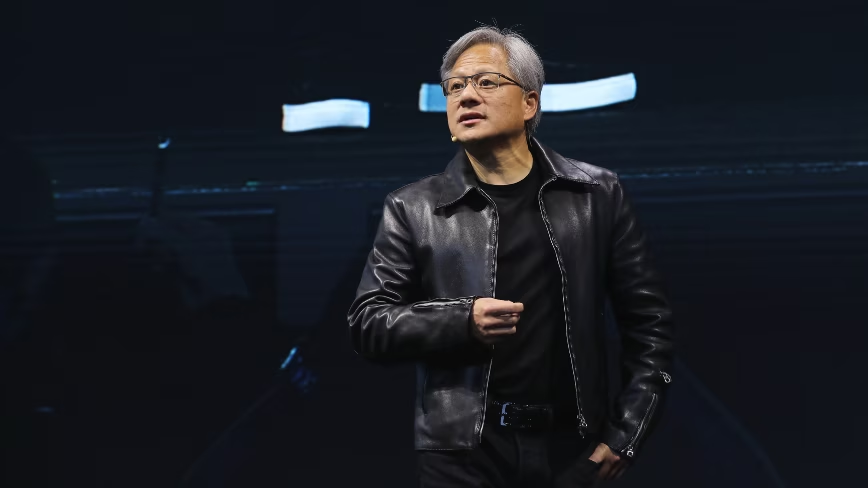
Nvidia chief executive Jensen Huang at Computex in Taipei in 2023.
 Credit: glen photo via Shutterstock
The chipmaker’s credit-default swaps had spiked to a record on fears of circular financing. They eased once Jensen Huang recast the plan as other people’s money, with Nvidia’s own exposure capped.
After weeks in which the cost of insuring its debt climbed to a record on worries about so-called circular financing, that cost eased once chief executive Jensen Huang spelled out how his $500bn plan to bankroll the AI build-out actually works.
Nvidia’s five-year credit-default swaps, in effect a wager on the odds it fails to pay its debts, jumped from around 40 basis points at the start of the month to a record near 82 in late July, the sharpest single-day move since the contract began trading.
And the shares shed close to 5%, which briefly cost Nvidia its crown as the world’s most valuable company. As we noted when its own credit market first flinched, traders had been unnerved by the sheer scale of Nvidia’s entanglement with its customers.
Nvidia has been taking equity stakes in, and offering debt guarantees to, the very companies that then spend the money on its chips, from a reported $250bn backstop for OpenAI’s Ohio data centres to tens of billions in AI equity bets, all of which flatters demand for its own hardware.
By Bloomberg’s count Nvidia had announced some $540bn of such deals this year alone, and both the IMF and the Bank for International Settlements have flagged the pattern as a systemic risk.
The $500bn platform, formalised this week with Apollo, BlackRock, Blackstone, Brookfield, Goldman Sachs and KKR, mobilises third-party capital rather than Nvidia’s own balance sheet, which lets AI labs, enterprises and cloud providers lease GPUs and build data centres without loading the assets onto their books.
Because six finance giants are underwriting the plan, he stressed, each runs its own due diligence, and Nvidia caps its residual-value support at up to 25% on certain deals, which he argued is far lower than the typical compute-financing arrangement.
The pitch rests on an audacious idea, namely that a graphics chip is now a financial asset in its own right.
“This is really the first time that technology chips are an investable asset class,” Jensen Huang said, describing them as revenue-generating, long-lived, fungible and flexible enough for lenders to underwrite much as they would a building.
Goldman’s David Solomon called it a new credit market backed by Nvidia compute, while BlackRock’s Larry Fink reached all the way back to the birth of mortgage-backed securities in the 1970s for his comparison.
That analogy is double-edged, though, because mortgage-backed securities also gave the world the crash of 2008.
The short-seller Jim Chanos likened the structure to pre-crisis financial engineering, and Michael Burry, of Big Short fame, argues that fast-depreciating chips make the residual-value assumptions shakier than they look.
The Bank of England, meanwhile, has warned about heavily leveraged AI companies and how little banks can actually see of their indirect exposure.
Even so, the clarification did its job in the near term. By insisting that the $500bn is an aggregate, multi-year target rather than Nvidia revenue or a single fund, and that both the capital and most of the risk sit with outside investors, Jensen Huang gave the credit market a reason to unclench, and it duly did.
For a company whose valuation now rides as much on confidence as on silicon, that was no small thing.
The deeper worry, however, has not gone anywhere. The whole edifice still assumes that the infrastructure being financed will eventually earn enough to justify the trillions going into it, with Morgan Stanley alone pencilling in $3.5tn of hyperscaler spending through 2028.
Jensen Huang has bought himself calmer markets by arguing that the risk is spread widely rather than concentrated in Santa Clara. Whether that is genuine prudence or simply a bigger, better-dressed version of the same loop is the question the swap traders will keep asking.
Get the TNW newsletter
Get the most important tech news in your inbox each week.


