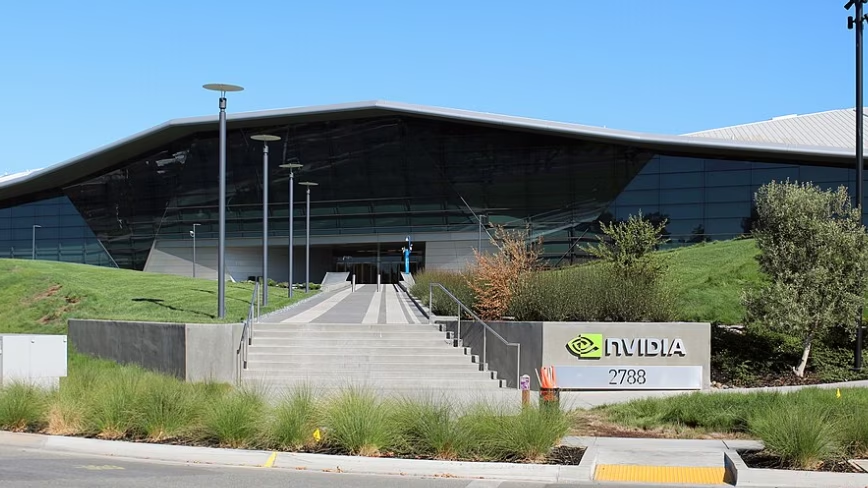
Nvidia headquarters in Santa Clara, California

Nvidia took a minority stake in Cloverleaf Infrastructure on Friday. Cloverleaf secures land and electricity for data centres. It is the third company of that kind Nvidia has bought into in quick succession, according to The Information.
Neither company disclosed terms. The Wall Street Journal reported on Friday morning that Nvidia was expected to invest several hundred million dollars.
What Cloverleaf does
Cloverleaf was founded in 2024. It raised $300mn that year from NGP and Sandbrook Capital.
The company sits between utilities and data centre developers. It arranges the power and the sites, which builders then lease to the cloud providers and model developers who buy Nvidia hardware.
The other two
Nvidia announced an investment in SB Energy the week before. On 17 August it said it had secured land, power and shell capacity at SB Energy’s PORTS-Pike campus in Ohio, which will exclusively host Nvidia AI compute. The desk covered the PORTS-Pike guarantee at the time.
The third is Lancium, the power developer behind OpenAI’s Stargate facility in Abilene, Texas. The Information reported that OpenAI explored investing in or acquiring Lancium last quarter. Nvidia invested billions in the firm instead.
Why the buildings matter now
Nvidia can sell only as many chips as there are data centres able to house them. That constraint has tightened with each generation.
The Register set out the engineering. Until 2024 most Nvidia systems ran on air. Blackwell’s NVL72 racks needed liquid cooling that not every facility could supply.
With Rubin, Nvidia offers the chips in liquid-cooled form only, for the first time. The desk covered Vera Rubin entering production in July.
The numbers behind the cooling
Liquid-cooled racks run denser, heavier and hotter. They need larger backup supplies, heavier power distribution units, and coolant distribution units at roughly one per one to three megawatts of compute.
Racks move from about 250kW to 600kW starting next year, according to The Register. A facility built for air cannot simply take the new hardware.
The spec Cloverleaf is adopting
Nvidia introduced a platform called DSX last autumn and launched it this spring. It is a set of blueprints stating how much power, cooling and space a given amount of compute requires.
Cloverleaf is adopting the DSX spec as part of the deal. That includes DSX Flex, which lets a data centre scale back its workloads in response to grid conditions, or shift demand onto on-site generation or batteries.
Who actually owns the buildings
Many of Nvidia’s largest customers do not own data centres. They lease.
Crusoe built OpenAI’s Stargate site in Abilene and Oracle runs it. Nvidia has taken positions in model developers and neoclouds including OpenAI, CoreWeave and Nebius.
What Nvidia has spent elsewhere
The company announced a $500bn financing plan for AI infrastructure this month, working with six asset managers. The desk covered that plan on 11 August.
Bloomberg Intelligence analyst Kunjan Sobhani put Nvidia’s supply commitments above $100bn, saying the company is “effectively locking in critical AI-infrastructure capacity multiple quarters in advance”.
What it is charging
Nvidia’s biggest customers have been told that servers containing its AI chips will rise in price by more than 15% in many cases. The desk covered that rise on 22 August.
Bloomberg puts Nvidia at roughly 90% of the accelerator market, about $30,000 for a high-end chip, and gross margins near 75%, some 20 points wider than its nearest rivals.
What the buildings are running into
Data centre construction has met organised opposition in the US. The desk covered the industry’s local PR campaigns on 20 August.
Grid capacity is the other constraint. Nebius has started using natural gas fuel cells from Bloom Energy rather than relying on grid supply alone, according to The Register.
What Nvidia announced on Monday
Nvidia said its Groq 3 LPX rack entered full production. That commercialises the technology from its largest acquisition, the $20bn purchase of assets from the chip startup Groq in December.
Each rack packages 256 Groq 3 chips. Nvidia says the rack delivered 3,400 output tokens per second running Gemma 4 31B with a 100,000-token context, citing benchmarking by Artificial Analysis. Samsung manufactures the Groq chips. TSMC makes Nvidia’s GPUs.
Nebius is the first AI cloud to adopt it, and the racks go online later this year, Nvidia senior director Dion Harris told reporters. “This isn’t about replacing GPUs,” Harris said. “It’s about using the right price, right processor for the right part of the workload.”
Nvidia separately said SpaceXAI will deploy its Vera CPUs, and plans to put an optimised Vera Rubin NVL72 system into orbit aboard a first-generation Starmind satellite.
Who is coming for the market
Bloomberg counted the challengers on Monday. AMD’s data centre revenue more than doubled last quarter to $6.7bn. Broadcom expects to sell $56bn of custom AI chips this year.
Amazon chief executive Andy Jassy told analysts in July that a standalone Amazon chip business would turn over more than $25bn a year. Jon Peddie Research counts 150 companies working on more than 200 AI semiconductor designs.
Nvidia shares have risen 15% in 2026. The Philadelphia Stock Exchange Semiconductor Index has gained 66%.
What happens this week
Nvidia reports earnings on Wednesday. Analysts polled by Bloomberg estimate that revenue nearly doubled last quarter from a year earlier, to $92bn.
Nvidia did not respond to requests for comment from The Register or TechCrunch. Neither Nvidia nor Cloverleaf has put a figure on the stake.
The company is also in talks to invest in Perplexity at a valuation above $30bn, The Information reported on Monday. Its chip prices are rising about 17%, the same outlet reported last week, against the 15% figure server makers gave customers.
What none of the sources establish
The size of the Cloverleaf stake is unconfirmed. The several hundred million dollar figure is the Wall Street Journal’s, attributed to one person familiar with the deal, and Nvidia has not confirmed it.
The Lancium figure is looser still. The Information puts it at billions without a number. The count of three land and power investments is that publication’s, and Nvidia has not framed the deals as a series.
Get the TNW newsletter
Get the most important tech news in your inbox each week.


