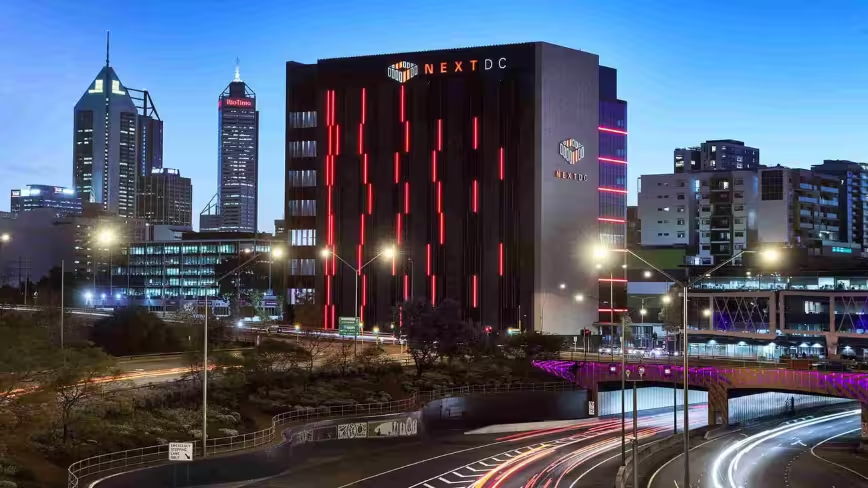
 Credit: NEXTDC
NextDC is raising A$1.1bn, about $796M, through convertible notes to fund the continued expansion of its Australian data centres. It is the third time the company has raised capital in a little over four months.
The terms were reported by Reuters on Wednesday. The notes mature on 17 September 2031, with holders able to put them back to the company in September 2029.
The conversion price will be set at a premium of 32.5% to 37.5% over a reference share price, with that price floored at A$12.40.
NextDC will also enter capped call transactions, with an indicative cap around 70% above the reference price, to reduce potential dilution if the notes are converted into shares.
The structure says something about how NextDC sees its share price. By issuing convertible notes instead of new shares, the company avoids selling equity at today’s price.
The conversion premium also assumes the shares will be worth more in the future. The capped calls are there to reduce dilution if the share price rises enough for investors to convert.
Convertible notes have become a common way for data centre companies to raise money during the current expansion. These businesses need to spend heavily before the additional capacity starts generating revenue.
Convertible debt allows them to raise that money without immediately issuing more shares. Investors accept a lower interest rate in exchange for the possibility of converting the debt into equity if the share price rises.
The risk is that the debt still has to be repaid if the expected growth does not arrive. If new data centre capacity takes longer to generate revenue, the notes remain a liability regardless of what happens to the company’s share price.
NextDC’s capital expenditure plans explain why it needs the money. The company expects to spend between A$5.25bn and A$5.75bn in the 2027 financial year, roughly 55% to 70% more than the previous year.
This is not simply a balance-sheet top-up. NextDC has contracted capacity that still needs to be built, and it needs to build it quickly.
The recent fundraising history shows the same pressure. In April, the company announced an A$2.2bn capital plan, including a fully underwritten A$1.5bn entitlement offer and hybrid commitments from La Caisse.
In May, it added A$1.8bn in senior debt from Australian and international banks, taking pro forma liquidity to about A$8.4bn.
At the same time, it announced 250MW of newly contracted capacity, increasing its forward order book by 83%. Four months later, it is raising another A$1.1bn.
Investors did not appear concerned. NextDC shares closed 2.2% higher on the day of the announcement at A$12.79. A third capital raise in less than a year could normally suggest that a company is spending faster than expected.
In this case, investors appeared to see the fundraising as evidence that the demand behind the expansion is there.
NextDC is also competing with other Australian operators for the capital needed to build new capacity. Nvidia-backed Firmus has been raising money for its own expansion, including a $505mn fundraising and $10bn in Blackstone debt, while preparing for an ASX listing.
It has also secured OpenAI as an anchor customer for capacity in Malaysia. Australian data centre companies are increasingly competing for the same investors, construction capacity and electricity connections.
The bigger constraint is not capital. Australian data centres are expected to use seven times more electricity by 2036, according to the market operator’s forecast.
New efficiency rules for data centres have also run into a basic problem: there is not enough electricity available in some locations.
Also, Reuters also points to access to power and water as potential limits on the country’s wider data centre expansion.
For NextDC, raising the money is therefore only one part of the plan. The company has customers waiting for capacity and can finance the buildings.
Whether it can deliver that capacity on schedule will depend on the availability of electricity and water. Its planned A$5.5bn in capital spending next year assumes those constraints can be resolved in time.
Get the TNW newsletter
Get the most important tech news in your inbox each week.


