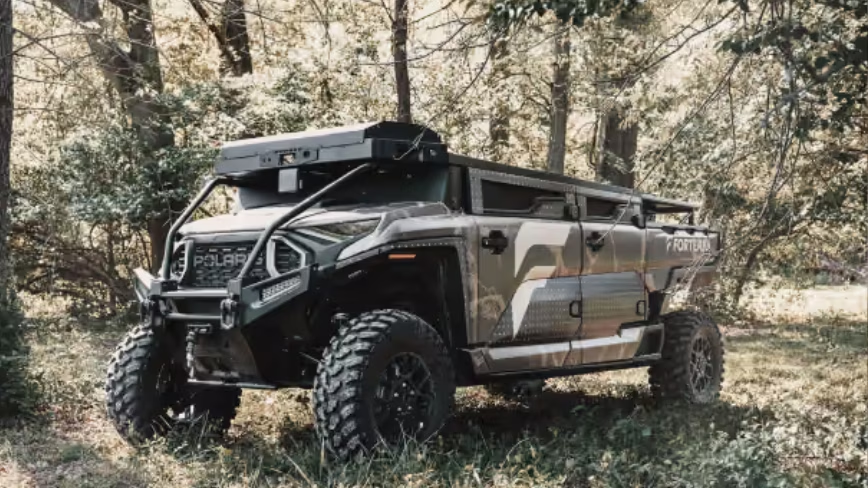
Military-car
 Credit: Forterra
NATO is building a vast AI network along its eastern flank, designed to spot an attack early and strike back fast. The plan is called the Eastern Flank Deterrence Initiative, and internal documents name one adversary outright: Russia.
German tabloid BILD obtained the papers and shared them through the Axel Springer network, Business Insider reported.
The documents keep returning to one phrase: a “Kill Web”. It describes a tightly linked digital mesh that ties together satellites, reconnaissance drones, radar, ground sensors and cameras. If one node drops out, another takes over.
The network watches the whole border at once, from Finland down to Romania.
See first, decide first, strike first
The idea is to shrink the time between spotting a target and hitting it. In the past, a drone would flag a target to headquarters. Analysts checked it, then passed a firing order down the chain. That took time NATO no longer wants to lose.
Under the new model, data from every member flows into one shared picture. Palantir’s Maven Smart System acts as the AI brain, sorting sensor feeds so commanders can decide faster. Other contractors plug in around it, including RTX, Rheinmetall, Saab, Lockheed Martin and Boeing.
NATO sums the loop up in six words: “See first. Decide first. Strike first.”
In practice, a drone might catch a Russian armoured column. The system cross-checks it against satellite images, radar and ground sensors at once. A commander then picks the weapon, be it a drone, artillery or a rocket launcher, by range and by the target’s value.
Machines take the first hit
The front line changes too. NATO wants uncrewed systems to meet an attacker before its soldiers do. A forward zone of drones, ground robots and sensors would absorb the first blow. The logic is cold but simple: machines, not troops, take the opening hit.
Tanks and jets do not go away. Leopard 2s, Abrams, HIMARS and F-35s stay the backbone. “EFDI does not replace tanks, artillery, fighter aircraft, or soldiers,” said Maj. Matt Blubaugh, a spokesman for US Army Europe and Africa. “It is designed to help preserve their combat power and give commanders more time and decision advantage.”
Lessons from Ukraine
The concept comes straight from the war in Ukraine. Cheap drones, robots and sensors, fielded in their thousands, aim to offset Russia’s edge in sheer numbers and speed. It echoes the kill chains both sides built on that battlefield, now stretched across an entire alliance.
It also fits a wider European push. NATO has been funding defence startups and folding autonomous ground systems into its plans, even as who controls the underlying AI stays a live question.
Why it matters
NATO calls the strategy “deterrence by denial”. The aim is not just to repel Russia, but to make an attack look pointless before it starts. It marks a real shift, from holding ground with troops to contesting it first with software and machines. The hard part is trust: an alliance that hands early decisions to AI has to be sure the machines read the battlefield right.
Get the TNW newsletter
Get the most important tech news in your inbox each week.


