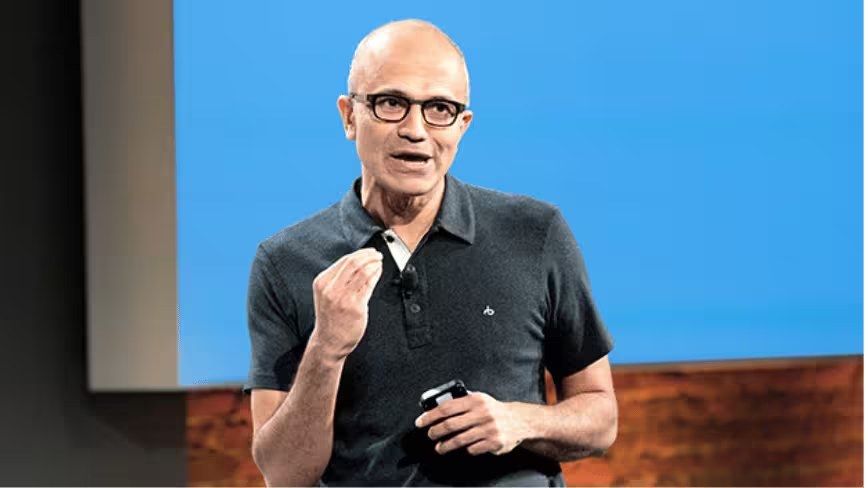
Satya Nadella, CEO, Microsoft
 Credit: Microsoft
In a blunt interview, Satya Nadella warned that the AI giants cannot keep promising mass job losses while demanding the power to build whatever they want. Microsoft’s answer: cheaper models, more control for customers, and a pitch for the public’s trust.
Satya Nadella helped start the AI boom. Now he has a warning for the companies running it.
In an interview with the Wall Street Journal, the Microsoft chief took aim at the AI giants. They cannot keep telling the world that AI will erase white-collar work, he argued. Meanwhile, they ask for limitless power to build as they please.
“You can’t say, hey, all white-collar jobs are gone and this could even be a weapon, and we will use all the power to build data centres,” Nadella said.
He was pointing at OpenAI and Anthropic. The two labs build the most advanced proprietary models, and Microsoft now positions itself against them.
Earning the public’s permission
Nadella’s core argument is about trust. AI cannot hollow out whole industries and still expect the public to wave it through.
The public will not tolerate a few firms “doing all of the learning for the world,” he said. “If all the value is accrued by only a few models, the political economy will simply not tolerate it.”
“There is no societal permission for an AI future that hollows out entire industries,” he added.
He reached for a historical parallel. The backlash could echo the anger that followed globalisation, when whole communities lost out and never forgave the people who had promised otherwise.
That marks a pointed reversal of Big Tech’s own warnings about disappearing jobs. Nadella thinks that pitch is not merely unpopular. He thinks it is politically unsustainable.
He kept returning to one idea: agency. People need to feel they have economic opportunity, he said, not that a few firms get to decide their future.
“We now have to do the hard work in earning the social permission,” he said. Narrative alone, he added, will not cut it.
Microsoft’s counter-pitch
The alternative he describes is less dramatic and more commercial. Nadella frames AI as a knowledge engine that helps companies use their own people and data.
He calls it a “frontier ecosystem” rather than a single “frontier model.” Every organisation, he argues, should build its own “learning loop” from its private data and its own evaluations.
“The last thing any of us want is a world where every company across every sector is ceding value to a few models that eat everything they see,” he said.
He frames the goal as a reorganisation of work, not its end. He wants “a real cognitive loop between people and digital systems.”
Customers should draw on a spectrum of models at different prices and abilities, he argued. The models should be “all hill-climbing inside of a machine you control.”
Microsoft has started to back the talk with products. In recent weeks it rolled out a suite of low-cost models, aimed squarely at customers reeling from the sticker shock of soaring AI bills.
It is also weighing whether to host a version of DeepSeek, the ultra-low-cost Chinese model that OpenAI and Anthropic accuse of copying their work.
That move would send far more traffic to the Chinese model-maker. It would also pile pressure on OpenAI and Anthropic, which already face a prolonged price war.
Not the only one rethinking
Other giants want to undercut the frontier labs too. Amazon has admitted its own models trail the leaders. It hopes to close the gap with cheaper options.
The timing stings for the labs. Both OpenAI and Anthropic are marching toward blockbuster stock-market debuts, and both lean on the story that their models will remake the economy.
There is self-interest in the warning, of course. Microsoft is itself one of the largest concentrations of AI power on Earth. It plans to spend a reported $190bn on data centres and capacity this year alone.
It also remains OpenAI’s biggest backer. Yet Microsoft gains either way if no single lab corners the market.
His bet is that the next wave of AI rewards breadth over dominance. Whether OpenAI and Anthropic agree is another matter. They are still racing to build the biggest models in the world.
Get the TNW newsletter
Get the most important tech news in your inbox each week.
Also tagged with


