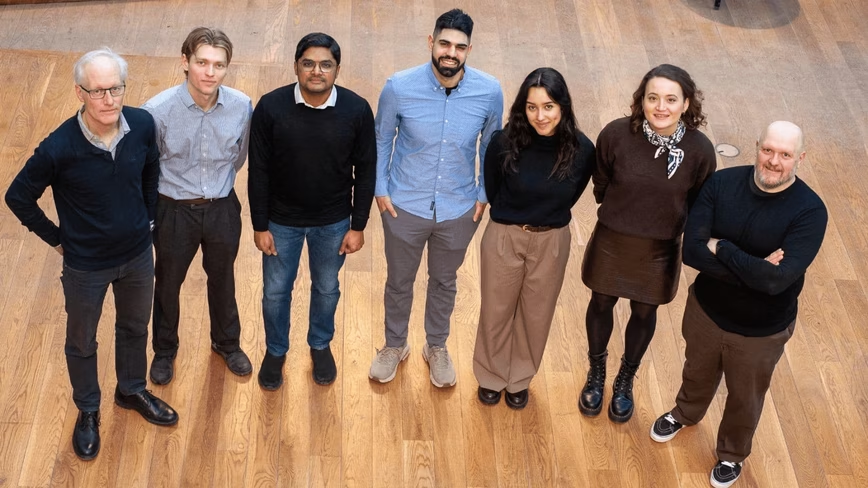
Copenhagen-area AgTech startup Mycoverse has secured €2.4 million in pre-seed equity financing to advance a biological crop protection platform that uses fungi to replace or reduce chemical pesticides.
The round was co-led by Future Food Fund and High-Tech Gründerfonds (HTGF), with participation from PINC, the venture arm of Finnish food company Paulig.
Including previous support from Denmark’s BioInnovation Institute, Mycoverse’s total funding now stands at around €4.3 million.
What is Mycoverse?
Mycoverse is positioning itself at the intersection of microbiology, agronomy and sustainable farming. The startup has built a discovery and development platform that combines artificial intelligence with fungal biology to identify naturally occurring strains with protective properties against crop diseases.
Its first commercial goal is a product targeting Phytophthora infestans, the organism behind potato late blight, a persistent and damaging disease in Europe and beyond.
Farmers typically apply chemical fungicides repeatedly to control late blight; Mycoverse’s approach aims to offer a biological alternative that integrates into existing spraying routines without major changes to farming practice.
Beyond potatoes, the company has plans to extend its fungal solutions to other crops, including grapevines, as it scales field trials.
The €2.4 million pre-seed round brings Mycoverse’s cumulative funding to about €4.3 million when combined with earlier backing from the BioInnovation Institute, a Danish public innovation body.
Future Food Fund and HTGF co-led the latest tranche, with participation from PINC. Detailed terms, such as the company’s pre-money valuation or any investor rights, have not been disclosed publicly.
Use of the new capital is described primarily as funding expanded field trials over the next two years to validate performance under commercial conditions and support the pipeline’s progression toward regulatory approval and scale-up.
Mycoverse competes in a field that includes both established agricultural chemical companies now pursuing biocontrol portfolios and newer bio-agriculture entrants.
Traditional agricultural inputs firms such as BASF and Syngenta have been expanding biological agents alongside synthetic products, and smaller specialists develop microbial or plant-derived treatments for specific diseases.
Farms’ entrenched practices and the dominant position of conventional fungicides present structural challenges for adoption, particularly where proof of consistent efficacy in diverse field conditions is required.
The financing round is a data point in the gradual maturation of Europe’s agritech venture scene, especially where sustainability and regulatory alignment confer structural opportunity.
For European founders and investors, Mycoverse’s ability to attract dedicated food-systems capital alongside deep tech investors points to continuing interest in solutions that respond to policy constraints on chemical inputs.
For the Danish ecosystem specifically, this round underscores how spin-outs from research institutions such as the Technical University of Denmark can chart paths toward commercialisation with blended public and private support.
The next phase for Mycoverse will test whether efficacy in controlled and early field trials translates into predictable performance at scale and whether biological alternatives can achieve commercial price points acceptable to growers.
As Europe’s regulatory environment continues to evolve, startups that bridge scientific innovation and practical farmer workflows will shape how agricultural inputs transition toward sustainability.
Get the TNW newsletter
Get the most important tech news in your inbox each week.
Also tagged with


