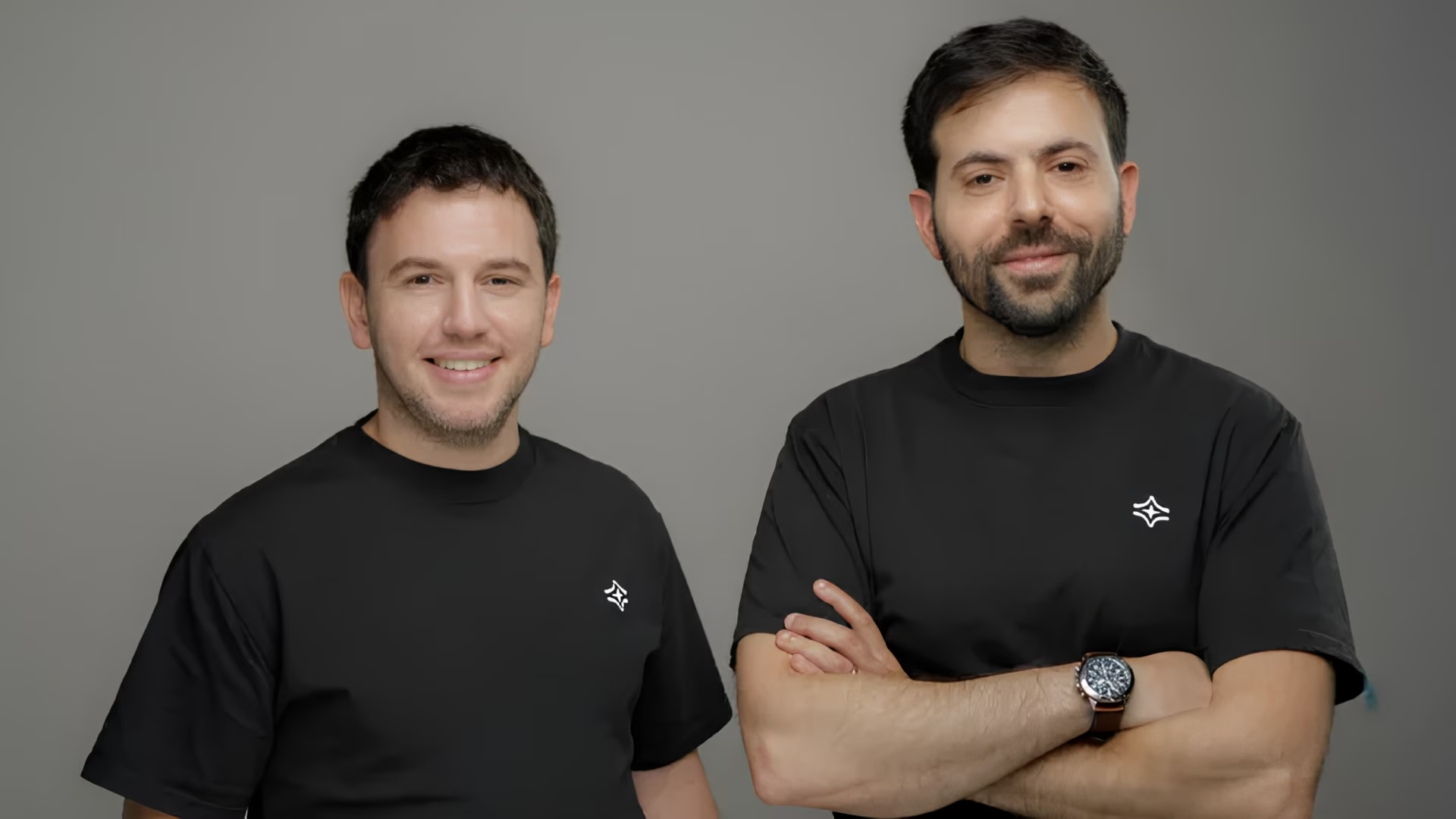
Modus co-founders Daniel Shimoni (CEO) and Tomer Mesika (CTO)
 Credit: Modus
The next phase of enterprise AI will not be decided solely by which company has access to the most powerful model. As models become increasingly interchangeable, a more important question is emerging: who owns the intelligence that makes AI useful inside a particular business?
Companies are already experimenting with multiple models, agents, and AI platforms. But every deployment creates another dependency on the systems supplying its instructions, memory, integrations, and knowledge. If a company changes models or switches providers, how much of what its AI has learned about the business can it actually take with it?
This is becoming an issue of AI sovereignty. A company’s most valuable AI asset should be the institutional knowledge it builds over time: its business logic, workflows, relationships, decisions, and accumulated experience. Unlike the underlying models, this intelligence is uniquely tied to the organization. It becomes more valuable as it learns from how the business operates. The opportunity is to turn that knowledge into an owned asset that compounds with every new AI interaction. That is better than leaving it scattered across disconnected tools and platforms.
That is the premise behind Modus and its Context Warehouse: infrastructure designed to build and maintain the context that powers enterprise AI.
Why More Skills Are Not Enough
As agentic AI matures, companies are investing in reusable skills, instructions, and workflows to make agents more capable. These capabilities are important, but they address only part of the problem.
A predefined skill can teach an agent how to complete a task. It cannot necessarily tell the agent what has changed inside the business since someone created that skill. Nor can it say which internal definitions apply, or how a particular team actually performs the work.
Business knowledge is dynamic. Processes evolve, employees establish new practices, metrics change, and relationships between systems shift. An agent relying on static instructions can quickly become disconnected from the organization it is supposed to serve.
The distinction is between teaching agents how to do something and maintaining an understanding of the environment in which they operate.
This is where a dedicated context layer becomes important. Rather than building isolated knowledge repositories for individual agents, enterprises need infrastructure that continuously learns from their existing systems. That infrastructure makes that understanding available across workflows.
Building an AI Infrastructure That Compounds in Value
The Context Warehouse is the infrastructure behind this approach. It is the engine that builds, maintains, and continuously updates an organization’s context layer. It gives its AI systems a shared understanding of how the business operates.
A September 2026 study by Stacklok surveyed 520 enterprise AI leaders. It found that 84% considered avoiding vendor lock-in important to their AI strategy. Meanwhile, 81% agreed that the proprietary platforms of frontier labs and hyperscalers make it difficult to move between vendors.
Those findings point to a challenge that extends beyond choosing a model. Enterprises need to preserve the knowledge, business logic, and operational context built around their AI deployments.
Modus approaches this by learning from the work already happening across an organization. That includes its data warehouses, BI platforms, pipelines, code, documents, and collaboration systems. Its metadata-first integrations allow it to connect to structured and unstructured sources without requiring the underlying data to move.
The Context Warehouse continuously builds an understanding of the business, then composes the relevant information for each AI interaction. As the organization changes, its context can change with it. Rather than starting from scratch with every new agent, teams can draw from the same evolving foundation.
This creates the possibility of compounding value: new workflows and accumulated organizational knowledge strengthen the context available to future AI applications.
Sovereignty Requires Governance and Portability
Owning enterprise context also means controlling who accesses it and where it goes. As agents operate across more systems, organizations cannot rely on individual applications to independently enforce every business rule.
IBM’s September 2026 guidance on third-party AI agent governance highlights the need to assign agents clear ownership. It also calls for limiting their access to their business purpose and enforcing controls before consequential actions occur.
Modus builds these boundaries into its Context Warehouse. Companies can establish permissions and access scopes for individual teams, agents, and workflows. That ensures each receives only the information it is authorized to use before context reaches a model.
Portability is equally important. Modus supports integrations through APIs, an SDK, CLI, and the Model Context Protocol (MCP). These allow companies to connect agents built with Claude, Cursor, or their own internal systems. Context and configurations remain exportable. That gives organizations flexibility to change models and tools without rebuilding their knowledge infrastructure.
The platform also says its context composition can reduce token usage by up to 10 times per query by supplying agents with only the information relevant to their tasks.
After the Company Brain: Delegation
Most enterprises today use agents to answer questions. The next step is trusting them to do the work: reconciling a quarter, flagging an at-risk account and drafting a response, or resolving a data request without human intervention. That shift depends less on better models than on whether an agent understands the business well enough to act on its behalf.
That is what a company brain makes possible. It is also why it cannot be a static repository. An understanding that was accurate last quarter can become a liability once agents begin making decisions and executing workflows based on it.
“Everyone is asking how to get agents to do real work, not just answer questions,” said Daniel Shimoni, CEO and co-founder of Modus. “The blocker is almost never the model anymore. It’s that the agent doesn’t know how this company actually operates, and nobody has the time to keep teaching it.”
Modus designed its Context Warehouse for this next stage. It continuously learns how the business operates from the systems where work already happens. It keeps that understanding current as the company changes. And it powers the context layer that delivers each agent only the governed information it needs for the task at hand. Companies can introduce new agents without rebuilding their context infrastructure. Meanwhile, the underlying understanding continues to evolve with the business.
Models will keep improving, and agents will keep multiplying. The companies that pull ahead will be those whose agents share a living understanding of how the business works, and whose institutional knowledge becomes more valuable with every new deployment.
Get the TNW newsletter
Get the most important tech news in your inbox each week.
Contributed article. Not produced by the TNW newsroom and does not reflect the editorial stance of TNW.


