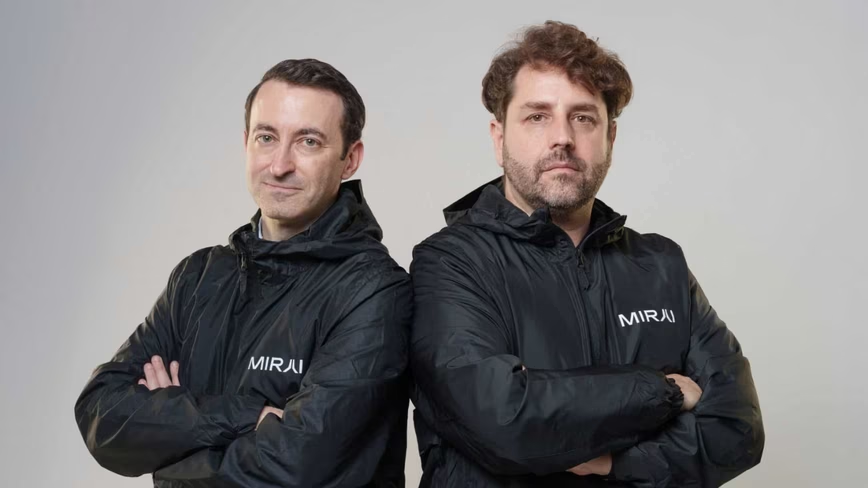
A Puglia-based startup founded by the man behind aircraft maker Blackshape has closed a pre-seed round to build software-defined ships and maritime AI. The ocean, it argues, is the last major physical environment not yet governed by software.
Mirai Robotics, a startup headquartered in Puglia, southern Italy, wants to change that. The company has closed a €3.9 million (~$4.2M) pre-seed round to develop autonomous surface vessels and a maritime intelligence platform designed to operate continuously, without a crew, across inshore and offshore environments.
The round was led by Primo Ventures, Techshop, and 40Jemz Ventures, with participation from Italian and international angel investors.
Primo Ventures, whose Chairman and General Partner Gianluca Dettori commented on the deal, is an Italian early-stage VC firm managing around €438 million across digital, space, healthcare, and climate technology funds. It is among Italy’s most active seed-stage investors.
What Mirai is building
At the core of Mirai’s platform are software-defined autonomous surface vehicles, designed for what the company calls dock-to-dock autonomy: the ability to complete full missions without human intervention from departure to return. The vessels combine advanced sensing systems, autonomous navigation, remote supervision tools, and built-in safety layers.
The company has already developed two autonomous vehicles for intelligence, surveillance, and reconnaissance and maritime patrol missions, operating either as standalone units or within coordinated fleets.
Alongside its own hardware, Mirai also develops modular autonomy and control systems that can be integrated into third-party vessels, which means shipyards, industrial operators, and public institutions can adopt autonomous technology without retiring existing fleets.
Underpinning both is a proprietary maritime intelligence and mission management platform providing what Mirai describes as persistent domain awareness: the ability to monitor maritime environments, coordinate robotic assets, and maintain operational control across complex conditions over extended periods.
“The sea is one of the last major physical infrastructures not yet governed by software,” said Luciano Belviso, Mirai’s CEO, in a statement. “Autonomy is the key to finally making the oceans safe and usable, unlocking enormous resources and addressing critical security challenges. But it must be implemented through systems capable of operating continuously and safely in extreme environments. This is a technological and industrial challenge that requires a true robotics-lab approach.”
The founders
The three co-founders bring unusually varied credentials for an early-stage robotics startup. Belviso founded Blackshape Aircraft in Puglia in 2009, a carbon fibre aircraft manufacturer that builds high-performance two-seater planes for both recreational and military training markets, and which is today part of the Angel industrial holding group.
He holds degrees in aerospace engineering, mechanical engineering, and space law from institutions including the Polytechnic of Turin, EPFL in Lausanne, and the Université Paris XI.
Luca Mascaro is the founder and president of Sketchin, a Swiss-based strategic design studio that became part of BIP Group, the Italian management consulting firm, following a majority acquisition in 2016. Mascaro remained at Sketchin as Founder and President after the deal. At Mirai, he brings experience building technology-centred service businesses at a European scale.
Davide Dattoli is the founder and Executive Chairman of Talent Garden, one of Europe’s largest education and technology community networks, which operates across 12 markets and trains around 25,000 professionals annually. He has been recognised in the Forbes 30 Under 30 Europe list and is a venture founder at Italian Founders Fund.
The market context
The strategic logic for maritime autonomy is not hard to find. Europe’s blue economy, the range of economic sectors that depend on or interact with the sea, including shipping, fisheries, offshore energy, and port operations, is worth over €750 billion annually according to European Commission figures.
It also faces compounding pressures: rising operational costs, an accelerating workforce crisis as experienced maritime specialists retire, and an increasing need for persistent surveillance of infrastructure, including subsea cables, offshore wind farms, and energy platforms.
The dual-use angle is significant, too. Autonomous vessels for patrol and ISR missions sit at the intersection of civilian maritime operations and defence technology, a sector attracting a growing share of European venture capital as governments across the continent increase defence budgets and seek sovereign capability in critical infrastructure monitoring.
Mirai is based in Puglia, which the founders describe as an ideal location for their ambitions, sitting at the intersection of Mediterranean maritime activity, industrial manufacturing heritage, and academic research institutions.
The company says the funding will accelerate its technology stack, expand its engineering team, and support pilot deployments with industrial and institutional partners.
“The maritime domain is at an inflexion point,” said Dettori of Primo Ventures in a statement. “We’re looking at a huge economy that still relies on operational models designed decades ago.
The human capital gap alone, thousands of unfilled roles, ageing workforces, and increasing operational risk, make the status quo unsustainable. What Mirai Robotics is building isn’t just automation; it’s the fundamental infrastructure layer that will allow the blue economy to scale safely and efficiently.”
Get the TNW newsletter
Get the most important tech news in your inbox each week.


