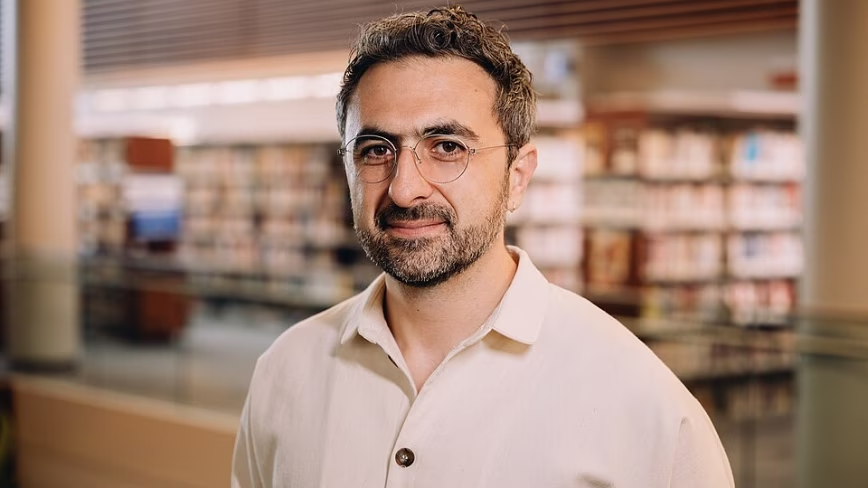
Mustafa Suleyman, chief executive of Microsoft AI, photographed in April 2024.

Mustafa Suleyman has identified Microsoft’s biggest AI competitor, and it is not OpenAI. “Anthropic is extremely expensive and I think many people are urgently looking for alternatives,” the head of Microsoft’s in-house model effort told Bloomberg in an interview.
The statement is more than competitive positioning. It is a declaration of intent. “We pay a lot of money to Anthropic, so our goal is to reduce and ultimately eliminate that cost,” Suleyman said.
To back it up, Microsoft this week announced seven new in-house AI models at its annual Build conference for developers, including MAI-Thinking-1, a reasoning model it says matches Anthropic’s Claude Opus 4.6 on a widely used coding benchmark at a lower price point.
The price pitch
Suleyman’s argument arrives at a moment when enterprise AI spending is becoming a genuine problem. Uber burned through its entire 2026 AI coding budget in four months and introduced a $1,500 monthly cap per employee per tool. Walmart has similarly capped access to its internal AI assistant after usage exceeded expectations.
For Microsoft, which uses enormous quantities of AI tokens across Copilot and its own engineering teams, the cost question is existential. “Many, many people in our organisation are spending millions of dollars” on AI tokens, Suleyman said. Building cheaper in-house alternatives is not just a competitive move against external providers. It is a way to protect Microsoft’s own margins.
After refining its models for consulting firm McKinsey, Microsoft claims it was able to outperform OpenAI’s GPT 5-5 with 10 times better cost efficiency, according to Suleyman. The company has also been talking with Adobe about using the in-house models, Bloomberg reported.
From contractually bound to building its own
Until late 2025, Microsoft was contractually prohibited from independently pursuing frontier AI development under its partnership with OpenAI. A renegotiated agreement freed the company to build competing models while retaining licence rights to everything OpenAI builds through 2032.
That clock is now ticking. Suleyman’s MAI Superintelligence team, formed in November 2025, has shipped its first public models within six months. For a company with virtually no track record in frontier model development, the pace is aggressive but the gap remains real.
Suleyman was candid about that. “We’ve closed an enormous gap in six months,” he told Benzinga, while acknowledging that Anthropic has released two more advanced models since Opus 4.6, giving it a lead of several months.
Why Anthropic, not OpenAI
The strategic calculus is revealing. Microsoft retains discounted access to OpenAI’s models through 2032. It does not have a comparable arrangement with Anthropic. That makes Anthropic the more expensive dependency, and the one Suleyman can most directly address by building in-house alternatives.
There is also a competitive logic. Anthropic’s Claude models have become the default choice for enterprise AI coding tools, and the company is preparing an IPO that could value it above $1 trillion. If Microsoft can offer comparable performance at lower cost, bundled with the Azure infrastructure its enterprise customers already use, it undercuts the case for buying Anthropic separately.
Whether Microsoft’s models can actually match Anthropic’s latest generation, rather than a prior one, is the question Suleyman’s seven new models do not yet answer. Matching Opus 4.6 on a benchmark is a credible starting point. But Anthropic has already moved past it, and in a market where the frontier shifts every few months, catching up and staying there are very different problems.
Get the TNW newsletter
Get the most important tech news in your inbox each week.
Also tagged with


