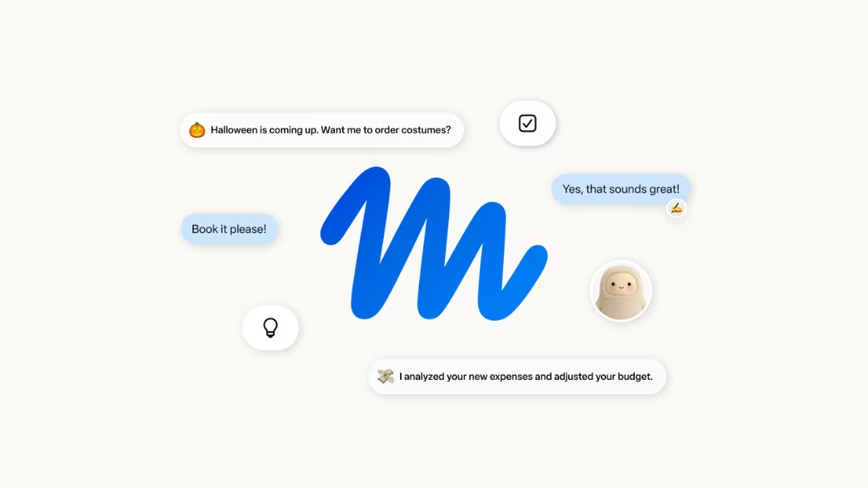
Muse, Meta’s personal AI agent.
 Credit: Meta
Meta has launched a personal AI agent that will read your email, book your travel, fill in your forms, negotiate on your behalf, and pay for the results with your card.
The company that built the world’s largest behavioural advertising business also says none of what you tell it will reach the ad systems.
Muse was announced by Meta on Tuesday and is rolling out in the United States on iOS, Android and the web, with support for the company’s AI glasses to follow.
There is a free tier plus subscriptions at $20 and $100 a month, according to Axios. Meta says there is no advertising inside the product.
The distinction Meta is drawing is between a chatbot and something that acts. Muse keeps working after the app is closed, makes suggestions nobody asked for, remembers preferences across sessions, and turns a saved recipe reel into a shopping list.
It runs on a model the company calls Muse Spark, described in the announcement as Meta’s “most capable model to date, built for real-world agentic work”.
Payments run through Stripe’s Link with purchase protections, and support for Shop Pay and 1Password is promised.
The security architecture is doing most of the persuading, and it is more considered than the usual launch-day assurances. Each user gets an isolated virtual machine holding both the agent and their data, so agents cannot reach each other.
A separate system called Sentinel sits between Muse and the internet, distinguishing read access from write access with time-limited permissions, allowing low-risk tasks and stopping to ask before anything consequential.
Meta says credentials are stored so that Muse cannot see passwords or card details, and every action leaves an audit trail.
Later this year, a confidential version is meant to arrive in which Meta itself cannot observe what happens inside the workspace.
Until that ships, the advertising promise is a policy rather than a property of the system. Meta says conversations are kept away from its ad machinery and that users can opt out of having interactions train its models, or tell the agent to forget particular things.
Those are real commitments, and they are also revocable ones, which is a distinction worth keeping in view when the company making them earns most of its revenue from knowing what people want before they say so.
Alexandr Wang, Meta’s chief AI officer, is leading the effort, and the framing is straight out of the essay Mark Zuckerberg published this summer.
“The full vision in the future is we want to develop personal superintelligence that helps people accomplish their goals, pursue their passions,” Wang told Axios.
We have covered that essay when it landed as a Rorschach test, and Zuckerberg has separately predicted billions of people will have a personal agent within five years. Muse is the first product built to make that claim testable rather than rhetorical.
Wang also managed expectations on price. Most people, he told Axios, should be able to do what they need within the free tier, which is either reassurance or an admission that the $100 plan is aimed at a narrow group, depending on how the thing performs.
The elaborate safety scaffolding has a reason behind it. Consumer agents have had a rough few months in public: Axios notes that a Meta researcher’s own experiment with an agent ended with files deleted, and booking platforms including Resy have told customers not to point automated agents at them.
An agent that fills forms and completes purchases is one that can also fill the wrong form and complete the wrong purchase, at speed, with a saved card. Sentinel is not a nice-to-have. It is the thing standing between a useful assistant and a very fast mistake.
Get the TNW newsletter
Get the most important tech news in your inbox each week.


