Why manufacturers under workforce pressure should look closely at the tool drawer
Credit: Canva
TL;DR
U.S. manufacturing averaged 420,000 job openings in 2025 (PwC), and Deloitte estimates 1.9 million could go unfilled over the next decade. TraceMySpace founder Cody Spears argues that custom laser-cut foam inserts, which give every tool and part a defined position, can reduce search time, make missing items immediately visible, and support safety accountability in aerospace and racing environments. The broader point: when skilled capacity is constrained, even small workspace improvements deserve review.
For a manufacturer short on skilled people, time can disappear in routine places. A worker searches a drawer, walks back for a forgotten part, or discovers too late that an item is missing. PwC reported that U.S. manufacturing averaged about 420,000 job openings in 2025. Deloitte has also cited an estimate that 1.9 million manufacturing jobs could go unfilled over the next ten years if talent challenges are not addressed.
Although Deloitte emphasizes long-term workforce planning and digital tools, the physical workspace offers another area for examination. The position of a socket, the sequence of parts in a drawer, and the ability to recognize an empty space may influence routine work. When skilled capacity is constrained, manufacturers have reason to ask whether clearer workspaces could help employees spend more of each shift on the task itself.
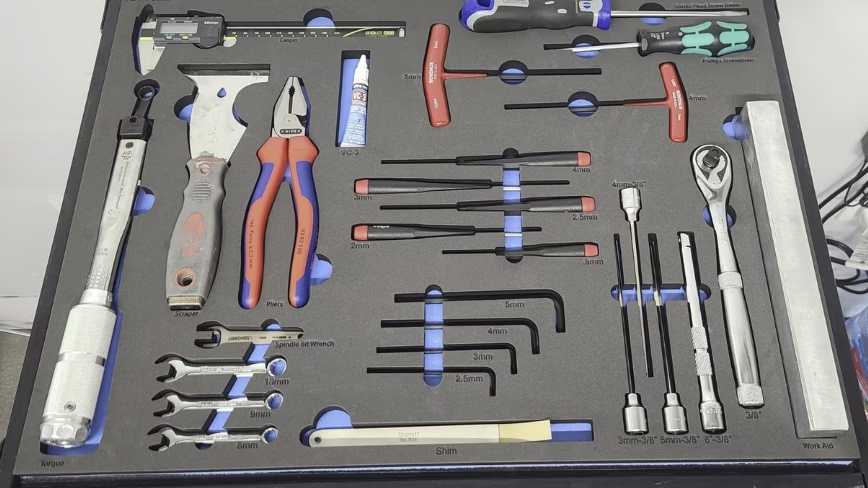
Cody Spears, founder of TraceMySpace, has built his company around that question. TraceMySpace designs laser-cut foam inserts that give tools, components, and other equipment defined positions inside drawers and cases. Customers arrange the items, provide measurements, and upload a photograph. The company then prepares an insert for that layout. Spears views the product as visible process control that may help teams locate an item and notice its absence sooner.
Credit: TraceMySpace
“Having an insert with a spot for each tool means you know where it is every time, and you know when it is missing every time,” Spears explains. In his view, the empty outline matters as much as the occupied one. A team preparing for a job can inspect the drawer before leaving, rather than discovering the missing item after reaching the worksite. On a production floor, the same cue may simplify a handoff or end-of-shift check.
Customization gives that idea an operational dimension. Spears recommends putting frequently used items near the front and less frequently used ones farther back, while considering the order in which a task is performed. “It sounds minor, but when those movements are repeated throughout an eight- or 12-hour workday, they can add up,” he observes. This does not establish a universal productivity gain. It illustrates how leaders can examine repetitive motion and tool placement during a workflow review.
Racing offers a time-sensitive example. Spears says TraceMySpace has begun working with teams in NASCAR that place both tools and selected car parts in fitted drawers. If a component is needed during a repair, the crew has a defined place to reach for it. “When seconds count to get the car back on the track, they need to know exactly where those parts are,” he notes. The principle can apply more broadly wherever teams depend on repeatable access to known items.
Tool visibility may have another role in workplaces where accountability supports safety procedures. In aerospace settings, Spears believes that recognizing a missing tool promptly may help a team begin its established response sooner. These inserts become a crucial part for many organizations, giving them clear insight during audits and training, all while supporting documentation. “The bigger picture is knowing that something is gone without spending hours searching and hoping it is not somewhere it could cause damage,” he explains.
The wider lesson is modest, but useful. Workforce strategy often focuses on recruitment, retention, and automation. Spears encourages manufacturers to include the physical environment and study the small interruptions employees encounter repeatedly. Leaders could observe one workstation, record where searches and unnecessary movements occur, and ask employees how the layout could better follow the work.
That review may reveal that a custom insert is appropriate, or it may point to labeling, replenishment, storage, or process changes. Spears’ argument is that efficiency becomes easier to manage when it is visible. For companies facing limited skilled capacity, careful organization offers a concrete way to respect the working time already available.
Get the TNW newsletter
Get the most important tech news in your inbox each week.


 Credit: Canva