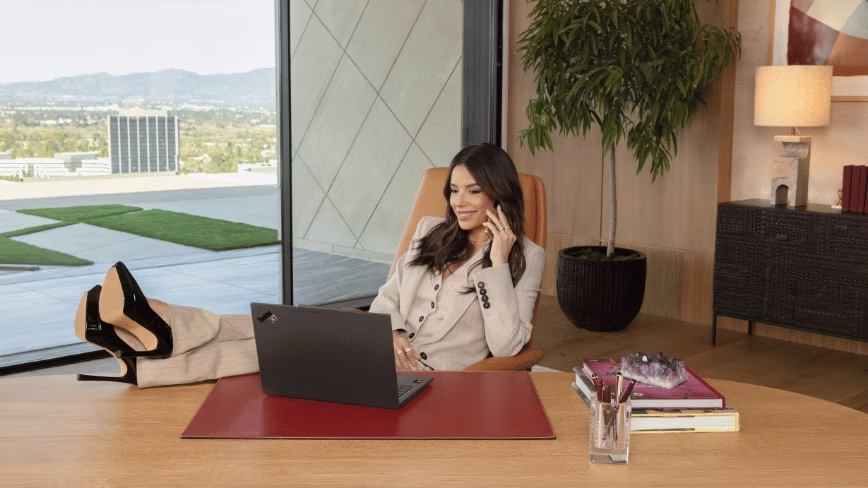
Eva Longoria in Lenovo’s campaign for Call Eva.

Lenovo has given entrepreneurs a phone number to ring, and Eva Longoria is on the other end of it. The service is called Call Eva. It opened on Tuesday and works roughly the way a radio phone-in does.
You call, you leave a voice note with a business question, and you wait. Lenovo says it may then contact a selection of callers and offer them a live conversation with Longoria on 16 September. That session goes out on her Instagram account at about 9:30am Pacific time.
The service covers seven markets: Brazil, France, India, Japan, Mexico, the United Kingdom and the United States. Most share one international freephone number. Mexico, India and the US get their own. Standard call and data charges apply, and the campaign site lists them all.
Nothing about the mechanism is new. Brands have run phone lines, competitions and ask-me-anything sessions for decades. What has changed is that the answer arrives as a livestream rather than a letter, and that the person answering is a shareholder in the outcome.
What it is part of
Call Eva sits inside Backing Every Business, Lenovo’s global small-business programme. Longoria is the company’s global ambassador for it.
The programme already had a component along these lines. Twinning pairs entrepreneurs in different countries who face similar problems. The theory is that a peer who has met the same wall beats a consultant who has not. Lenovo ran it across Japan, Mexico, the UK and the US earlier this year.
Longoria is the ambassador for that too. Beyond acting, directing and producing, she has investments across food, beverage, media and other consumer businesses. She also founded the Eva Longoria Foundation, which works on educational and economic opportunities for Latinas.
The pitch
The argument Lenovo is making is about isolation rather than technology, which is unusual for a hardware company.
“One of the biggest lessons I’ve learned as an entrepreneur is that you don’t have to have all the answers yourself,” Longoria said in the announcement. The appeal, as she framed it, is giving founders somewhere to bring the questions they are “really wrestling with”. Another business owner has probably faced the same dilemma.
Emily Ketchen, Lenovo’s chief marketing officer for its Intelligent Devices Group and international markets, made the company’s version of the point. “Technology can unlock enormous opportunities for small businesses, but technology alone doesn’t build a business,” she said.
That is a franker line than most vendor marketing manages. It is also, read a certain way, an admission that selling laptops to small firms is a crowded business and the differentiator has to come from somewhere else.
Read the small print
Two details in the announcement are worth pulling out, because they describe what the service actually is.
The first is the disclaimer. Longoria’s commentary “reflects her personal opinions and experience and does not constitute professional business, financial or legal advice”, Lenovo says. Somebody sensible looked at an advice line staffed by a celebrity and added a sentence.
The second is the funnel. Callers leave voice notes. Lenovo picks some of them. A smaller number reach the livestream. The questions Lenovo says it expects cover growth, leadership, hiring, marketing, AI adoption and competing priorities, which is also a fair description of a market research brief.
None of that makes it worthless. It does mean the primary output is a set of recorded questions from small business owners in seven countries. Lenovo says as much. Understanding what founders are asking, the company argues, is how it works out what else to build for them.
Why a laptop company is doing this
Lenovo is an $83bn revenue business that sells in 180 markets, and its recent growth has come from PCs and AI infrastructure rather than services. It beat revenue estimates in May on exactly that mix.
Small firms are a hard market to reach at that scale. There is no procurement department to sell to and no obvious channel, so brands reach for content, community and personalities instead. The wider pattern is visible elsewhere: brands have been rethinking what they get from influencers. Budget is shifting towards anything that produces an owned relationship rather than a rented audience.
A phone line produces exactly that. Everyone who calls has raised a hand, in a market where identifying the buyer is most of the work.
The problem underneath is real
It would be easy to be cynical about all of this, and the campaign would deserve some of it. But the problem it points at is real.
Running a business is isolating, decisions are constant, and the people best placed to help are usually other founders rather than professionals. Loneliness has become a product category in its own right, which tells you how much unmet demand sits there.
AI adoption is on Lenovo’s list of expected questions for a similar reason. Britain’s official statistics showed adoption widening rather than deepening, with plenty of small firms trying tools and few embedding them. Those firms have real questions and very little to ask.
Whether a fifteen-minute Instagram livestream answers any of them is a different matter. Marketing departments long ago worked out that useful content outperforms advertising. That is why even Disney is rebuilding how ads get made. Call Eva takes that idea to its logical end. Here the advert is the helpline.
Lenovo has not said how many calls it expects, how it will choose between them, or what happens to the voice notes that never make the broadcast. Those answers would tell you which of the two this really is.
The test arrives on 16 September, when a handful of callers find out whether they got useful advice or a segment.
Get the TNW newsletter
Get the most important tech news in your inbox each week.
Also tagged with


