The London and Budapest startup runs its modernisation AI entirely on-premise, aimed at the banks and insurers whose core systems still run on COBOL and Oracle Forms.
The most important software in a bank is often the software nobody fully understands any more. It runs the core processes, it has run them for decades, and the engineers who wrote it have retired. Changing it is slow, expensive and risky, which is why so much of it never changes at all. Kodesage wants to fix that, and on Thursday it raised $6.6M to try.
The seed round is led by VentureFriends, with pre-seed lead Portfolion returning and a notably eclectic group of angels alongside them: Christian Szegedy, a co-founder of Elon Musk’s xAI, and Mario Götze, the footballer who scored the goal that won Germany the 2014 World Cup. It follows a roughly €2.3M pre-seed the company raised in early 2025.
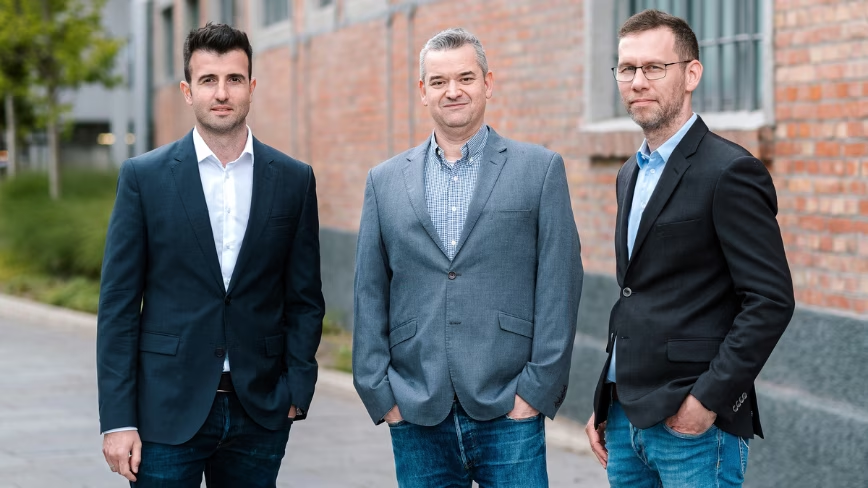
Kodesage, based in London and Budapest, was founded in 2024 by Gergely Dombi, Miklos Szurdi and Gyorgy Szilagyi. The pedigree matters to the pitch. Dombi and Szurdi had built a 300-plus-person consultancy that specialised in exactly this work, modernising legacy systems, and watched it run into the same wall every time: projects that dragged on for years because the knowledge lived in a handful of specialists’ heads. Szilagyi was a co-founder of Tresorit, the encrypted-storage company Swiss Post acquired in 2021.
The technical problem Kodesage is built around is specific and unglamorous. Legacy systems written in COBOL, PL/SQL, PowerBuilder, RPG or Oracle Forms do not keep their business logic tidily in source code. It sits in stored procedures, database schemas and configuration, much of it undocumented, accreted over decades.
The platform performs what the company calls automated deep discovery of these codebases, extracts the buried logic, and turns it into a living documentation layer that both human teams and AI agents can read. From there it supports context-aware code conversion, automated test generation and AI-assisted production support.
The genuinely differentiating decision is where all this runs. Modern cloud AI coding tools live outside the enterprise perimeter, and the regulated institutions that most need legacy modernisation, banks, insurers, energy and transport operators, the public sector, cannot connect their core databases to a public cloud. The institutional knowledge that AI would be most useful on is precisely the knowledge compliance rules keep out of reach.
Kodesage’s answer is to operate entirely inside the customer environment: on-premise, in a virtual private cloud, or fully air-gapped where required. Source code, schemas and database content never leave the organisation’s control.
That architecture also detaches costs from per-token cloud pricing, which the company pitches as more predictable for enterprises wary of metered AI bills. Szilagyi’s Tresorit background, a company built on the promise that data never leaves the user’s control, is visible in the design.
The wedge into the market is Oracle Forms, with a dedicated modernisation kit aimed at a stack still widespread across regulated industries and, as the company correctly notes, poorly served by mainstream tooling. Kodesage claims its migration recipes, for instance Oracle Forms to Oracle APEX, accelerate conversions by up to 3x and cut documentation effort by more than 80%.
Those are company figures, not independently audited, and the “multi-trillion-dollar drag” chief executive Gergely Dombi attaches to the problem is a sizing claim rather than a measured one.
The ambition Dombi describes goes further than migration. The stated vision is “self-healing enterprise applications,” systems where AI agents prepare, test and implement fixes while engineers review and approve rather than diagnose and code from scratch. That is some distance from automated documentation, and the company frames it as a direction of travel rather than a shipping product.
The new money funds a go-to-market push in the United States and Europe and more hiring in engineering and product. Kodesage is entering a crowded race to point AI at the enterprises legacy software has not fixed. Its bet is that the winners there will be the ones allowed inside the building.
Get the TNW newsletter
Get the most important tech news in your inbox each week.


