TL;DR
Eindhoven’s Keiron raised €20.7M Series A to scale laser-based solder paste printing that replaces stencils. First-pass yield jumps from ~60% to 95%+. AI hardware with 10,000+ interconnects needs it.
Keiron's laser printer replaces stencils with a digital process. Yield jumps from 60% to 95%. AI chip packages with 10,000 interconnects break the old method entirely.
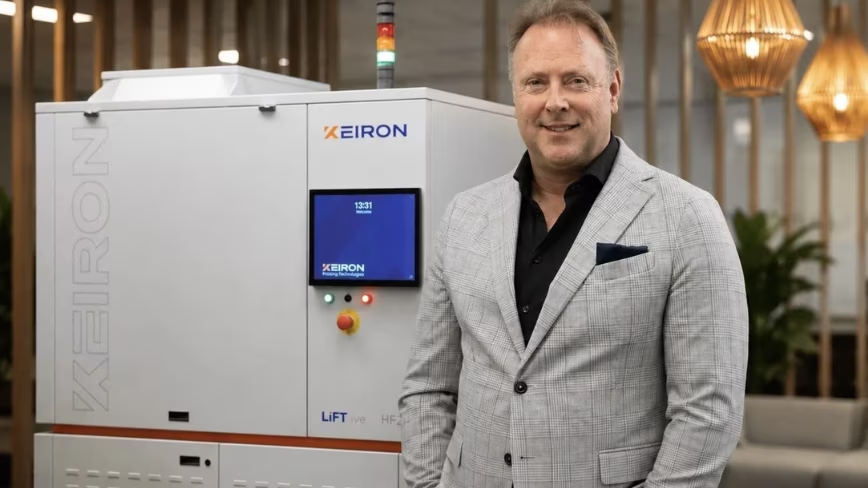
Keiron
 Credit: Keiron
Eindhoven’s Keiron raised €20.7M Series A to scale laser-based solder paste printing that replaces stencils. First-pass yield jumps from ~60% to 95%+. AI hardware with 10,000+ interconnects needs it.
Keiron Printing Technologies, an Eindhoven-based deep-tech startup, raised €20.7 million in Series A funding to scale a laser-based solder paste printing system that replaces the stencil process used in electronics assembly for decades. The round was co-led by Invest-NL, DeepTechXL, and Waves Capital, with participation from Singapore’s ATUM Ventures. Solder paste printing is responsible for over 70% of printed circuit board assembly defects in a market worth more than €600 billion a year.
Keiron’s HF2 printer uses Laser-Induced Forward Transfer to deposit solder paste digitally and without contact, eliminating stencils entirely. The company says first-pass yield jumps from an industry-typical 60% to above 95%, production lead time halves, uptime doubles, and programming is 10 times faster. The technology originated from TNO Holst Centre, a collaboration between Dutch research organisation TNO and Belgian semiconductor institute imec.
The AI hardware connection is what makes this relevant beyond the factory floor. Next-generation AI chip packages carry up to 10,000 interconnects per component. At that density, conventional stencil printing breaks down and yields collapse. The AI boom is already straining every layer of the electronics supply chain, from memory to power to packaging. Solder paste printing is the bottleneck nobody outside manufacturing talks about, but it determines whether the chips that cost millions to design actually work when assembled into systems.
The funding will scale production and expand commercial operations across Europe, North America, and Asia-Pacific. Eindhoven is emerging as a European deep-tech hub, anchored by ASML, NXP, and the Brainport ecosystem. Keiron’s ambition is to become the global standard for electronics assembly. At €20.7 million, it is early. But if AI hardware keeps adding interconnects at the current rate, the stencil method it replaces will not survive the decade.
Get the most important tech news in your inbox each week.


