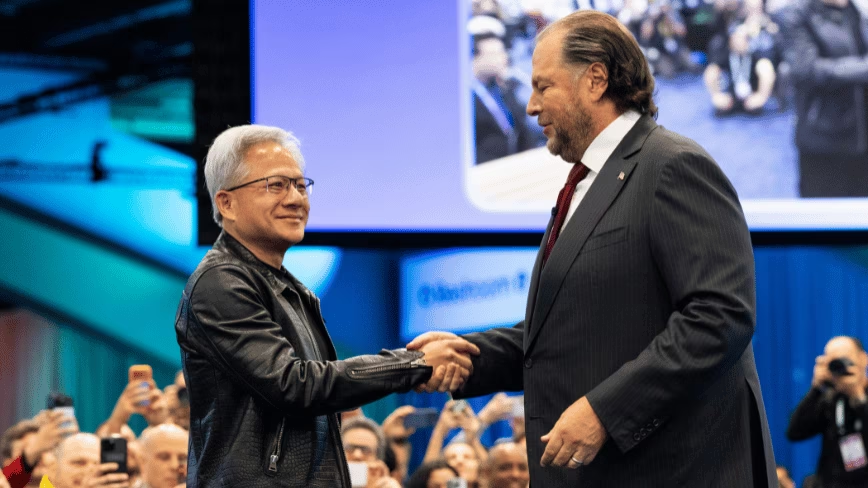
Nvidia’s Jensen Huang and Salesforce’s Marc Benioff shake hands on stage at Dreamforce 2026

“We don’t need any new laws. We don’t need new regulations,” Nvidia chief executive Jensen Huang said on Tuesday, on the main stage of Salesforce’s Dreamforce conference in San Francisco.
Earlier in the same keynote, Anthropic chief executive Dario Amodei made his case for the industry to slow down, which he set out in an essay over the weekend. Salesforce chief executive Marc Benioff interviewed both men. Salesforce has published the full keynote on YouTube.
Benioff told the audience there were 10,000 people in the room and 10 million watching online.
Amodei: “let’s look at our own record”
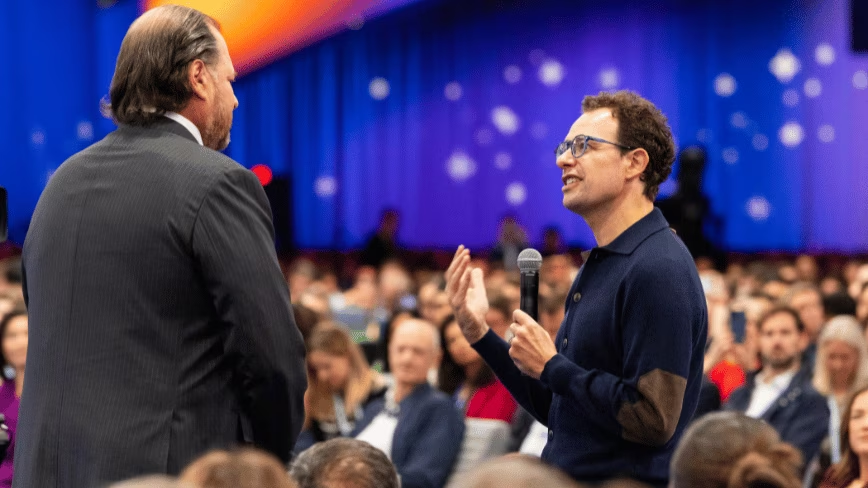
Benioff asked Amodei for his view on “the state of the AI industry and pacing”. Amodei answered with a car industry analogy. Another carmaker has a safety incident, he said, perhaps with its brakes, while your company believes it has the best safety record.
“Obviously it’s very tempting to attack your competitor and say these guys are unsafe, we’re safe. But I think the more responsible way to respond to it is to say, hey, first of all, let’s look at our own record. We may not have had this big high-profile incident, but I’m sure we’re not perfect.”
The next steps, he said, are to recommit to transparency and invest more in safety. Then the industry should agree standards for everyone, and finally there should be an international component.
That is the three-step plan in his essay. Anthropic has committed to the first step, Amodei said. On the others, it is “going to have a dialogue with the rest of the industry”.
“I think that’s the way to lead the industry forward, to set an example, to say that everyone can always be better,” he said.
Asked about his biggest surprise, Amodei said: “It’s been the pace of the progress, not just of the technology, but of the economic side of it.” Anthropic predicted how capable the models would become, he said, but not how fast the companies building them would grow.
Even if the technology were frozen in place, people would be using only about 5% or 10% of its possible value, Amodei said. His plan does not freeze anything, he added. “Pacing the Frontier is not doing that at all.”
Huang: “Run as fast as you can”
Huang walked around the theatre with Benioff as they talked. “We’re going through a new industrial revolution,” he said.
Benioff then asked him about “an incredible debate for the last day on pacing and safety”.
“Well, safety is paramount. In a lot of ways, it’s job one. However, safety is an engineering problem. We’re developing software after all. We’re developing computing systems after all.”
Companies first need safe test environments for these systems, Huang said, and then they must test their products. “If you build a product or a service and you’re not confident in its functionality, capability, or safety, then don’t release it,” he said.
“You pace yourself until you are confident you’re releasing something that the market would appreciate. The market forces are already there,” he added, before saying the industry needs no new laws.
Innovation, speed and safe products are not in conflict, according to Huang. “It’s a false choice. You could definitely have both at the same time.”
“So run as fast as you can, but if you feel at any given point in time the company’s out of control or the product’s not going to be safe, you know, take a pause and make sure you get it right.”
He also rejected the idea that AI will destroy jobs. “That’s also completely nonsense,” he said. Every company, every enterprise and every country would become an AI company, he added.
Huang on antitrust waivers: “completely unnecessary”
Later on Tuesday, Huang went further in an interview with Jim Cramer on CNBC’s Mad Money. He rejected the idea that AI labs need new laws, including antitrust exemptions, to coordinate their safety work. He called that “completely unnecessary”.
In his essay, Amodei wrote that some forms of coordination on pacing are legally difficult and would need government support. US antitrust law generally bars rivals from agreeing to limit competition, CNBC noted.
“We have plenty of laws,” Huang told Cramer. He also rejected warnings that AI threatens human survival. “We’re not going to die in 2030,” he said. Anthropic did not respond to CNBC’s request for comment.
Benioff: “We don’t want that to happen in AI”
Off the main stage, Benioff told reporters that the labs should slow down or speed up as they see fit, and then be held accountable, CNBC reported.
In a Q&A between the interviews, he said companies should follow existing laws. He compared AI to social media and said “we must hold companies and technology executives responsible for the technology they build”, Politico reported.
He made the same comparison on Mad Money. “A lot of companies got hurt, a lot of individuals got hurt through social media,” he told Cramer. “We don’t want that to happen in AI.”
A week of AI safety politics
The day before, US President Donald Trump phoned Huang while he was on stage at the All-In Summit in Los Angeles. On the call, Trump described AI fears as a hoax.
OpenAI’s Sam Altman and Elon Musk backed Amodei’s call last week. On Tuesday, OpenAI backed a bipartisan House plan for third-party safety assessments, and Musk called for the leading labs and Chinese companies to test each other’s models, Politico reported.
On Monday, Anthropic co-founder Jack Clark told the BBC that leaving AI as a “totally unregulated industry” would be rolling dice with immense risks.
Salesforce works closely with both Nvidia and Anthropic. It launched Claudeforce with Anthropic in August. In the same keynote, it announced Koa, a CRM reasoning model built on Nvidia’s Nemotron.
Get the TNW newsletter
Get the most important tech news in your inbox each week.


