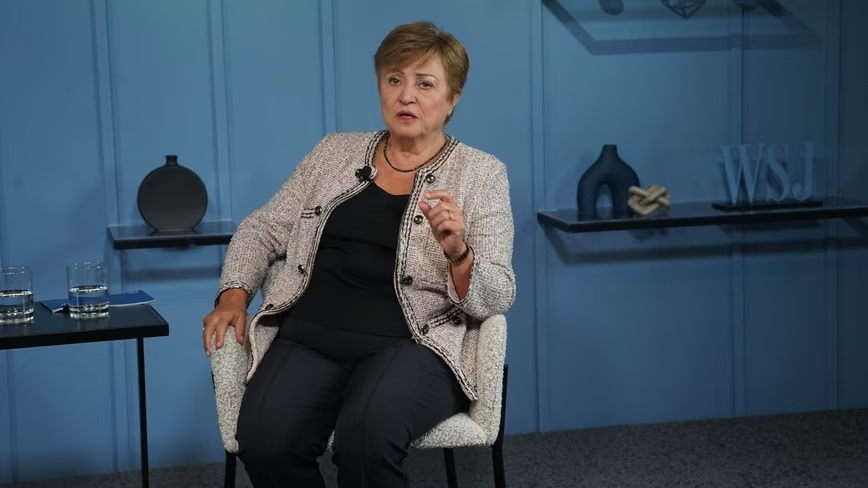
IMF Managing Director Kristalina Georgieva at Wall Street Journal House during Climate Week NYC, September 2025.
 Credit: Photo: Xuthoria / CC BY-SA 4.0 via Wikimedia Commons
IMF chief Kristalina Georgieva said on Monday that spending on AI infrastructure is helping the world economy grow by about 3% each year, even though energy prices are high.
She made these comments in Bangkok at the start of the IMF and World Bank annual meetings, according to Reuters.
According to Georgieva, Asian economies that produce AI hardware, like Thailand, benefit the most. She estimated that advanced Asian economies could see growth increase by 0.5 to 1 percentage point, while emerging Asian economies might gain 0.2 to 0.8 points.
The scale of that trade is large. In a speech in Singapore last week, Georgieva said AI hardware and related tech products now account for more than a tenth of global trade in goods.
Apart from the US, China, and India, most leading countries in this trade are Asian suppliers of chips, chip-making equipment, and robots.
This demand is rising as major tech companies plan to spend between $660 billion and $690 billion on AI this year.
In its July outlook, the IMF said that AI demand is boosting tech-exporting countries, while conflicts are affecting energy importers. The IMF also predicted 3% growth for 2026.
Georgieva also cautioned about the impact of AI on jobs.
She described AI as a “slow-moving tsunami” that will transform jobs, education, and how governments collect taxes.
According to the Fund, AI will eventually affect about four out of ten jobs worldwide, improving some and making others worse or unnecessary.
Georgieva said, as reported by CNBC, that richer countries are most exposed, with about 60% of jobs affected, compared to 23% in the poorest countries.
Young people entering the job market face the first hit, Georgieva said, because the routine roles they usually start in are disappearing.
Singapore’s President Tharman Shanmugaratnam, speaking on the same panel, said, “The first rung in employment, your first job upon graduation, is now seeing less demand.”
Tharman also warned that if governments do not act, AI could increase the gap in growth and jobs between wealthy and developing countries.
Ajay Banga, the head of the World Bank, said the bank is supporting small AI tools that do not rely on large language models. These tools are designed to help farmers, health systems, and teachers in emerging markets.
The IMF has also pointed out risks from the AI boom. In June, Georgieva warned that Mythos-class AI models could be used to attack the financial system. The Fund will release its updated growth forecasts on Tuesday.
Get the TNW newsletter
Get the most important tech news in your inbox each week.


