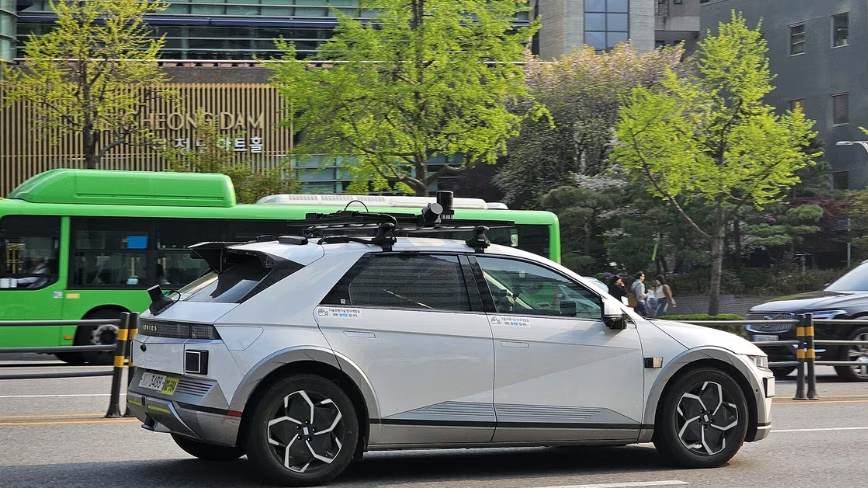
A Hyundai Ioniq 5 NE1 robotaxi test vehicle on a street in Seoul, April 2024.

Hyundai will build tens of thousands of Ioniq 5 robotaxis for Waymo at its plant in Georgia, chief executive Jose Munoz said, calling robotaxis the biggest new opportunity inside a slowing electric market. In Europe the only type approval route that works across the whole union for a fully automated car is capped at 1,500 units a year per vehicle type.
Hyundai will build “tens of thousands” of Ioniq 5 robotaxis for Waymo at its plant in Georgia, chief executive Jose Munoz told an event in San Jose, InsideEVs reported. He said the robotaxi manufacturing business is already profitable, and is becoming “a business unit on itself“.
The reason is the electric slowdown.
With the US tax credit and fuel economy rules gone, carmakers have taken large write-downs on electric assets. Where rivals “decided to write down their assets, we decided to make the most out of our assets“, Munoz said. Hyundai adjusted Savannah to build more hybrids and fewer electric cars.
Robotaxis are where the electric volume went.
Waymo runs about 4,000 vehicles across 14 US cities. The first Ioniq 5s not meant purely for testing arrive this quarter, built with redundant steering and braking and fitted with Waymo’s sixth-generation system at a plant in Arizona. Hyundai also builds Ioniq 5s for Motional, its own autonomous arm.
Hyundai is also the option that is not Chinese.
Waymo’s cheaper purpose-built robotaxi, the Ojai, has its bodies built by Zeekr in Ningbo and shipped to Arizona as stripped shells to keep the tariff bill down. A Georgia-built Ioniq 5 does not need that arrangement. Morgan Stanley puts the finished Ojai at about $125,000.
Europe cannot take these numbers.
The only approval route that works across the whole union for a fully automated car is capped at 1,500 units a year per vehicle type. Tens of thousands is not a European figure under that rule.
National approvals exist, and they stop at borders.
Waymo is going to Munich under the German framework for level four services passed in 2021, and is targeting late 2027 for commercial rides. It will spend the intervening period mapping the city and driving it manually. Germany passed the first level four commercialisation framework in the world.
That is one city, under one country’s law.
Munoz said there is “a lot of interest” from other customers and that he sees “a significant opportunity to scale up“. The scaling he means is American. Europe’s version of the same ambition runs at 1,500 cars a year per model.
Get the TNW newsletter
Get the most important tech news in your inbox each week.


