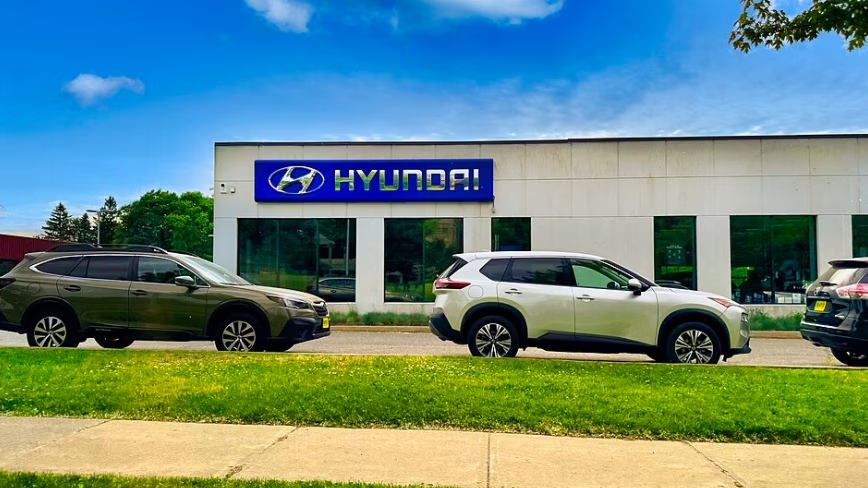
A Hyundai auto dealership in Burlington, Vermont.
 Credit: Harrison Keely
Hyundai Motor Group has grown its US market share faster than any major carmaker this decade and is investing $26B through 2028 to build at least 80% of its American sales domestically. Its European plants already account for around 80% of its European sales.
No carmaker has gained American market share this decade like Hyundai. The group has gone from 8.4% in 2020 to 11.8% through the first half of this year, on sales up 50%, which makes it the fourth best-selling automaker in the country.
The plan to keep going costs $26B through 2028. Its centrepiece is the $7.6B Metaplant in Georgia, which chief executive José Muñoz says could expand from 500,000 units a year to between 700,000 and 800,000 by 2028.
Underneath the spending is one number. Hyundai wants to build at least 80% of what it sells in America domestically by the end of the decade, up from roughly 40% in 2024.
Tariffs are part of the reason, though not the origin. “Tariffs are helping accelerate our localization plan,” Muñoz said of the 15% duty on Korean cars, noting the plan predated them, while Kia is running the same play.
The man delivering it is himself a departure. Muñoz is a Spanish-American dual national and the first non-Korean to lead the company, and he told CNBC his top three priorities are “U-S-A“.
Europe already has the thing America is buying. Hyundai’s plant at Nošovice in Czechia builds 350,000 cars a year with around 3,200 workers, and has done since 2008.
Add Türkiye and the picture is complete. The İzmit plant produces 230,000 units annually, and together the two account for roughly 80% of Hyundai’s European sales.
That is the same 80% figure. The target Hyundai is spending $26B to reach in the United States by 2030 is the level at which its European operation has been running for years.
Those plants are not placeholders either. Nošovice runs on 100% renewable electricity and builds the Kona Electric, Tucson and i30, while İzmit makes the i10, i20 and Bayon.
What Europe has not been given is a number. Hyundai announced 41 new or refreshed models for the region with no comparable investment figure, and its new Genesis flagship arrived with no European plans at all.
So the $26B is not Hyundai discovering local manufacturing. It is America being brought up to the standard Hyundai has applied in Europe for nearly two decades, at a moment when the company’s attention is pointed firmly the other way.
Get the TNW newsletter
Get the most important tech news in your inbox each week.


