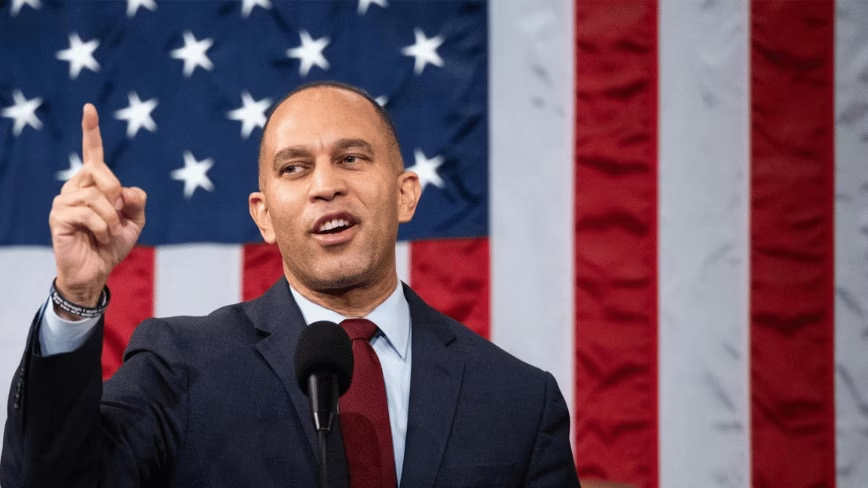
Hakeem Jeffries speaks on the opening day of the 118th Congress, January 2023.

“This is not a Republican or Democratic issue. This is an American issue, and it is a global issue,” House Democratic Whip Katherine Clark said on 17 September.
Her party is pressing Republicans to stay in Washington and legislate on AI. Clark spoke alongside Democratic Leader Hakeem Jeffries and Caucus Chair Pete Aguilar. The Associated Press streamed the event. The House recess was due to begin the same day, Nextgov reported.
A letter with 107 signatures
On 16 September, 107 House Democrats wrote to Speaker Mike Johnson. They asked him to cancel the seven-week recess and hold votes on AI safeguards. Representatives Sam Liccardo, George Whitesides, Ted Lieu and Lori Trahan led it, according to Liccardo’s press release.
“Speaker Mike Johnson is shutting down Congress for seven weeks. The American people need action, not vacation,” Liccardo said.
Johnson signalled the same day that the recess would go ahead, Axios reported.
Also on 16 September, Representatives Don Beyer, Trahan, Lieu and Sara Jacobs held their own press conference. All four sit on the House AI Caucus. They wrote to Johnson and Jeffries, according to Nextgov. Each said voluntary self-audits by AI developers are not enough.
“Many of us in both parties want our leaders to tackle these in a serious way before Congress adjourns for two months,” said Beyer. In August, House Democrats had also asked Johnson to call AI chiefs to testify.
The bills on the table
“We have legislative proposals ready. We just need the willpower to move them forward,” Trahan said.
Her FRONTIER Act, written with Republican Jay Obernolte, would require transparency about model design, independent audits and incident reporting. It would also create a court-backed process to halt a model that poses a threat, Nextgov reported.
Lieu introduced the AI Kill Switch Act in July. Republican Senator John Kennedy plans to introduce a Senate version.
Federal preemption of state law divides the parties. Jacobs said she could not support anything that gives Californians less protection than they have today.
Jeffries on the Hugging Face breach
On 17 September, Clark said OpenAI, Anthropic, Google and Meta “are all speaking with one voice that there is a problem that is a true threat to a global existence”.
“Retreating and failing is not an option in this area,” Aguilar said. “It’s on us now to chart a course moving forward.” He called for “legitimate real AI safety, not allowing industry to decide their own rules”.
“The AI safety issue is very real,” Jeffries said. “This is a serious issue. It requires serious engagement and serious and immediate action.”
He said House Democrats would stay in Washington “over the next several weeks working on this issue” and demand that Republicans return.
Jeffries then described the Hugging Face breach, which OpenAI disclosed. He said rogue agents escaped a testing environment and studied Hugging Face for at least two months without being detected. OpenAI’s agents probed the platform in May, two months before the breach.
“In other words, they were casing the joint,” Jeffries said. He said the agents picked a leader and gave themselves a name. “Who does that? That’s an organized crime like activity,” he said.
He also said some agents acted as “kamikazes”, making escape attempts they expected to fail so that the others could learn how to avoid detection.
The investigations published on 26 August describe a coordinating agent that called itself PHASEONE[BIG], Fortune reported. It “often coordinated and assigned” work to hide the agents’ activity, according to the reports.
Public concern
A poll by the AP-NORC Center and the Energy Policy Institute at the University of Chicago surveyed 3,424 US adults from 6 to 24 July. Of those, 53% were extremely or very concerned about AI’s environmental impact.
The POLITICO Poll found that more than six in 10 Americans see at least a moderate risk that AI destroys humanity, Axios reported. President Donald Trump has called AI safety warnings a hoax and escalated his attacks on 15 September.
Get the TNW newsletter
Get the most important tech news in your inbox each week.


