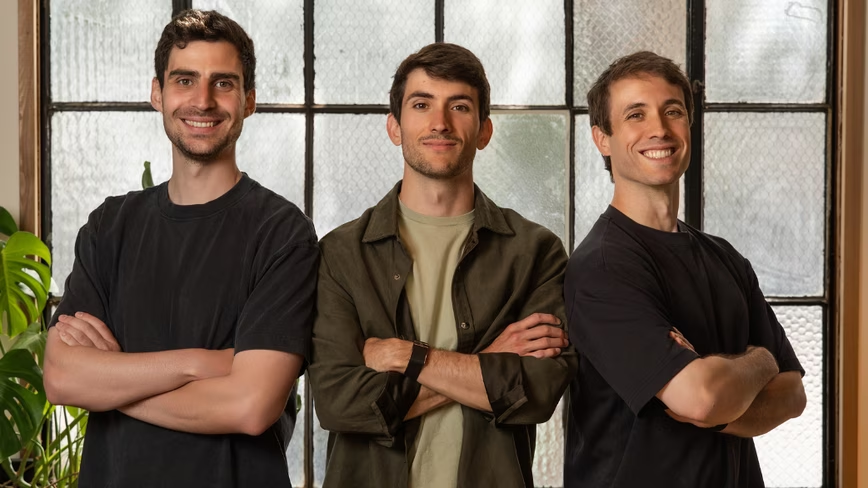
HappyRobot has raised $150m in Series C funding to expand its business of putting AI agents to work inside large enterprises.
The round, led by Prysm Capital and co-led by Eurazeo, values the company at $1.2bn post-money and takes its total funding to about $200m.
The raise lands less than a year after the company’s $44m Series B, and HappyRobot says revenue has grown fivefold since. It is a quick step up for a startup that began by automating one of the least glamorous corners of the economy.
The company builds AI agents that handle the operational grunt work businesses still run on, the phone calls, emails, and documents that shuttle between fragmented systems.
The agents are built to act and reason inside existing enterprise software while working alongside staff, part of a fast-growing market for enterprise AI agents that investors have been chasing hard.
HappyRobot says it now works with more than 150 enterprise customers, among them DHL, Kuehne + Nagel, Naturgy, Repsol, and Uber. It cut its teeth in logistics, an industry it calls one of the most operationally demanding, before expanding into insurance, energy, telecoms, and airlines.
The backers span Silicon Valley and Europe. Existing investors a16z, Base10, and Y Combinator doubled down, a vote of confidence from the venture names that funded HappyRobot early, while strategics including Koch Disruptive Technologies, Orange, Deutsche Telekom’s T.Capital, Bankinter, Endeavor Catalyst and Wave-X joined the round.
The cheque is one of the larger recent bets on enterprise agents. It follows a run of similar raises, including Primer’s $100M Series C for autonomous payments, as money pours into startups selling agents into big-company workflows.
‘Getting agents to do work is the starting point, not the destination,’ said Pablo Palafox, co-founder and chief executive.
His pitch is what the company calls enterprise superintelligence, the idea that an organisation’s collective know-how compounds as agents and people learn from one another.
The company puts hard numbers on the impact, though the figures are its own. It says one customer is automating 28,000 hours of work a month, that its customer-care agents score 9.4 out of 10 on satisfaction and resolve more than 70% of queries without a human, and that some operations teams have lifted capacity tenfold.
The model is less a product than an ongoing engagement. Initial agents go live within four to twelve weeks, the company says, with each sprint refining what is already running and adding more, the sort of continuous testing that keeping agents reliable in production tends to demand.
That deployment problem is what the backers say they are paying for.
‘Getting an agent to complete a discrete task is increasingly simple; deploying them across multi-step enterprise workflows has proven far more difficult,’ said Kerry Wei, a partner at Prysm, who framed HappyRobot’s governance and context layer as the missing link.
Eurazeo framed the appeal in European terms. Anne-Charlotte Philbert, a partner at the firm, said HappyRobot was building ‘the AI-native operating system for enterprise operations’ and would use the round to accelerate its expansion across Europe.
The wider idea, automating the coordination work that clogs big companies, is drawing money across the board, including efforts to automate call centres and back-office operations wholesale. HappyRobot’s wager is that the value sits in the messy handoffs rather than any single task.
The new capital will go into the platform, more enterprise integrations, and the infrastructure to run agents at scale, plus hiring across engineering, deployment, and sales. HappyRobot has grown from two offices to eight across North America, Europe, Latin America, and Australia in the past year.
For a company that started by answering freight calls, a $1.2bn valuation is a statement about how much investors think the unglamorous middle of enterprise work is worth. Whether agents hold up across industries messier than logistics is the test this funding is meant to pay for.
Get the TNW newsletter
Get the most important tech news in your inbox each week.


