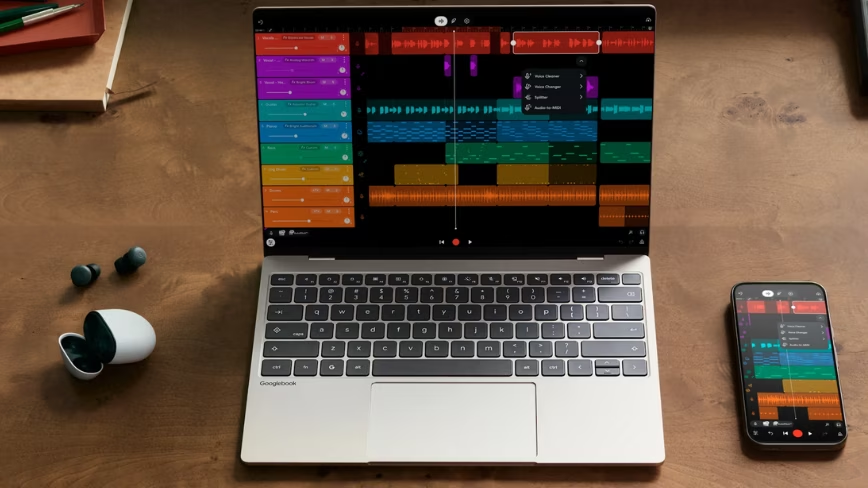
Google’s product image of a Googlebook laptop, with the same music app mirrored on an Android phone.

Google has said a small number of complex Android apps and games need developer tuning to run properly on the Intel versions of its new Googlebook laptops, which reached Britain, Ireland, France and Germany today. Three of the five models use Intel chips and run Android through a translation layer, while the Dell and HP machines use Arm chips and run it natively.
Googlebooks went on sale in Britain, Ireland, France and Germany today. Three of the five models run Intel chips. Google has now said that some Android apps need developer tuning to run properly on those.
A small handful of complex apps or games need the work, Google told Android Authority, as Engadget reported. It did not say which apps, or what goes wrong with them.
Android was built for Arm chips. The Intel machines run it through a hardware translation layer, which is the same arrangement Chromebooks used and which Googlebook was meant to end.
Google has said before that converting and executing Arm code on x86 costs performance and battery life. Apps compiled for x86 in the first place have no such problem, and most Android developers do not compile for it.
The laptops start at $899, or £999 in Britain, from Acer, ASUS, Lenovo, Dell and HP. The Intel versions are the Acer, the ASUS and the Lenovo.
The Android apps are the reason the machine exists, and the reason to pay for one over a cheaper Windows laptop.
We reported in May that Googlebook runs Android natively, unlike Chromebooks, which ran the apps inside containers, and that this removed the old compatibility limits. That holds for the two Arm models.
On the other three it is a translation, and Google has not said how much that costs in practice.
Google says the vast majority of apps run smoothly on both out of the box, and that it is working with developers, Intel and Qualcomm to widen compatibility.
Nobody has published a list of what does not. Engadget says it has not yet tested the machines, and neither has anyone else.
The machines arrive as ChromeOS winds down to 2034, with Google yet to say which existing Chromebooks can move across to the new system.
European buyers are choosing between the two architectures today, at £999 and upwards, on specifications that are reported to differ by country.
The Arm machines are Dell’s and HP’s, the Intel ones Acer’s, ASUS’s and Lenovo’s, and nothing on the box says which runs the apps natively.
Get the TNW newsletter
Get the most important tech news in your inbox each week.
Also tagged with


