 Credit: Google
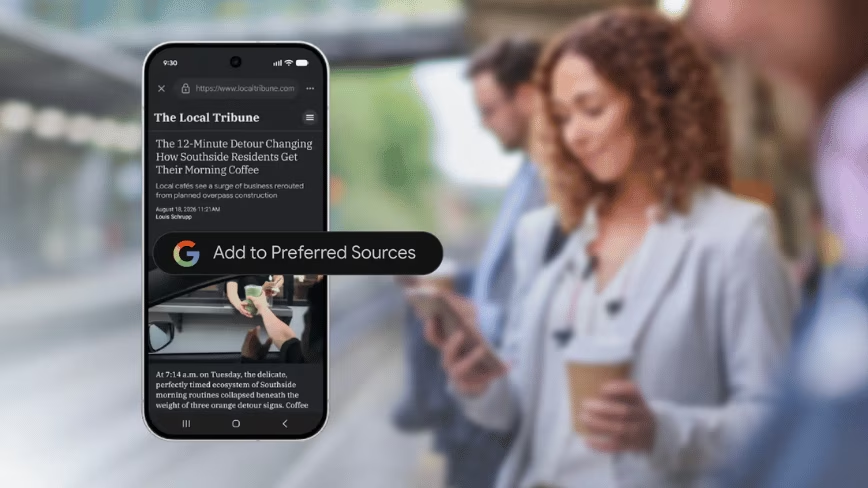
Google is giving publishers a button to put on their own websites. Clicking it adds that publisher to a reader’s preferred sources on Google.
It is one of three personalisation changes the company announced on Thursday. The other two are a chatbot for tuning the Discover feed, and topic controls for audio news briefings.
Mrinalini Loew, who runs the Google Search ecosystem team, framed all three as giving readers control “while helping publishers build stronger, direct connections with their readers”.
The button is the part with something in it for the people who make the articles.
What the button does
A reader clicks it on a publisher’s page. Google adds that site as a Preferred Source, then returns the reader to the spot they left.
That return trip is the difference. The badge Google introduced earlier this year dropped readers into Google’s own source preferences tool instead, Search Engine Journal noted, and left them there.
Publishers can find the embed code in Google’s Search Central documentation. Installing it is the publisher’s job, and so is persuading readers to press it.
Where being preferred pays off
Google’s documentation says sites chosen as Preferred Sources are more likely to appear in Top Stories.
Inside AI Overviews and AI Mode, those sites can also carry a “preferred” badge.
Those two surfaces are the ones publishers have been arguing with Google about. TNW reported in July that Reddit was weighing cutting Google off from its content. It was not the only site considering it.
The count has nearly doubled since May
Google says people have now selected more than 600,000 unique sources.
Search Engine Journal put the May figure at more than 345,000. The number has risen by roughly three quarters in three months.
Google did not say how many people made those selections. The figure counts distinct sites chosen, not readers doing the choosing, so a site picked once and a site picked a million times both count as one.
Discover becomes a chatbot
The second change turns feed tuning into a conversation.
In the coming days, Google app users can tap the three-dot menu on a Discover card and describe what they want more or less of. Google’s own examples are kitchen renovation ideas, eco-friendly only, and weekend road trip videos with no camping.
Tapping it opens a chatbot-style interface, The Verge reported. The chatbot confirms the request and lists what it will prioritise. If it has misread you, you can add more. Then you hit “Refresh your feed”, and the changes take effect.
Google can ask follow-up questions to narrow things further, according to 9to5Google. The entry point can also be a dedicated card rather than the menu. Google began testing the feature in December.
The feed remembers the request rather than applying it once. Google describes it as adjusting on the fly.
Discover already had two ways to do this
Readers could already follow and unfollow topics, and tell Google which topics or sources they did not want.
Typing a request in your own words is a third control layered on top, not a replacement. Google has not said which signal wins if two of them conflict.
Audio briefings get topic controls
The third change is in the Google News app on Android.
Listeners can now pick the topics in their daily briefing. The categories include Headlines, Business, Entertainment and lifestyle, Sports, and Science and technology. Each one breaks down further. Entertainment offers Arts and Design, Movies, Music, Theater and TV.
Google says briefings will carry clear source attribution and links out to full articles. That matters for a format where the audio is the product and the click is optional.
The deeper segments come from publishers in Google’s news AI pilot programme, which the company announced in December.
Prompt-tuned feeds are now standard
Google is not first here.
YouTube, Instagram, Bluesky and X have all added ways to shape a feed with AI, The Verge noted. Instagram’s head Adam Mosseri said in June that he wanted algorithm customisation to be a core part of the app rather than a buried setting.
What Google adds is scale. Discover reaches people who never chose a feed at all.
Discover recommends articles based on a reader’s activity across Google’s search engine and apps. Most people using it never opted into anything.
The wider fight this sits inside
Publishers have spent this year trying to get paid or get out.
Cloudflare gave AI crawlers a September deadline to pay publishers or lose access. Reddit started using its own AI to police marketing content as GEO became the new SEO.
Research this month found that ChatGPT and Gemini disagree on the best software in a third of categories, and that the answers skip the review sites entirely.
Preferred Sources is Google offering a way in rather than a payment. The reader has to pick you, and the publisher has to ask them to.
What publishers should check
Anyone who already installed the earlier badge has an open question. Search Engine Journal flagged it. Google has not said whether the new button replaces the old badge automatically, or whether sites need a fresh embed.
The Discover controls have no launch date beyond “in the coming days”. Google did not say whether they reach iOS at the same time, and testing has been running since December without a release.
Audio briefing controls are Android only. Google has not mentioned the iOS Google News app at all.
Google has also not said how much difference being a Preferred Source actually makes to placement, in Top Stories or anywhere else. Its documentation says only that selected sites are more likely to appear.
Get the TNW newsletter
Get the most important tech news in your inbox each week.
Also tagged with


