TL;DR
Google DeepMind reconstructed Pelé’s 1959 “lost goal” using Veo, Gemini Omni, and Nano Banana Pro. 2,000 records and eyewitness interviews informed the project. It is on display at the Pelé Museum.
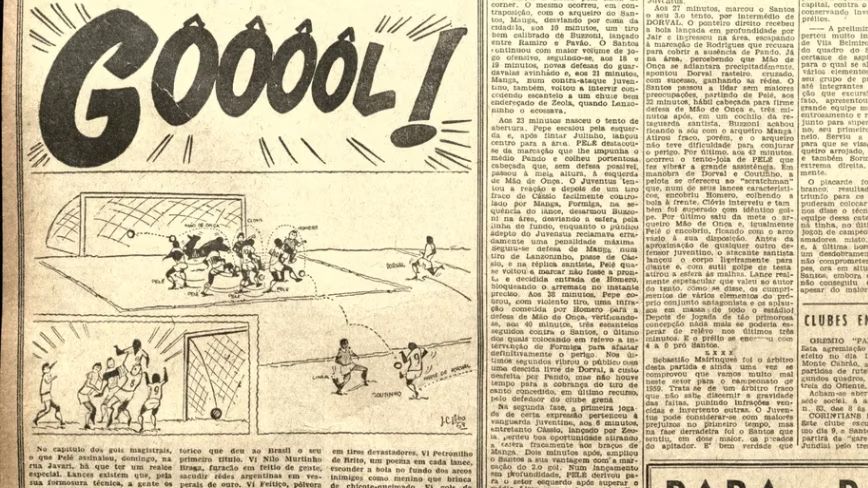
Three sombreros over defenders, a knee flick past the goalkeeper, a header into the net, the ball never touching the ground. It happened in 1959. Now you can watch it.
Deepmind-pele-goal
 Credit: Google
Google DeepMind reconstructed Pelé’s 1959 “lost goal” using Veo, Gemini Omni, and Nano Banana Pro. 2,000 records and eyewitness interviews informed the project. It is on display at the Pelé Museum.
On August 2, 1959, Pelé scored what he called the greatest goal of his career: three consecutive sombreros over defenders, a knee flick past the goalkeeper, and a header into the net, all without the ball ever touching the ground. It was never filmed. For 67 years, the “Gol da Rua Javari” existed only in the memories of the fans who were there. Google DeepMind has now reconstructed it.
The project, built in partnership with Pelé’s family and the Pelé Brand, combined traditional filmmaking with three Google AI models: Veo 3, Gemini Omni, and Nano Banana Pro. Historian Anita Lucchesi gathered nearly 2,000 historical records, from stadium blueprints to family albums, and interviewed surviving eyewitnesses. A crew then shot live-action footage at the original Rua Javari stadium using period-accurate leather balls and uniforms. The footage was fed into the AI models, which replaced the stunt player with Pelé’s likeness, restyled the modern stadium to match 1959 architecture and weather, and generated period-appropriate crowd scenes.
“He would be so proud to see all this happening. He’d always say it was a shame that the goal was never recorded,” said Flávia Kurtz, Pelé’s daughter. The reconstruction is now on display at the Pelé Museum in Santos. Google launched Gemini Omni as a conversational video-generation model at I/O 2026, and the Pelé project is its most culturally significant application to date, demonstrating that AI video generation can serve preservation rather than just content production.
The final output was run through a filmout machine to capture the look of 1950s cinema, then refined with traditional VFX for ball compositing and colour grading. Nano Banana Pro was designed for precision image generation, and the Pelé reconstruction shows the model working at its most ambitious: not generating content from nothing, but rebuilding a real event from fragments of evidence. In a year when AI has mostly been used to flood the internet with synthetic content, this is a rare case of it being used to recover something real that was lost.
Get the most important tech news in your inbox each week.


