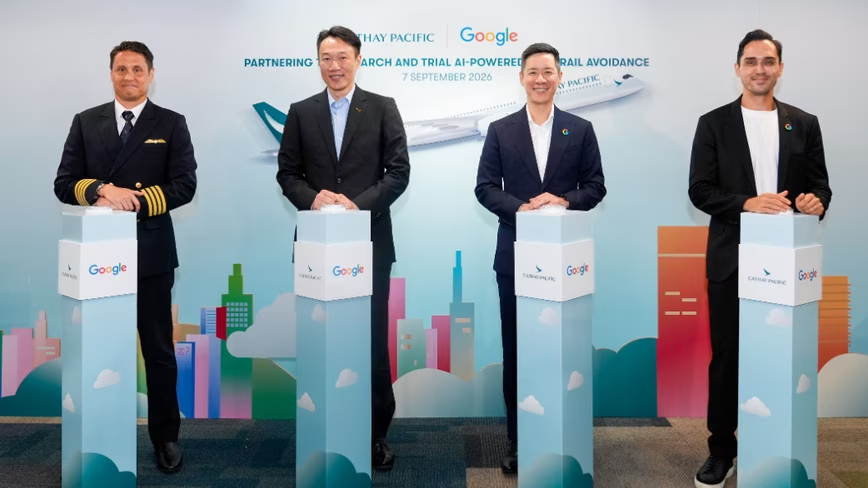
From left: Captain Tony Pringle, Line Operations Manager, Cathay Pacific; Lawrence Fong, Director of Digital and IT, Cathay; Michael Yue, Managing Director and General Manager, Google Hong Kong; and Kemal Armada, Product Manager, Climate & AI, Google.
 Credit: Cathay Pacific
Cathay Pacific has flown more than 80 contrail-avoidance routes in a trial with Google that began in late 2025, adjusting cruise altitude to steer clear of the thin bands of humid air where aircraft exhaust freezes into clouds that trap heat.
Google puts the result at roughly a 40% reduction in the warming impact of the contrails those flights would otherwise have made, based on its own satellite analysis.
The trial targeted ultra-long-haul services, meaning flights of more than 16 hours, and it is the first time the technique has been tested at that duration.
One corridor did most of the work: the Hong Kong to Singapore route, where persistent contrails form often, accounted for more than half the estimated reduction.
Predictions reached the flight deck through Cathay’s electronic flight folder over in-flight Wi-Fi, which is the unglamorous part that makes the rest of it operational.
Why this is worth doing at all comes down to a quirk of the physics. Only a small share of flights make contrails that persist and warm, and the effect is extraordinarily concentrated: research collated by Resources for the Future finds that 2% to 3% of flights produce around 80% of contrail warming.
On North Atlantic routes, roughly 38% of flights made warming contrails, 48% made none that persisted, and 14% produced contrails that were cooling on balance. Find the few that matter, move them a few thousand feet, and the rest can be left alone.
The obvious objection is fuel, since flying off the optimal altitude burns more of it, and burning more of it emits more carbon dioxide. Google’s earlier work with American Airlines has been the main evidence on that question.
A 2023 study across 70 flights cut contrails by 54% at a cost of about 2% extra fuel on the rerouted flights, which the researchers argued would fall to as little as 0.3% spread across an airline’s whole schedule.
A larger transatlantic trial running from January to May 2025 covered 112 flights, reported a 62% reduction against a control group, and found no statistically significant difference in fuel burn.
Google’s own calculation is that the warming avoided runs to roughly 20 times the warming added by the extra fuel, which puts the cost of abatement at somewhere between $5 and $25 per tonne of CO2 equivalent, cheap by the standards of almost anything else available to an airline.
Europe has already decided the effect is real enough to measure. The EU’s emissions trading system has required airlines to monitor and report their non-CO2 effects per flight since 1 January 2025, covering persistent contrails alongside nitrogen oxides and soot.
The European Commission’s own framing is blunt about the scale of it, putting non-CO2 effects at two thirds of aviation’s total climate impact, with contrails alone accounting for roughly a third.
That obligation is why the European end of this research has moved from voluntary to structural. Operation Blue Skies, announced in August, is a £5m programme running over 30 months across Shanwick oceanic airspace, the eastern half of the North Atlantic corridor and a stretch reckoned to produce about 5% of global contrail warming.
The Department for Transport is putting in £2.65m through the Aerospace Technology Institute, Google UK £1.4m in kind, and the consortium takes in the Met Office, NATS, Imperial College London, and the University of Cambridge, with 20 to 40 test days planned per winter season.
The forecasting underneath it leans on the same shift that produced machine-learning weather models able to beat conventional numerical forecasts.
“Aviation needs solutions to address climate change, and AI is accelerating that progress,” said Lawrence Fong, Cathay’s director of digital and IT, in a statement alongside Michael Yue, managing director of Google Hong Kong.
A second and larger phase will extend across Cathay’s Asian and transpacific network. The appeal for airlines is straightforward enough, since altitude changes cost almost nothing next to fleet renewal or sustainable aviation fuel, which remains scarce and expensive.
What has not yet been established is whether the satellite measurement is precise enough to survive being turned into a regulated number rather than a research finding, which is the test the EU reporting period will eventually apply.
Get the TNW newsletter
Get the most important tech news in your inbox each week.
Also tagged with


