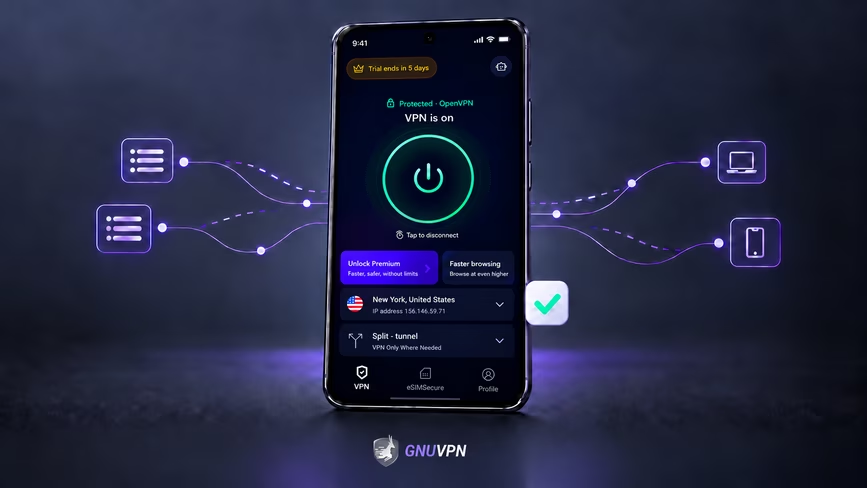
GnuVPN’s mobile app. Promotional image supplied by the company.
 Credit: GnuVPN
For years, consumer VPNs were easy to explain: choose a server, create an encrypted tunnel, and route your traffic through it. The product category was built around a fairly simple idea, and the buying criteria followed the same logic, speed, server count, and price.
That description is becoming less complete.
The way people connect to the internet is now far more fragmented than it was when VPNs first became mainstream consumer software. A laptop may spend the morning on home Wi-Fi, the afternoon on a corporate network, and the evening tethered to a phone. A smartphone can move between Wi-Fi and cellular data repeatedly without the user thinking about it. Travel adds hotel networks, airports, roaming, and increasingly eSIMs.
The network keeps changing. The expectation that connectivity should remain private, usable, and largely invisible does not.
Connectivity has become the harder problem
This changes what users need from a VPN. Encryption still matters, but the practical question is no longer simply whether a tunnel can be created. It is whether that connection remains usable when the network around it changes.
That helps explain why protocol choice, once something largely left to technically minded users, is becoming more relevant. WireGuard has become a popular option partly because of its deliberately lean design and focus on performance. But different protocols can respond differently to network conditions, leaving room for alternatives when the obvious choice is not the most practical one.
The point is not that users should spend their day manually comparing protocols. Ideally, they should not have to think about them at all. Giving the software more than one way to establish a protected connection simply gives it more room to adapt.
GnuVPN is a useful example of that approach. The service supports several connection options, including WireGuard, OpenVPN, SoftEther, and AmneziaWG. WireGuard can serve as an everyday option, while the alternatives provide other ways to establish a connection when network conditions become less straightforward.
The same principle applies beyond protocols. A service intended to sit quietly in the background of everyday internet use also needs to work across the devices people actually use.
GnuVPN’s downloads page currently offers clients for Windows, macOS, iOS, Android, Ubuntu, and Debian. Android distribution also extends beyond Google Play to Huawei AppGallery and Xiaomi GetApps. That breadth matters less as a box-ticking exercise than as a reflection of how fragmented personal computing has become: one person may work on Windows, travel with an Android phone, and keep another machine on Linux.
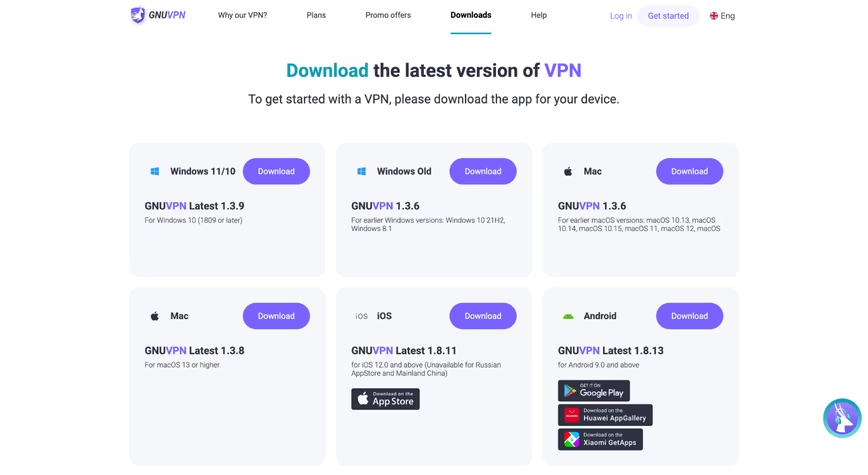
Cross-platform support is therefore part of the same connectivity problem. The tool needs to remain available as the user moves between devices, not just networks.
When privacy tools meet connectivity tools
The more interesting shift starts one step earlier.
A traditional VPN assumes the user is already online. It protects a connection that already exists. An eSIM solves a different problem: getting the device onto a mobile network in the first place.
Technically, those are separate jobs. To someone landing in another country, the distinction matters much less. The immediate task is simply to get online without unnecessary roaming friction and then use that connection with privacy in mind.
That is why the growing overlap between VPNs and travel connectivity is worth watching. GnuVPN now offers eSIMSecure plans that combine mobile data with a VPN subscription, placing access and privacy in the same product flow rather than treating them as completely separate purchases.
The broader mobile market helps explain why that combination is becoming more plausible. According to the GSMA Intelligence 2025 Global Consumer Survey, 12% of consumers who had travelled internationally during the previous 12 months used an eSIM while abroad. More than 70% of those users obtained a travel eSIM from a mobile operator.
This does not mean every VPN will become an eSIM provider, or that the two products are interchangeable. It points to something simpler: the line between tools that provide connectivity and tools that protect it is becoming less rigid.
For VPN companies, that changes the competitive picture. Server count and benchmark speed still matter, but so do continuity across devices, resilience across different network environments, and ease of everyday use.
The VPN is becoming less visible
None of this means a VPN is becoming an all-purpose connectivity tool.
It cannot repair a poor mobile signal, guarantee access through every restrictive network, replace endpoint security, or prevent a website from recognizing a signed-in user. More protocols do not remove those limits, and adding an eSIM does not make mobile connectivity itself a privacy technology.
What is changing is how much of the surrounding experience a VPN is expected to handle.
The original consumer VPN flow was deliberately visible: open the app, choose a country, press Connect. Increasingly, the expectation is that the service should simply keep working as the user moves between devices and network environments, with fewer reasons to think about what is happening underneath.
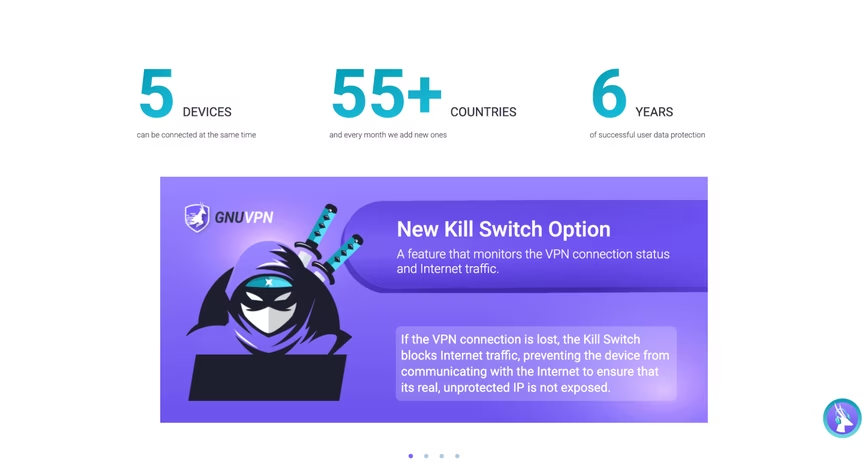
Taken together, protocol flexibility, broad platform support, and travel connectivity point to a wider shift in the category. They are increasingly being treated as parts of the same product experience rather than separate technical features.
That may be a more useful way to think about where VPNs are heading. The next stage is likely to be less about adding another headline feature and more about making protected connectivity fit more naturally into the way people already get online.
Get the TNW newsletter
Get the most important tech news in your inbox each week.
Contributed article. Not produced by the TNW newsroom and does not reflect the editorial stance of TNW.


