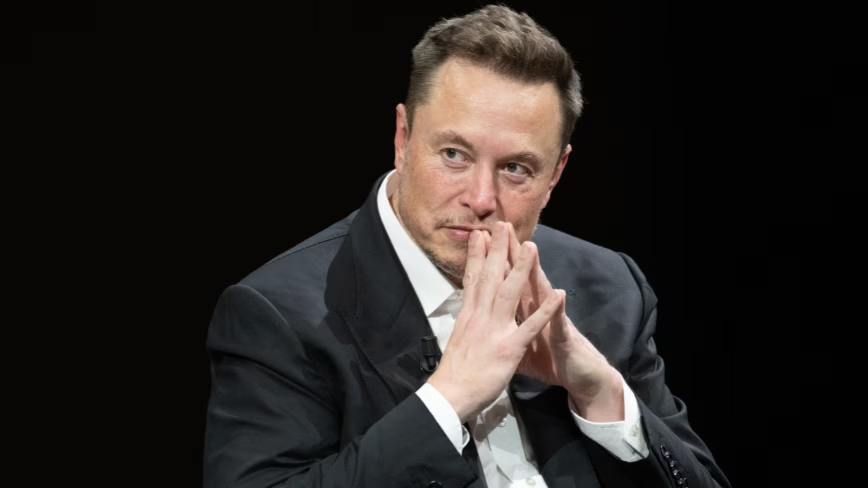
Elon Musk, founder, CEO, and chief engineer of SpaceX, CEO of Tesla, CTO and chairman of Twitter, Co-founder of Neuralink and OpenAI, at VIVA Technology (Vivatech)
 Credit: Frederic Legrand - COMEO via Shutterstock.com
Alex Gibney’s documentary about Elon Musk premiered at the Venice Film Festival on Tuesday. As its subject declined to sit for an interview, the film built one.
In a fine irony, a CGI avatar of Musk, driven by AI voice syncing, delivers statements he made in real interviews elsewhere. A man who has spent a decade suggesting we are probably living in a simulation has now been rendered as one, in his own words, for four hours.
Gibney called the choice intentionally ironic when he presented the film, the Associated Press reported, citing both simulation theory and Musk’s position on the technology.
The device conveys the “reality of what he’s done and unreality of his narrative”, he said. The production took legal advice before proceeding, which is a step the synthetic likeness business does not always bother with.
It runs 225 minutes with a ten-minute intermission, screened out of competition in the Venice Open strand, and reaches cinemas in October.
Gibney’s own statement compares Musk’s self-presentation to a confidence man and casts the film as Toto rather than Dorothy, watching the machine instead of the show.
Yet, Gibney is not a newcomer to this kind of material. He won the documentary Oscar in 2007 for Taxi to the Dark Side, having been nominated two years earlier for Enron: The Smartest Guys in the Room.
And has spent the two decades since on organisations that believed their own publicity: Scientology in Going Clear, WikiLeaks in We Steal Secrets, the Stuxnet worm in Zero Days, Elizabeth Holmes in The Inventor.
He also made Steve Jobs: The Man in the Machine, which picked apart a founder myth while the canonisation was still under way. Looking behind the curtain is not a new idea for him; it seems more like the job description.
The technique is what’s worth debating when a documentary presents an assertion as fact. Gibney’s version is the defensible one, because the words are Musk’s, the synthesis is disclosed, and lawyers looked at it first.
Those three conditions are also the entire distance between this and the thing everyone claims to be against, and the precedent will be inherited by people meeting none of them.
Which brings us to the awkward part. Musk’s own AI company is the subject of European legal action over synthetic imagery of real people. Paris prosecutors are investigating Grok, and Musk has refused to attend.
Apple privately threatened to pull the app over deepfake nudes. EU lawmakers have agreed on a ban on non-consensual deepfakes.
Consent, disclosure and legal review are a short list, and the complaints against Grok involve none of the three. Gibney managed two of them and paid for the third.
Still, the industry is writing its rules. For example, Cate Blanchett has backed a consent registry for performers who would rather not be generated, and the fight over synthetic performers has reached Netflix, where Christopher Nolan called the technology a Trojan horse.
Actors are getting a registry, and billionaires who own AI companies are getting a documentary.
The film’s broader argument is about power: how Musk built an extraordinary amount of it by selling a vision of the future that, Gibney argues, often runs ahead of the evidence, and what happens when that influence stretches from technology and business into politics and the information people consume.
X is an important part of that story. Gibney says Musk tweaked Twitter’s algorithms to prioritise “vitriol and hate” over the idea of a digital town square.
Zoë Schiffer of Wired, who appears in the film, said the changes suppressed mainstream journalism while amplifying inflammatory posts. Those are claims made by the film, rather than established findings.
That concern becomes more consequential as the documentary moves from X to Musk’s political influence and access to government data.
The director argues that the same confidence and ability to shape narratives that helped Musk build his companies have given him influence far beyond the businesses he controls.
The film’s warning is less about any single platform or decision than about what happens when so much technological, financial and political power accumulates around one person.
Ashley St. Clair, a former conservative influencer who appears in the documentary, said she had been “offered the opportunity not to speak for $40 million”, describing a non-disclosure agreement tied to paternity support.
That is her account; it is not verified here, and no response from Musk appears in the available reporting. If accurate, paying someone eight figures for silence is a striking position for the world’s most prominent free speech absolutist.
Gibney considers Musk extremely dangerous to democracy, which tells you the register.
But the real question is not whether the film works. It is how quickly this kind of approach could become normal: a respected documentary maker creating a portrait of someone who refused to take part. Musk, of all people, is unlikely to object to the idea of a simulation itself.
Get the TNW newsletter
Get the most important tech news in your inbox each week.


