The Paris techbio company screens microbial genomes to find molecules that evolution spent three billion years producing, and claims to have characterised more novel small molecules in 2025 than the rest of the field combined. Alven and Daphni co-led the Series A.
Generare, the Paris-based techbio company reading microbial genomes for molecules that drug development has never had access to, has raised €20 million in a Series A co-led by Alven and Daphni, with all existing investors including Galion.exe, Teampact Ventures, and VIVES Partners re-upping.
The company was founded by CEO Guillaume Vandenesch and CSO Dr Vincent Libis, who brings a decade of synthetic biology research, ERC grant funding, and prior co-founding experience at Abolis Biotechnologies. The round follows a €5 million seed in 2024.
The scientific premise is straightforward but the technical challenge is substantial. Microorganisms, bacteria, fungi, other microbes, encode molecular chemistry in their genes: biological recipes for small molecules shaped by three billion years of evolutionary pressure.
These molecules were once a foundational source of drug discovery: penicillin being the most famous example of a microbial compound becoming medicine. But conventional chemistry-based techniques could only access a tiny fraction of this chemistry.
Generare estimates that approximately 97% of the molecular chemistry encoded in microbial genomes remains uncharacterised.
The company’s platform uses high-throughput cloning and sequencing technology, validated through ERC-funded academic research and peer-reviewed publications, to screen tens of thousands of microbial genomes, identify the gene sequences most likely to produce bioactive molecules, express them, and characterise the resulting compounds for structure, biological activity, and drug potential.
The company claims to have characterised more than 200 previously unknown small molecules, with a hit rate it says matches the most successful drug discovery programmes in history, and asserts that in 2025 alone it characterised five times more novel molecules than every other player in the field combined.
These are company-disclosed figures, not independently audited. What is independently confirmed is the scientific approach: TechCrunch’s 2024 coverage of the seed round confirmed the cloning and biosynthetics methodology and Dr Libis’s background at Rockefeller University and as an INSERM team leader.
Partners include unnamed pharmaceutical and agrochemical companies, described as “some of the world’s most recognisable pharmaceutical companies.”
The €20 million Series A will fund a ten-fold scale-up of the molecule library by 2027, from roughly 200 to 2,000+ compounds, with a longer-term target of 10,000 over time.
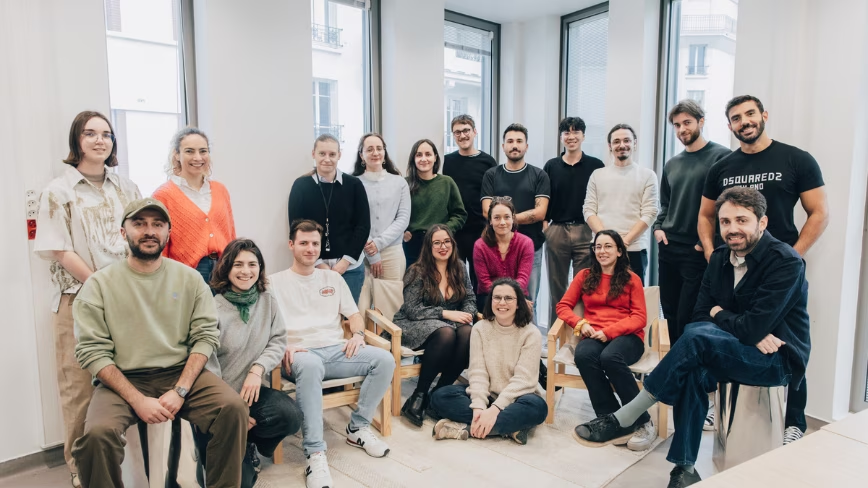
The team of 25, computational biologists, chemists, synthetic biologists, technicians, and engineers drawn from France, the UK, the US, Germany, and Australia, will be nearly doubled.
Advisors include Dr Frank Petersen, former Executive Director of Novartis’s Natural Products Chemistry Department, and Professor Nadine Ziemert, described as one of Europe’s foremost experts on microbial biosynthetic gene clusters.
The strategic argument is a data one: AI drug discovery models trained on the same recycled chemistry will keep converging on the same outcomes. Feed them genuinely novel structures with corresponding biological activity and the potential for differentiated outputs multiplies.
Get the TNW newsletter
Get the most important tech news in your inbox each week.


