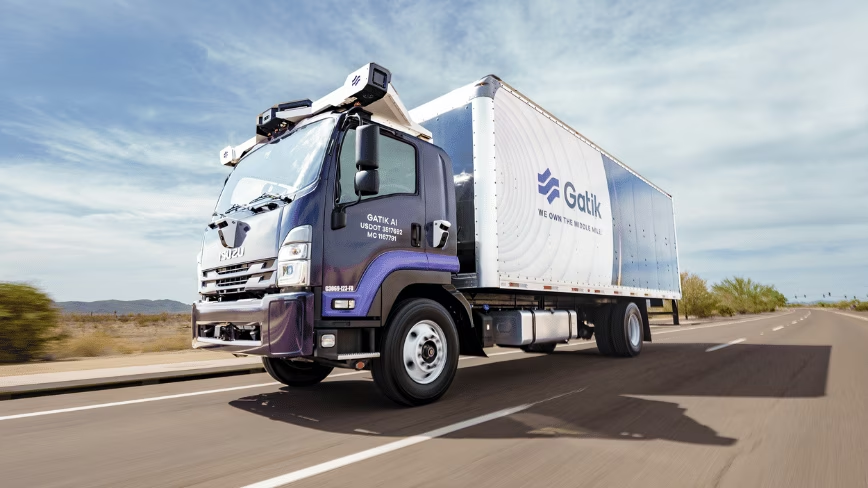
An autonomous Gatik delivery truck in transit.
 Credit: Gatik AI
Gatik has raised $200m in a Series D round led by Qatar Investment Authority and Koch Disruptive Technologies. It is the largest financing in the autonomous trucking company’s history. Millennium Management, ARK Invest and Intact Private Capital also took part, and the round brings Gatik’s total to about $500m since it came out of stealth in 2019. The company declined to disclose its valuation.
David Welch interviewed the chief executive for Bloomberg on Tuesday. The Santa Clara company set out the round the same day in a company release.
What the company says it has already sold
Gatik puts its contracted revenue above $600m. It says it has completed 85,000 fully driverless orders at 99% on-time delivery. Chief executive and co-founder Gautam Narang told Bloomberg in January that the company had signed deals worth $600m over five years, and he said this week that the backlog has grown since. He would not say by how much, and he declined to say whether Gatik is profitable.
The niche is the middle mile
Gatik moves freight between distribution centres and stores. It does not do long-haul, robotaxis or sidewalk delivery. Kirsten Korosec set out the history at TechCrunch. The company began with fixed routes under ten miles, and now runs dynamic routes with dozens of pick-up and drop-off points covering up to 400 miles.
The box trucks come from Isuzu Motors, and Gatik supplies the driving system it calls the Gatik Driver. Narang told TechCrunch the third-generation trucks run around the clock on surface streets and motorways. They can handle light rain and snow.
Who it drives for
Walmart was the first customer, disclosed in 2019, and PepsiCo, Kroger and Tyson Foods followed. The PepsiCo agreement, signed in June, is the largest public one. Forty-one driverless box trucks move Frito-Lay products from distribution centres to stores in Dallas, Phoenix and Northwest Arkansas, and Gatik calls it its biggest commercial deployment so far.
The company also runs for Loblaw in Ontario, where a safety driver is still behind the wheel. Its trucks operate nearly around the clock, carrying ambient, refrigerated and frozen goods. Its customers are Fortune 50 retail, grocery and consumer packaged goods companies, according to the release.
The fleet numbers do not sit still
Gatik says it has dozens of driverless trucks running today and plans to expand to thousands in the years ahead. A spokesperson told Reuters the target is more than 100 by the end of 2026. Narang told Forbes in January that the fleet would go from fewer than a dozen to hundreds of box trucks by the end of this year.
The driverless routes run in the Dallas and Fort Worth region, Phoenix and Northwest Arkansas. Gatik pulled its safety drivers from commercial routes last year, which is what made those operations possible. The release describes the routes as high-frequency regional networks, time-sensitive and operationally complex.
What the money is for
Narang said the round funds more trucks, more customers and more cities. Gatik will hire engineers and operational staff on top of its 350-person workforce, and will expand both into new markets and further inside the ones it already serves.
“These are very sophisticated long-term financial investors that usually get involved when the business is proven out and the economics are proven out,” he told Bloomberg. “It’s less about building a business. It’s more about scaling the business that we have today.”
What the investors said
Cathie Wood, who runs ARK Invest, said autonomous freight is reaching an inflection point as AI and robotics converge. Abdulla Al-Kuwari, head of industrials at QIA, said the fund is backing companies shaping the future of freight infrastructure.
Byron Knight, president of Koch Disruptive Technologies, said autonomy is moving beyond a promising technology into real-world commercial operations. His colleague Celeste Dauner said the firm first backed Gatik in 2021 and has watched it build scale around a focused application. Justin Smith-Lorenzetti of Intact Private Capital said his firm has tripled its commitment with this round, and ARK’s Tasha Keeney said autonomous trucking should meaningfully lower the cost of transporting goods.
Europe is not on the map yet
Gatik operates in Texas, Arizona, Arkansas and Canada. Its site also lists California, Michigan, Nebraska, Iowa and Ontario. Narang told TechCrunch that scaling means more trucks, customers and cities, and someday operations outside North America. Reuters reported interest in driverless commercial freight surging in both North America and Europe.
No European route has been announced, and the company has not said which market would come first. Waymo said this month it is laying groundwork in Munich for late 2027, though that is passenger service rather than freight.
The European trucking comparison
Einride is the closest European name, and it took a different route. It listed on Nasdaq in June at $1.35bn, below the $5bn it had once discussed with banks. This month it agreed to buy 500 Tesla Semis, with Amazon holding a stake in the buyer.
Rivian’s spinout Also raised $150m this month, and Waymo built its own chip. Capital is moving across the whole autonomy stack rather than one part of it.
What to watch
Gatik has not published a valuation, a profit figure or a precise fleet count. Its release carries a forward-looking statements disclaimer covering the revenue targets, the customer base and the fleet plans, and notes the securities were sold in a transaction exempt from registration.
The company says it will reach thousands of trucks, while Reuters has it at more than 100 by December. Loblaw in Ontario remains the one operation still carrying a safety driver, and Gatik has not said when that changes.
Get the TNW newsletter
Get the most important tech news in your inbox each week.


