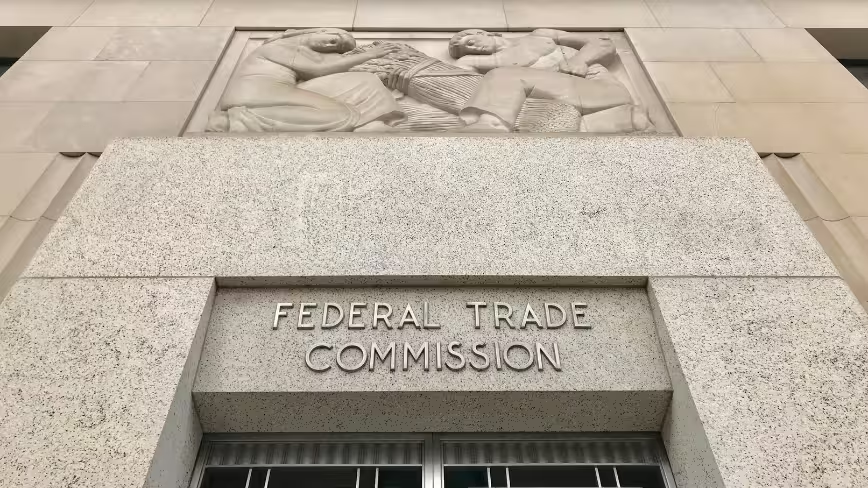
The US Federal Trade Commission headquarters
 Credit: DCStockPhotography via Shutterstock
Amazon runs a second-price auction for its search ads, a system in which the winning advertiser is supposed to pay one cent more than the next-highest bid.
The Federal Trade Commission now alleges that Amazon charged advertisers their full winning bid roughly 80% of the time instead.
The agency and 22 states sued Amazon on Monday, in a case first reported by the Wall Street Journal. The complaint covers seven years of advertising activity involving more than one million brands and sellers.
The reason second-price auctions became common in digital advertising is that they are supposed to make honest bidding the rational choice.
If an advertiser knows it will pay only slightly more than the next-highest bidder, there is little reason to deliberately bid below what the ad is worth to the business.
That makes the difference between the auction Amazon describes and the one the FTC says it actually ran particularly important. A second-price auction is not just a label for a particular type of bidding system.
It tells advertisers how their bids will translate into the prices they ultimately pay, and the FTC’s argument is that Amazon advertised one set of rules while applying another.
The agency says Amazon “covertly and substantially increased the prices that more than one million brands and sellers were required to pay” and estimates that the practice generated tens of billions of dollars in additional revenue.
Amazon is disputing that interpretation rather than accepting the FTC’s description of how advertisers behaved. The company says advertisers set and adjust their bids based on the results they get from advertising, rather than relying on descriptions of the underlying auction mechanics.
In Amazon’s view, that means sophisticated advertisers were making decisions based on performance rather than on the precise way the auction was supposed to work.
There is a problem with that defence, because advertisers can optimise around performance only if the system translating their bids into prices behaves consistently.
If the auction rules differ from what advertisers are told, the fact that they measure outcomes does not make those rules irrelevant; it can make their optimisation less predictable.
Amazon is also pointing to the savings its auction system has generated for advertisers. The company says that taking ad relevance into account saved advertisers more than $8 billion between 2021 and 2025, suggesting that the system should be judged on the prices and results advertisers actually receive rather than on the FTC’s description of a particular bidding mechanism.
The scale of Amazon’s advertising business helps explain why the allegations are potentially so expensive. Its advertising operation generated $68.6 billion in 2025, making Amazon the world’s third-largest digital advertising platform behind Google and Meta.
A large share of that business comes from sellers that have relatively few alternatives. For a merchant that depends on Amazon for distribution and customer access, refusing to buy sponsored listings can be a difficult choice, which is what turns an argument about auction mechanics into a broader question about market power.
Advertising has also become one of the most important sources of profit supporting Amazon’s wider retail operation. Retail margins are relatively thin, while AWS operates as a separate business, leaving advertising as a significant contributor to the company’s overall profitability.
The involvement of 22 state attorneys general could make the financial consequences much larger.
State consumer-protection laws can allow penalties to be calculated on a per-violation or per-day basis, and the complaint covers seven years of conduct involving more than a million advertisers.
TNW reported in June, citing Bloomberg, that a complaint had already been drafted and that the involvement of the states was the element that could push potential penalties into the billions. That complaint has now been filed.
Amazon is already dealing with other major regulatory cases. The company agreed to pay $2.5 billion to settle deceptive-practices claims over Prime enrolment in autumn 2025, while a separate antitrust case filed in 2023 is scheduled to go to trial in early 2027.
The advertising case is narrower than that antitrust proceeding, but it could present a different kind of problem for Amazon. The central question is relatively concrete: whether the auction operated in the way the company told advertisers it did.
That is less dependent on competing economic theories than a broader argument about market power, and the FTC says it has evidence covering seven years.
European advertisers will also have a reason to follow the case even though it was filed in the US. The evidence produced during discovery could reveal more about how Amazon’s advertising auctions actually work, and the underlying system is not confined to the American market.
The timing is particularly awkward for Amazon because the company is now defending the auction case while preparing for a broader antitrust trial.
Both proceedings touch on the same underlying question about the company’s relationship with sellers: how much freedom do businesses that depend on Amazon really have to walk away from its ecosystem?
Nothing has been established in court yet. For now, there is a complaint, a set of allegations and figures that Amazon disputes, and a $68.6 billion advertising business whose auction system is suddenly under scrutiny because the rules advertisers were told to trust may not have been the rules being applied.
Get the TNW newsletter
Get the most important tech news in your inbox each week.
Also tagged with


