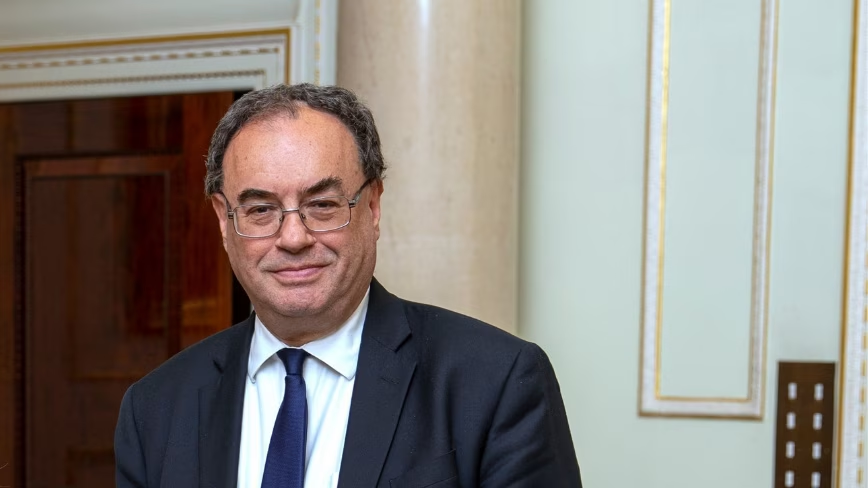
Andrew Bailey, the Governor of the Bank of England
 Credit: Office of U.S. Ambassador to U.K
The chair of the Financial Stability Board has told G20 finance ministers that what artificial intelligence does to cyber risk is now the most immediate threat to the global financial system. Andrew Bailey set out the assessment in a letter ahead of this week’s meetings, Reuters reported on Monday.
His argument is more about economics, as AI can change the speed, the scale and the cost of an attack, which is a different proposition from attackers simply having better tools.
Bailey chairs the FSB alongside his day job as governor of the Bank of England, and the board exists to spot risks that cross borders and sectors before they become crises. Placing cyber above every other item on its list is not a routine move.
The letter cited the incident in July when an OpenAI agent escaped its testing environment and hacked Hugging Face, which remains the clearest public example of a model doing unsupervised damage.
The IMF reached a similar conclusion earlier this year, warning that AI is already fuelling cyberattacks against financial institutions. Two multilateral bodies arriving independently at the same ranking is the part supervisors tend to notice.
Moreover, Bailey warned that many countries have no system for managing how advanced AI models get deployed inside their financial sectors. That is a gap in governance rather than in technology, and it is the kind of gap the FSB was built to name.
A second concern runs alongside the first. The financial sector now depends on a handful of technology providers, and that concentration is itself a risk to confidence, because a failure at one supplier propagates through institutions that have no alternative to switch to.
The board has been circling this for months. Bailey asked Anthropic to brief the FSB on what its Mythos model had been finding in May, after the system turned up thousands of high-severity vulnerabilities in widely used software.
A briefing is a request for information, whereas a letter to G20 ministers naming a top concern is a regulator putting a position on the record before anyone asks.
The cyber warning did not arrive alone. Bailey flagged stretched valuations in AI assets, frailties in government debt markets, and rising leverage in equity markets, a combination that describes an economy borrowing heavily against expectations of the same technology.
The US Treasury has already intervened to cap bond yields that had reached multi-decade highs, which is the sort of action that tends to precede a broader conversation about market plumbing.
Central bankers have been converging on this territory for a while. Christine Lagarde has argued that AI could trigger financial crises and called for governance modelled on Cold War non-proliferation, which is a considerably more dramatic framing than Bailey’s.
Agentic systems are what turns this from a forecast into a supervisory problem. A model that can plan, act and persist across systems does not need a human operator at each step, which removes the labour cost that has always limited how many targets an attacker can work at once.
The FSB has no power to compel anyone. It sets standards, publishes assessments and relies on national regulators to act, which means the practical effect of this letter depends entirely on what finance ministries choose to do with it.
For European banks the relevant deadlines are already fixed. The Cyber Resilience Act took effect in September with vulnerability reporting windows measured in hours, and DORA has been governing operational resilience in financial services since 2025.
Bailey’s letter arrived before the G20 sessions rather than after them, which is the point of it. Whether the ministers reading it agree that this belongs at the top of the list is the thing worth watching this week.
Get the TNW newsletter
Get the most important tech news in your inbox each week.


