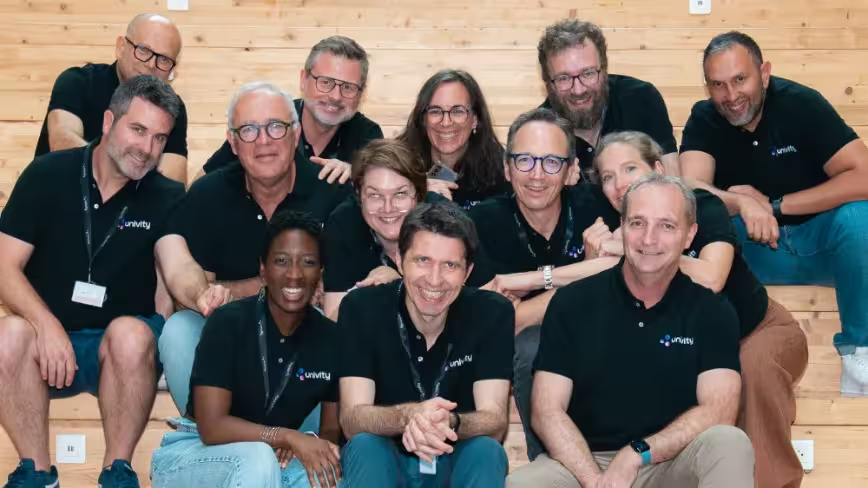
Founded in 2022 and formerly called Constellation Technologies & Operations, Univity is targeting a constellation of at least 1,600 satellites in very low Earth orbit, using telecom operators’ own 5G mmWave spectrum rather than competing with them. The Series A takes total financing to €68M across equity, debt, subsidies and contract revenues.
Univity, the Paris-based satellite connectivity startup formerly known as Constellation Technologies & Operations, has raised approximately €27 million (∼$32 million) in a Series A round led by investment firms Blast and Expansion Ventures, alongside France’s Deeptech 2030 fund managed by Bpifrance and two family offices.
According to founder and president Charles Delfieux, the company has now raised €68 million in total financing to date, including equity, debt, subsidies and contract revenues from France’s CNES space agency.
The Series A will fund the uniShape demonstration programme: building, launching, and operating two very low Earth orbit (VLEO) satellites by February 2028 to validate the company’s end-to-end 5G connectivity system before commercial deployment.
Univity’s strategic proposition is unusual in the satellite connectivity market. Rather than selling internet access directly to consumers, the model used by Starlink, which now operates more than 6,000 satellites and is the dominant player, Univity is building infrastructure for telecom operators to extend their existing 5G services from space.
The technical mechanism is the use of operators’ own 5G millimetre-wave (mmWave) spectrum for satellite-based connectivity, meaning a user’s existing phone plan and SIM card would work with Univity’s satellites just as it does with a terrestrial mast.
By operating as a neutral wholesale infrastructure provider, Univity avoids competing with its potential customers and positions itself as the space-based layer of an operator’s existing network rather than a rival service.
The VLEO altitude of approximately 375 kilometres, significantly lower than Starlink’s operating altitude of roughly 550 kilometres, is central to the company’s technical claims.
Closer proximity to Earth reduces signal latency, enables better performance for smartphones and connected vehicles, and allows for smaller, cheaper ground terminals.
The trade-off is aerodynamic drag, which depletes fuel faster; Univity’s satellites use an aerodynamic design specifically to minimise drag, allowing them to operate for approximately seven years before running out of propellant, according to Delfieux.
The company has already demonstrated the core technology. In June 2025, Univity launched its first regenerative 5G mmWave payload for space telecommunications, a technology demonstrator called uniSpark, which processes and manages the 5G signal actively in orbit rather than simply relaying it.
The Series A funds the next phase: two full prototype satellites (the uniShape mission) to be launched in 2027, demonstrating high-throughput, low-latency end-to-end 5G connectivity via VLEO satellites linked to gateway stations and ground terminals. A successful demonstration would move the company to Phase 3: deploying the uniSky constellation commercially from 2028 onwards.
That constellation ambition has grown since previous disclosures. Univity is now targeting an initial constellation of at least 1,600 satellites, up from a previously stated figure of 1,500, with a long-term plan that could scale to 3,400 spacecraft.
At full scale, Delfieux has described a manufacturing cadence of two satellites per day, launched in batches of roughly 30 approximately once a month, with a seven-year replenishment cycle. The total cost of deploying the constellation at that scale would run into several billion euros.
Univity’s funding base reflects both the commercial and sovereign dimensions of the project.
In September 2025, CNES awarded the company €31 million under France’s France 2030 national investment programme as part of a €44 million programme with additional industrial co-financing. Bpifrance’s participation in this Series A, through its Deeptech 2030 fund, reinforces the state-backed character of the project.
Stéphane Lefevre-Sauli, senior investment director at Bpifrance, described Univity’s VLEO and space-based 5G technologies as critical to helping European telcos remain competitive as space and terrestrial networks converge.
French telecommunications infrastructure operator TDF, which has signed a strategic agreement with Univity, will host and operate three gateway stations, two in mainland France, one overseas, essential for connecting the satellite system to terrestrial operator networks.
The competitive context for European satellite connectivity remains shaped by the dominance of US and Chinese players.
Starlink holds a commanding position in low Earth orbit broadband; Amazon’s Kuiper constellation is scaling rapidly; OneWeb (now Eutelsat OneWeb) serves enterprise and government markets from medium Earth orbit; and the EU’s IRIS² constellation programme is under development as a government-backed alternative.
Univity’s wholesale-to-operators model occupies a distinct niche, it is neither competing with operators nor attempting to replicate IRIS²’s institutional scope.
Whether that positioning proves defensible at scale will depend on how quickly European telcos commit to non-terrestrial network deployments, a market that remains largely in the demonstration phase across the industry.
Get the TNW newsletter
Get the most important tech news in your inbox each week.


