The startup, whose agents negotiate and pay across procurement for the likes of Unilever and Pfizer, is betting enterprises want software that acts, not software that suggests.
Freehand, a startup whose AI agents take over the grunt work of managing what large companies spend on their supply chains, has raised $75 million.
The round is co-led by Battery Ventures and NewRoad Capital Partners, with participation from Nexus Venture Partners and PSP Growth, the fund run by former US Commerce Secretary Penny Pritzker.
The company sits in a lane that is filling fast. Its pitch, that enterprises want software which acts rather than merely advises, is the same one behind a wave of agentic startups, including Pivot, which raised $40 million for an AI procurement system aimed at the same enterprise back office.
Freehand’s target is the invoice. Its agents read contracts, negotiate rates with suppliers, catch overbilling, process payments, and reconcile the results inside a company’s own ERP systems, work that has traditionally run on legacy software and large teams of outsourced staff.
The customer list is the headline claim. Freehand says its agents are deployed at Meta, Unilever, Johnson & Johnson, Pfizer, Dunkin’, and Cardinal Health, an unusually blue-chip roster for a company that only emerged from stealth in February.
One of those customers went on the record. “Freehand marks one of the first full-scale agentic deployments at Unilever,” said Matt Algar, the consumer-goods group’s global vice-president of supply chain, describing a shift “from software that assists to software that runs our supply chain.”
The numbers Freehand attaches to those deployments are its own. It says early customers have recovered 5 to 10% of spend in complex categories, completed workflows five to seven times faster, and shortened procure-to-pay cycles by more than 70%, figures that have not been independently audited.
The macro pitch is about timing. Tariffs, taxes, and tighter immigration policy are straining the outsourcing model that ran corporate supply chains for three decades, and Freehand argues the same pressure is what makes autonomous software attractive now, at a moment when even governments, Dubai among them, are pushing agentic adoption.
The market it is chasing is enormous on paper. American companies spend more than $20 trillion a year on the materials, logistics, data centres, and services behind the economy, according to the Bureau of Economic Analysis, while Freehand’s own estimate is that enterprises spend $16 billion a year on supply-chain software and a further $348 billion on the people doing what that software cannot.
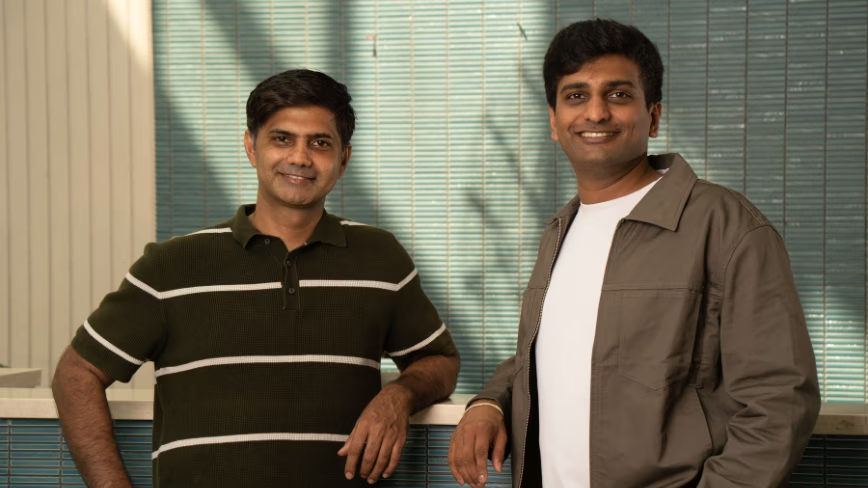
“We built Freehand to close that gap, with AI Agents that decide, act and take accountability for outcomes,” said Nitin Jayakrishnan, co-founder and chief executive, who previously founded the enterprise logistics company Pando.
The technical claim underneath is a data structure. Freehand’s core intellectual property is what it calls a Category Context Graph, a running record of every decision, transaction, and exception in a category of spend that stitches the unstructured signals in emails and documents to the structured data in enterprise systems.
The idea is that context, not the model, is the moat. Co-founder Abhijeet Manohar puts the distinction bluntly, that “the difference between an agent that acts and a chatbot that suggests is context,” and every agent Freehand deploys is meant to enrich the graph for the next one.
The plan is to widen out from there. Having started with the narrow job of checking and paying invoices, Freehand says it intends to expand across supply-chain processes and categories of spend until it becomes, in its own words, part of the infrastructure that runs global supply chains.
Battery Ventures, whose general partner Dharmesh Thakker is joining the board, has been busy in this corner of enterprise software, having also backed the procurement startup Levelpath.
Get the TNW newsletter
Get the most important tech news in your inbox each week.


