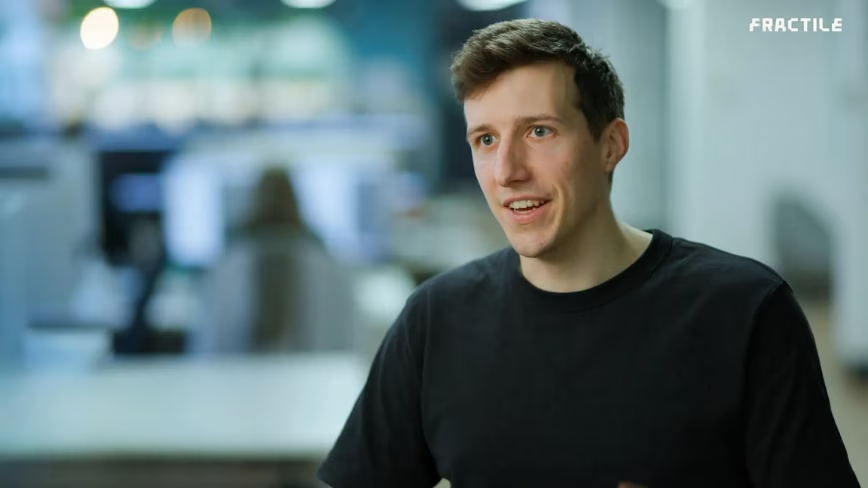
Dr. Walter Goodwin, founder and CEO of Fractile

Fractile, a British startup building chips for artificial intelligence, is in advanced talks to raise money at a valuation more than six times what it fetched three months ago, Bloomberg reported. The jump follows a deal to supply chips to Anthropic.
The company is raising funds at a pre-money valuation of $6.5bn, according to people familiar with the matter cited by Bloomberg reporters Rebecca Torrence and Dina Bass. It expects to bring in about $600mn in the round. That figure includes some money invested at a lower valuation, the people said. A pre-money valuation measures a company’s worth before the new cash lands, so the round would push the headline figure higher still once it closes.
The round has not closed, and details could change, the people said. Fractile and Anthropic both declined to comment.
Six times the May price
Fractile raised a $220mn round three months ago. The venture firms Accel, Founders Fund and Factorial Funds led that deal. It gave the startup a valuation of around $1bn, Bloomberg reported at the time. Fractile said at the time that it was raising money to bring its first AI chips to market.
The new talks value the company at more than six times that level. The Anthropic deal drives that leap. Fractile has reached an initial agreement to sell roughly $250mn of chips to the AI lab, the people said. It intends to expand that contract in the future, the people said, though the two sides have not set out how large it could grow.
The chips will not be ready for use until 2027, the people said. That gap is common in the chip business, where designs take years to reach production. The Anthropic deal is an early commitment rather than a live supply line.
Built for inference
Walter Goodwin, a roboticist from the University of Oxford, founded Fractile in 2022. The company designs systems meant to cut the time AI takes to generate answers or solve hard problems. It focuses on running existing AI models, a task known as inference.
Inference is the work a model does after training, each time it responds to a request. It is a growing share of the computing that AI firms pay for. As chatbots and agents handle more queries, the cost of running them has become a target for cheaper, faster hardware.
Fractile has also pointed to uses beyond chatbots. The startup has said its chips could suit AI systems that discover new drugs and materials, Bloomberg reported. Those tasks lean on the same kind of fast, repeated computation. Fractile has framed inference speed as its core pitch, arguing that faster responses matter as AI moves from single answers to long chains of reasoning.
Chasing Nvidia’s market
Fractile is one of several newcomers designing chips tuned for AI inference. They are trying to claim parts of a market dominated by Nvidia.
The challengers include Cerebras Systems, the wafer-scale chipmaker, and venture-backed startups such as Etched.
The field has drawn heavy funding this year. Etched raised $700mn last week at a $21bn valuation. Groq closed a round this month at $3.5bn, with Nvidia itself joining. Each is betting that specialised inference chips can undercut Nvidia’s general-purpose processors on cost and speed. The wager is that a chip built for one job can beat a flexible one at that job. Investors have poured money into the idea, even though Nvidia still supplies most of the industry’s AI computing.
A British challenger
Fractile’s British base is notable in a race led by American firms. It sits alongside a small cluster of UK chip startups pushing against Nvidia, including OLIX, which raised money this month at a $3.3bn valuation. Founders Fund, the firm co-founded by Peter Thiel, is among Fractile’s backers, a sign of American venture money flowing into British hardware. The country’s AI-hardware scene has grown as investors chase the next supplier to the AI boom.
Why the labs are spreading their bets
The Anthropic tie also fits a wider pattern. Big AI labs are spreading their chip bets beyond Nvidia to control cost and supply. The shortage of top-end processors has pushed them to look for their own silicon and to back outside designers. Anthropic has confirmed it is designing its own custom chips, and it has struck compute deals across several suppliers. Backing a startup like Fractile gives it another route to the hardware its models need. Anthropic has grown fast this year, and its demand for computing has climbed with it. Locking in a chip supplier early, even one whose product is years away, hedges against a market where Nvidia processors are scarce and costly.
For Fractile, the raise would mark a sharp change in fortune in a matter of months. The company was a roughly $1bn startup in May, still working to get its first chips out. Now it is fielding talks at $6.5bn. The change rests on a single customer deal and the market’s appetite for Nvidia alternatives, rather than on shipped hardware. A customer deal and a fresh round would place it among the more richly valued names in AI hardware, well before its chips ship.
Whether that value holds will depend on delivery. The chips will not ship until 2027, and the round has yet to close. What the talks show is how quickly a supply deal with a major AI lab can reprice a chip startup, and how much money is chasing an alternative to Nvidia.
Get the TNW newsletter
Get the most important tech news in your inbox each week.


