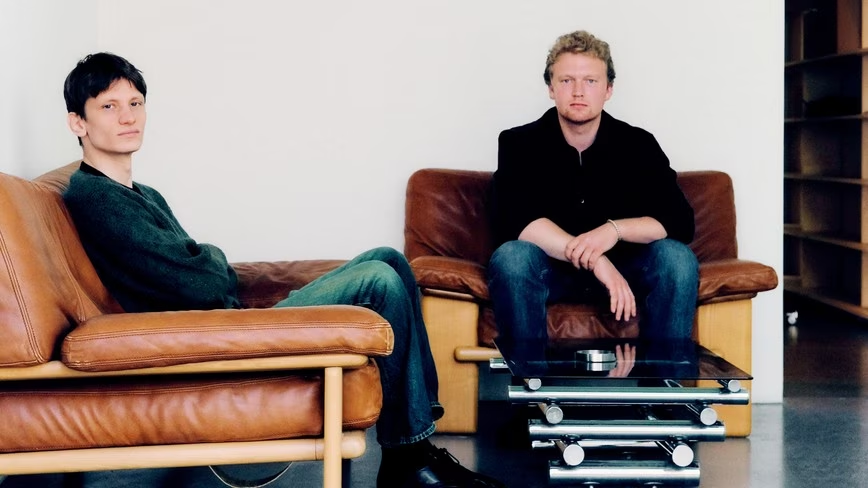
F13 co-founders Ingimar Tomasson (left) and Gregory Janik.
 Credit: F13
F13, an AI company that trains models to generate vector graphics, has come out of stealth with a $5M pre-seed round led by Credo Ventures and Point Nine Capital.
Angel investors, including Carles Reina of Baobab Ventures and Jack Richardson of Mainframe, also took part.
Images described using vector graphics are made up of shapes and coordinates rather than pixels, which means they can be enlarged without loss of quality and have individual lines altered.
The format is used by designers and engineers for charts, diagrams, maps, and brand assets when accurate proportions are more important than an eye-catching image.
The company states that popular image models can generate creative images, but they cannot reliably produce a chart that matches the data or a diagram with the correct proportions, and it often takes them minutes to render a single visual.
The model associated with F13 will accept text, images, or existing graphics as prompts and produce output that adheres to the user’s design specifications and remains fully editable, allowing a person to improve a draft rather than start from scratch.
Moreover, the company affirms that its proprietary technology enables the model to better understand 2D space and adds that, in its own tests, it outperformed general-purpose image and code models developed by major AI labs.
Early access customers can start using it now via an API and a web app to create and edit shareable designs.
Supported materials include charts, editorial infographics, scientific and teaching diagrams, maps, and presentation layouts that align with the company’s brand. A public launch is scheduled for later this year, and the company’s website offers a waitlist.
The money will enable the first model to go to market and fund additional computing power, data, and staff as F13 develops models for more complex design tasks.
Gregory Janik, the company’s chief executive, and Ingimar Tomasson, a machine learning researcher who trained as a mathematician at UCL, first met at the edtech company Knownunity while working on the product’s visuals.
“We didn’t want to build another model that’s impressively expressive and quietly wrong. We create visuals that are not only beautiful to look at, but are true to the brief, with the correct proportions, accurate data, and precise layouts,” said Gregory Janik.
Janik says he has two exits behind him, including a drone company that was later acquired by Helsing.
The team also includes researchers formerly at Meta and Porsche, and designers who have worked for Versace, Gucci, and Nike.
“Our first cheque came from a chance conversation with an investor, back when F13 was nothing more than an idea. We raised the rest of the round without ever putting together a pitch deck,” continued Janik.
Pawel Chudzinski, a partner at Point Nine, said software engineers now hand much of their work to AI agents while designers still work by hand, and that he expects F13 to change that.
Get the TNW newsletter
Get the most important tech news in your inbox each week.


