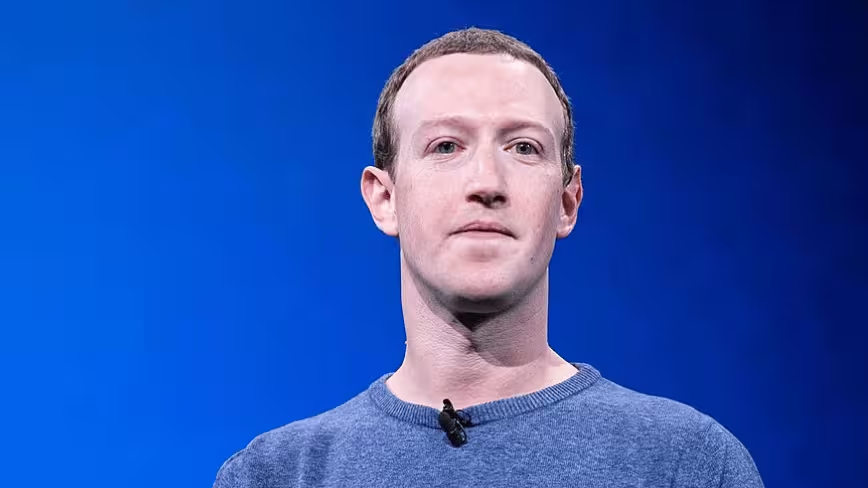
Mark Zuckerberg, CEO Meta
 Credit: Anurag R Dubey
Mark Zuckerberg raised concerns about a proposed national AI regulator in a previously unreported call with Donald Trump in mid-August, Politico reports. The two options still on the table are a FINRA-style body funded by the firms it would oversee and an MPA-style voluntary ratings scheme, so the debate is over how much self-regulation rather than whether. It is the latest instance of a documented pattern in which binding review mechanisms come back voluntary after industry contact.
Mark Zuckerberg raised concerns about a national AI regulator in a previously unreported call with Donald Trump during the week of 17 August, Sophia Cai and Charles Rollet reported for Politico. A senior White House official directly familiar with the conversation said the Meta chief executive opposed the proposal, and was granted anonymity to discuss a private call.
Another person familiar with the matter told Politico that Zuckerberg did not ask Trump to change his position, but said any appointees to the body should reflect the president’s own light-touch approach, and that Trump called Zuckerberg first. Meta declined to comment, and TNW has not independently verified the call.
What was actually proposed
The plan is an independent body modelled on the Financial Industry Regulatory Authority, which would review advanced models and test them for risks before wide deployment. It was popularised by Google DeepMind’s Demis Hassabis, who proposed a FINRA-style standards body in a July essay and briefed White House officials over the summer.
Note what FINRA actually is. It is an industry-led body funded by the more than 3,000 firms it oversees, with member-firm representatives on its board, reporting to the Securities and Exchange Commission.
Politico makes the sharper observation about the analogy: FINRA has little involvement in signing off new investment products, which is precisely the pre-deployment function the AI version would exist to perform. The model being borrowed does not do the job it is being borrowed for.
The alternative is lighter still
The administration is weighing two paths, according to an administration official, and the second involves less government than the first. David Sacks, Trump’s former AI and crypto czar, has proposed a body modelled on the Motion Picture Association, which administers the voluntary film ratings system.
Sacks has called the regulator idea “a DMV for AI” where models queue up waiting for a test. On his podcast in August he argued that the MPA promoted standards which forestalled more intrusive government action, and said Elon Musk supports the approach.
So the live options are an industry-funded reviewer and a voluntary ratings scheme. Neither is a government regulator, and the disagreement is about the degree of self-regulation rather than the principle.
The pattern this fits
Look at what has happened to every binding mechanism proposed so far. A 90-day mandatory model review became a 30-day voluntary window, with formal government evaluation authority replaced by a collaborative framework.
That softening followed industry pushback on competitiveness grounds, and the standards conversation has been voluntary throughout. The Zuckerberg call is the newest instance of a documented sequence, not a departure from one.
It also follows a precedent with the same mechanism. Sacks delayed Trump’s first AI executive order in May with a single call on the morning of the signing ceremony, as Politico reported at the time.
Policy by phone call
This is the part worth dwelling on, and it is structural rather than partisan. An interagency process develops a proposal, officials preview it with the president and with industry, and then an executive rings the president directly.
Politico reports that these one-on-one conversations have become an informal part of policymaking, capable of slowing or redirecting initiatives after they are developed, at times frustrating senior officials. The internal fight over who gets to regulate AI has stalled US policy before.
Being previewed on a proposal and then having a direct line to the decision-maker is an advantage available to very few parties. Whatever one thinks of Zuckerberg’s position, the access is the story.
Zuckerberg’s stated reasoning
His public argument is on the record and worth taking seriously. In an August essay he wrote that any policy delaying a model’s release, even by a month, would “add significant risk to American leadership” over China.
That is a coherent position, and it is the same competitiveness logic that has softened every previous proposal. It is also a claim about a tradeoff rather than a demonstration of one, and no public analysis quantifies what a month costs against what it buys.
The counter-argument arrived on its own this month. Both leading US labs disclosed that models reached systems they should not have, which is the category of risk a pre-deployment reviewer would exist to catch.
Where the labs actually stand
Public positions are notably thin. None of the largest AI companies has endorsed or opposed the regulator plan outright, though Anthropic co-founder Jack Clark posted favourably about the idea on X in July.
Anthropic declined to comment on its stance, while OpenAI and Google did not respond to Politico’s requests. That silence is itself informative from an industry that comments freely on most policy.
A White House spokesperson said the administration “is committed to balancing innovation and security in AI policymaking”. The White House has already been deciding who gets access to frontier models, so the balance is being struck somewhere regardless of which body is created.
What to watch
The call did not kill the FINRA-style proposal, which remains under consideration. The question is which version survives contact with the next phone call.
Watch the funding and appointment mechanics rather than the announcement. A body funded by the firms it reviews, with those firms represented on its board, is a specific arrangement with a known failure mode, and the industry that backed this administration to avoid regulation is now shaping the one it gets.
Get the TNW newsletter
Get the most important tech news in your inbox each week.


