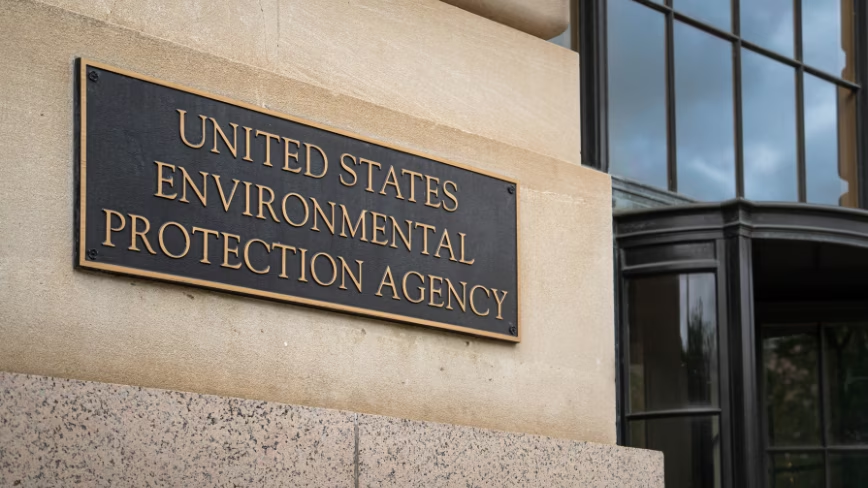
United State Environmental Protection Agency
 Credit: Lucas via Shutterstock
The US Environmental Protection Agency has proposed making public disclosure of air pollution from minor sources voluntary rather than mandatory, a change that would cover the diesel generators clustered around data centres.
It follows the same direction as the exemptions the administration has already granted, having excused data centres and rockets from parts of environmental law earlier this year.
Under the Clean Air Act, facilities classified as minor polluters currently have to disclose their emissions to the public through state agencies, and the proposal would leave that decision to state and local officials instead.
How data centres come to be minor sources at all is the part worth understanding. Operators frequently split permits across individual generators or turbines, so that no single permitted unit crosses the threshold that would trigger stricter federal review, even where hundreds of them sit on one campus.
Northern Virginia shows what that looks like at scale. The region holds roughly 10,500 diesel generators at data centres with a combined capacity approaching 27 gigawatts, which is a fleet of fossil generation assembled without ever being permitted as a power station.
Amazon’s minor source permits in Northern Virginia alone allow backup generators to emit up to 4,200 tons of nitrogen oxides a year, according to Sierra Club analysis, a figure it compares to a mid-sized coal plant. Those permits are legal precisely because each unit is assessed on its own.
Nitrogen oxides are the primary concern because they form ground-level ozone, though the emissions also include carbon monoxide and heavy metals. Between them, the facilities produce all six criteria pollutants the EPA associates with asthma, heart disease, and cancer.
“Every single person in this country deserves clean air, and the EPA’s plan opens the door to silence communities concerned about pollution,” said Jeremy Fisher, a senior adviser at the Sierra Club.
The practical objection is that without disclosure, residents cannot establish what they are breathing, which makes both legal challenges and local campaigns considerably harder to mount.
Joe Goffman, a former EPA assistant administrator, put the shift in blunter terms. The message to communities, he said, is that “you all may have thought this was an ironclad promise, but it no longer is”.
Disclosure is also doing more work than it appears. Minor-source permits are rarely challenged at the point of issue because they are individually small, so the public record created afterwards is often the only way anyone assembles the cumulative picture across a cluster of sites.
The agency has published a dedicated Clean Air Act resource page for data centre developers under administrator Lee Zeldin, whose stated aim is to make the United States the AI capital of the world, alongside guidance on backup generators, a July clarification covering islanded generators and the Acid Rain Program, and a proposed redefinition of when construction is deemed to begin.
The regulatory actions were posted on 8 July, a public hearing was held on 22 July, and the comment period closed on 21 August. What happens next is a decision rather than a consultation.
The contrast with Europe is stark enough to be worth stating. Brussels has been telling Big Tech to align data centres with climate goals or stay away, Denmark has paused grid connections outright, and Spain is drafting rules that would make grid access conditional on hourly renewable matching.
Europe is not obviously better at this, only differently exposed. Its constraint has been electricity and, increasingly, water, whereas the American constraint is local air quality, largely because US facilities lean far harder on on-site diesel generation to cover grid gaps.
That difference is the reason this rule matters beyond the states affected. Backup generation is what allows a data centre to be built faster than the grid serving it, and a disclosure regime that becomes optional removes the main mechanism by which anyone downwind finds out.
Get the TNW newsletter
Get the most important tech news in your inbox each week.


