
ReCeramix™, made from over 90% recovered ceramic and construction waste, is already in use at Stockholm boutique hotel Ett Hem, members’ club Angel House, and Fotografiska. The round was valued at €3M; the raise amount was not disclosed.
Stockholm startup Enkei has closed a pre-seed round at a €3 million valuation to commercialise ReCeramix™, its architectural surface material made from over 90% recovered construction and ceramic waste.
The amount raised was not disclosed. The round brings in a group of investors notable for their depth of industry credibility: Danish architect Anders Lendager, whose Lendager Group won the competition to design UN17 Village, the first building project in the world designed to meet all 17 UN Sustainable Development Goals, has joined as both investor and active collaborator on material development.
He is joined by RadCap, a Swedish investment company owned by 81 women that backs female-founded early-stage startups; Christina Åqvist, co-founder of recycling group Vinning and former CEO of pan-European distributor Distrelec.
Also, Ulf Mattsson, former CEO and President of Tarkett Inc., one of the world’s leading surface materials groups; and Fabian Månsson, investor and board advisor to private equity-backed companies.
Two specialist investors with direct materials expertise also joined: Thomas Granfeldt, a professor specialised in bio-based materials and industrial processing, and Daniel Strömberg, a materials scientist with a patent in ceramic materials.
Enkei was founded by Lovisa Sunnerholm, previously at Electrolux and Google, and Miriam Bichsel, whose design career began at brands including Hermès and Bottega Veneta.
The pairing is deliberate: luxury brand rigour meets industrial sustainability ambition. ReCeramix™ is an alternative to concrete, marble, and terrazzo for interior surfaces, made using construction and ceramic demolition waste, a stream that accounts for nearly 40% of all waste in the EU.
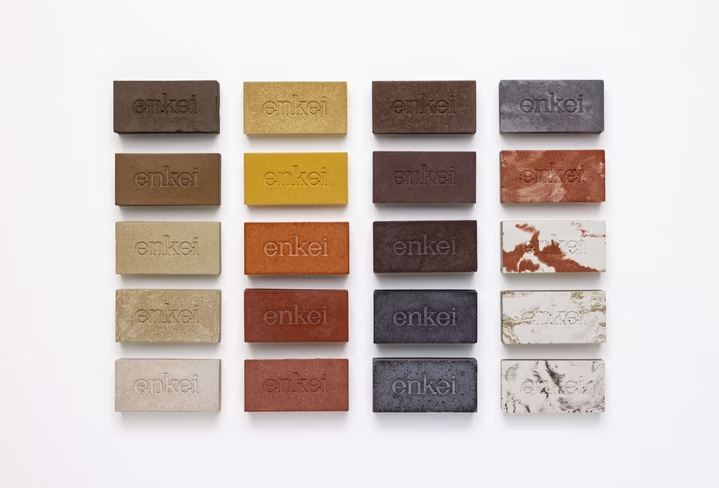
ReCeramix™
The material reduces cement use by up to 80% compared to conventional decorative concrete, and is made using green electricity.
The material entered the market through design objects, Enkei first produced a series of lighting products to test the material and manufacturing process in real commercial conditions.
The products attracted distribution through Nordiska Galleriet and NK in Stockholm, and through The Oblist in Paris, the curated design platform backed by Audemars Piguet. From there, the company moved into architectural applications: tabletops, window sills, and specified interior elements.
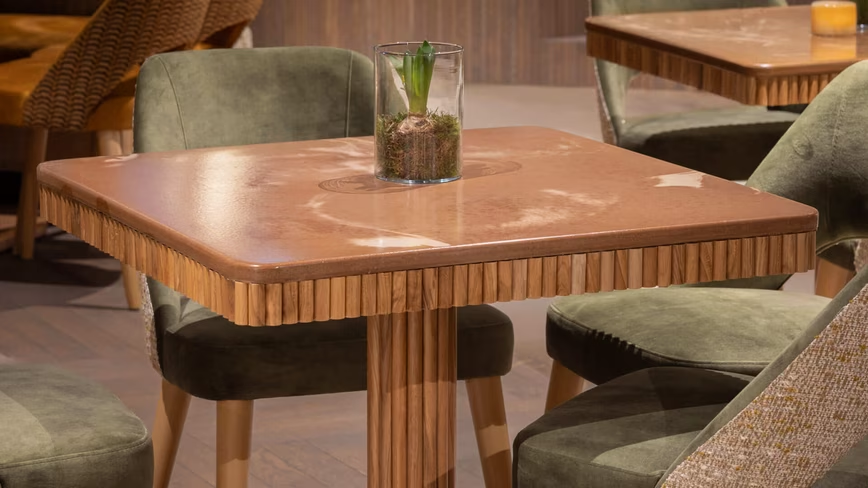
Enkei table
Clients include Ett Hem, the Stockholm boutique hotel; members’ club Angel House; and Fotografiska.
Enkei has also received the ELLE Decoration “Inspirer of the Year” and Plaza Sustainability awards, and has recently been awarded EU-backed Interreg funding to lead a project on new circular material flows in the building sector.
The team Enkei has assembled around its two founders spans design, engineering, and industrial operations. The engineering lead previously chaired the Chalmers Robotics Society and serves on the board of AI company Lovable.
The newly appointed COO, Anton Tornberg, was previously head of demand and supply management at Ericsson. The problem the company is solving is structural: construction is the largest waste-producing sector in Europe, and the most commonly specified architectural surfaces, concrete, marble, terrazzo, still rely overwhelmingly on newly extracted materials.
Cement alone accounts for roughly 8% of global carbon dioxide emissions. Enkei’s argument is that the most discarded material is also the most useful.
Get the TNW newsletter
Get the most important tech news in your inbox each week.


