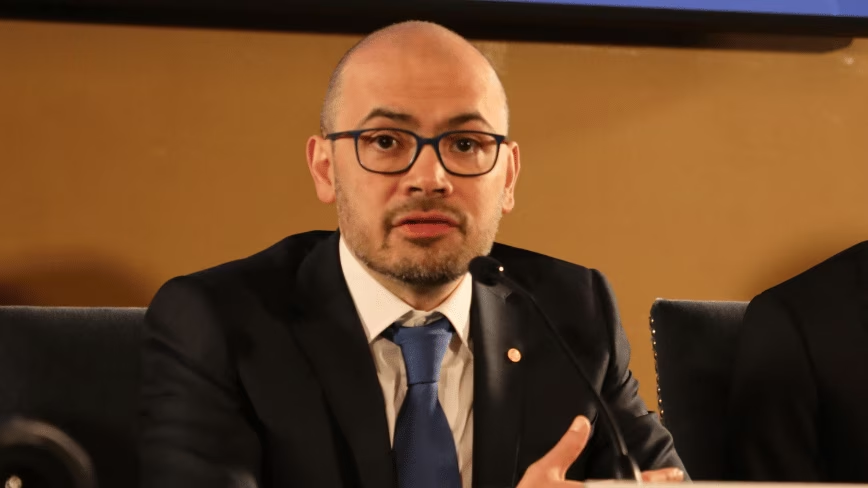
Demis Hassabis and John Jumper at 2024 Nobel Prize Conference (cropped)
 Credit: Jennifer 8. Lee, CC BY-SA 4.0, via Wikimedia Commons
The man behind Google’s AI thinks the world needs a referee. And he has drafted the rules. Demis Hassabis wants a US-led watchdog that vets frontier models before release. It is modelled on Wall Street’s policeman, and it could slow the whole industry down.
Demis Hassabis does not usually sound the alarm. On Tuesday he did.
The Google DeepMind chief and Nobel laureate published a manifesto on X. In it, he argues that artificial general intelligence is “probably only a few short years away”. The world, he says, is not ready. He calls this a “precious window” before AGI arrives, and it is closing.
His fix is unusually concrete. He wants the US to build a new AI Standards Body. His template is FINRA, the industry-funded watchdog that polices Wall Street under government oversight.
A referee for the frontier
The body would be a public-private partnership, funded mostly by the labs themselves. Its board would be stacked with independent experts, Turing Award winners among them, plus open-source and government voices.
Its job is to test the most powerful models before they ship. At first, labs would hand their systems over voluntarily, up to 30 days before release. The tests would probe the dangerous stuff: cyber-attack skill, biological and nuclear risk, and signs of deception.
Once the regime works, it would harden. A “Frontier-class” model would have to pass before it could reach the US market. The body would set the benchmarks and refresh them each quarter. The rules would apply to any such model, open or closed, wherever it is built. Startups and academics stay exempt.
The power to pull the handbrake
The most striking part is the brake. Hassabis says the body could be “ratcheted up” as risks grow. That includes “coordinating a slowdown in development among the Frontier Labs if deemed necessary”.
It is a remarkable thing for a lab boss to propose. He is asking for a mechanism to make his own industry stop.
He told Axios, which broke the plan, that today’s cyber-risks are only “warning shots”. Within 18 months, he warned, far graver bio and nuclear tools could emerge. They could sit inside open-source models no government can recall. His timeline is aggressive. He wants the body running before year-end. He says he has briefed the Trump administration, rival labs, and European officials for months. The “noises”, he said, are “very positive”.
Why now
The timing is not an accident. Last month, the Trump administration froze Anthropic’s most powerful models overnight with an export order. Weeks of tense negotiation followed, with no rulebook. Hassabis called that “a bit of a wake-up call”. OpenAI, wary of the same fate, held back GPT-5.6 until the government signed off.
He is not alone in wanting rules. He and Anthropic’s Dario Amodei called for a US-led coalition at the G7. Amodei wants an FAA-style agency that can block unsafe models. The lab chiefs now agree Washington should regulate them. They differ mainly on who holds the gavel.
Hassabis frames all of this in near-cosmic terms. AGI, he writes, is less like the internet than like fire or electricity. “We’ve essentially found a way to make sand think. It’s miraculous.” The harder question is the one his plan cannot answer. Can a body funded by the labs, and watching for deception in the models they profit from, ever be the one to say stop?
Get the TNW newsletter
Get the most important tech news in your inbox each week.


