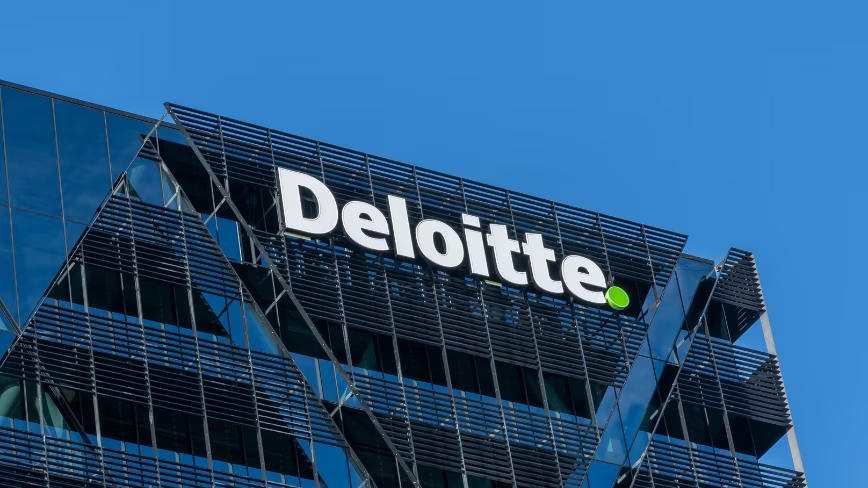
Deloitte office building in Wellington, New Zealand.
 Credit: JHVEPhoto via Shutterstock.com
Deloitte has agreed to pay $21.5M to settle a US Justice Department investigation into its diversity practices, without admitting liability.
The firm is one of the largest technology consultancies in the world as well as an accountancy, and it sits inside the same enterprise AI and systems integration market that has drawn Indian IT firms into forward-deployed engineering and AI labs and into buying consultancies outright.
The allegations concern how business units set and used internal targets. The department claimed Deloitte units tracked demographic goals monthly, and evaluated partners, principals, and managing directors partly on their contribution to workforce composition goals aimed at Black and Hispanic representation.
The DOJ’s position is that those objectives fed into promotion decisions. Deloitte denies discriminatory conduct, and the settlement agreement states explicitly that it does not constitute an admission of liability.
“Deloitte was pleased to resolve the matter to avoid the cost and distraction of protracted litigation,” the agreement records, which is the standard formulation for a company settling something it says it did not do.
The legal route is the part worth understanding. The case came through the DOJ’s Civil Rights Fraud Initiative, established last year to challenge diversity policies using civil anti-fraud law rather than employment discrimination statutes.
Anti-fraud law applies to representations made to the federal government, which means the exposure attaches to being a federal contractor rather than to employment practice in general, and it carries the treble damages that make settlement attractive.
The American Alliance for Equal Rights, founded by the affirmative action opponent Edward Blum, filed companion claims under the False Claims Act and will receive $ 4.3 million of the settlement. Roughly a fifth of the payment therefore goes to the organisation that brought the claims rather than to any affected individual.
That is how the False Claims Act works by design, since its whistleblower provisions reward those who surface fraud against the government. Applying it to diversity programmes is the innovation here, and it creates a financial incentive for further filings.
Deloitte’s federal work is the reason this bit is expensive. The firm holds substantial US government contracts across technology modernisation, cloud migration, and systems integration, and a company that depends on federal revenue has limited appetite for testing a novel theory in court.
What makes the theory novel is the causal chain it requires. A contractor certifies compliance with anti-discrimination requirements, and the government’s argument is that internal demographic targets made those certifications false, which converts a disputed employment practice into an alleged fraud on the federal purse.
The settlement lands in a broader retreat. Large numbers of American companies, technology firms prominently among them, have scaled back or renamed diversity programmes since the executive orders targeting federal contractors, generally without waiting to be investigated.
Other large consultancies will be reading the agreement closely. Accenture, KPMG, and their peers run comparable federal practices and, until recently, comparable internal reporting, and a $21.5mn resolution establishes a price for the same exposure.
For firms operating across the Atlantic, there is a genuine tension developing. European employers face positive obligations on pay transparency and gender balance under EU directives, while their American operations now face legal risk for tracking the same categories, and a global consultancy has to satisfy both.
Consultancies are unusually exposed to all of this. Their business is selling professional judgement to clients, including the government; their partners are promoted on criteria the firm controls and documents, and both of those things are now discoverable in a way they were not two years ago.
Deloitte has not detailed what it will change in practice. The settlement resolves the investigation, though it does not resolve the underlying question of which internal measurements a federal contractor may now safely keep.
Get the TNW newsletter
Get the most important tech news in your inbox each week.


