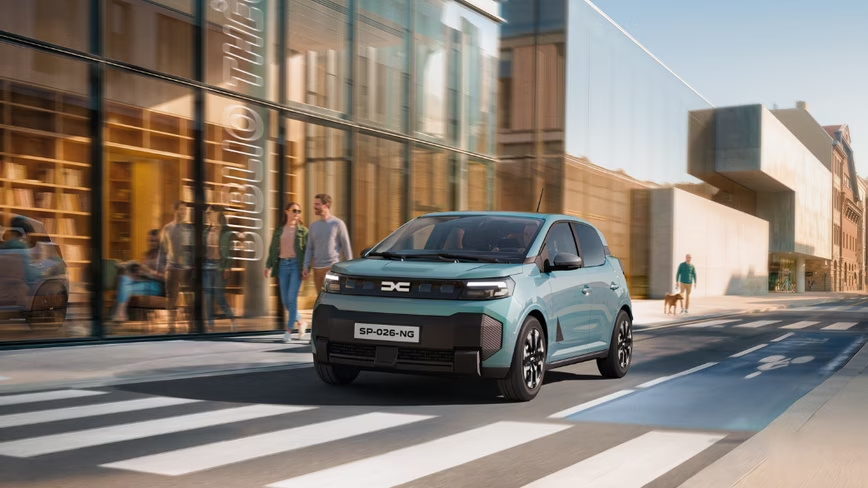
The second-generation Dacia Spring, built at Renault’s Novo Mesto plant in Slovenia.
 Credit: Dacia
Dacia has revealed a second-generation Spring built at Renault’s Novo Mesto plant in Slovenia, and the entire range is priced below €20,000 before government subsidies.
The first-generation car, which sold more than 210,000 units across forty countries since 2021, was built in China.
That relocation is the story, and the press materials do not mention it once. Dacia says only that the Spring is “made in Europe” and that being built in Slovenia makes it eligible for the EV purchase incentives many EU member states operate.
The European Commission imposed countervailing duties on battery EVs built in China in October 2024, and several national subsidy schemes have since been rewritten to favour vehicles assembled in Europe. A Chinese-built Spring was becoming an expensive proposition on both counts.
What makes the economics work is a new platform. The Spring is the first Dacia on Renault Group’s RG-EV small architecture, and the first to go through the group’s new development programme, which the company says cut the design cycle to under two years and reduced development costs with it.
The car is 15cm longer and 18cm wider than its predecessor, at 3.85m by 1.74m, and has grown a 337-litre boot that Dacia claims beats some cars a segment above.
The specification is deliberately modest and mostly honest about it. A 60kW motor produces 80hp and 175Nm, enough for 0 to 100 km/h in 12.1 seconds and a top speed of 130 km/h.
The LFP battery holds 27.5kWh of usable capacity for up to 250km on the WLTP combined cycle, and the car weighs from 1,212kg, which is what delivers consumption of 12.7kWh per 100km, among the lowest figures on the market.
The chemistry choice is not incidental either. LFP uses iron and phosphate rather than the nickel and cobalt in higher-density cells, which are both more expensive and more exposed to supply chains Europe does not control.
It is the same reasoning that has been pulling the industry towards LFP for entry-level cars, and it is the reason Europe’s battery strategy keeps running into China even when the assembly line is in Slovenia.
Charging is where the budget shows. A 6.6kW onboard AC charger is standard, which means 15% to 80% takes nine hours on a domestic socket, five hours 40 on a heavy-duty one, or two hours 55 on a 7kW wallbox.
The optional Charge Pack adds an 11kW AC and 50kW DC charger, bringing the DC figure down to 28 minutes, and brings vehicle-to-load with it, so the car can run a coffee machine or charge an e-bike.
The plant has built small Renault-group models for decades and sits inside the EU customs union, so a Spring assembled there faces none of the duties a Chinese-built one does and counts as European for every subsidy scheme that asks.
Slovenia also offers a labour cost well below France or Germany, which is the part that lets a sub-€20,000 sticker survive the move west.
Dacia says first-generation owners drove an average of 34km a day and charged at home three quarters of the time, which is the usage pattern the whole car is designed around.
Two trim levels, Expression and Journey, share the same motor, battery and charger. Both get a 7-inch digital cluster; Journey adds a 10.1-inch touchscreen with wireless CarPlay and Android Auto and eight years of connected navigation.
The competitive context is unforgiving. Chinese brands have been taking record share of the European market, and cars such as Geely’s $15,000 EX5 are setting the price expectation that a European-built A-segment car now has to meet.
Dacia’s answer is a car that is cheaper than the one it replaces, built inside the tariff wall, and eligible for the subsidies that wall was designed to protect.
The Spring is the first of four all-electric Dacias promised by 2030.
Get the TNW newsletter
Get the most important tech news in your inbox each week.


