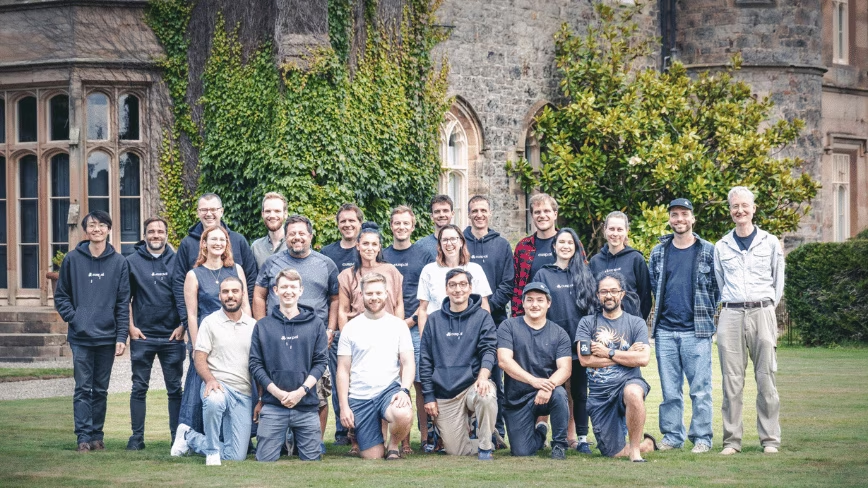
 Credit: CuspAI
A two-year-old British AI lab wants to build the search engine for materials that do not exist yet. On Monday it gathered an unusual crowd to help.
Cambridge-based CuspAI launched the AI Materials Foundry, a coalition of more than 45 companies and research labs, Reuters reported. The founding partners include Nvidia, Meta, Samsung, Hyundai Motor Group, Applied Materials, Tokyo Electron and Lam Research.
The idea is to pool their data, labs and computing power to design new materials faster. Nvidia is supplying the computing muscle, and Meta’s research lab is contributing a model built to simulate atoms.
The launch came with money to match. CuspAI confirmed a $450m (€385m) Series B led by Kleiner Perkins and NEA, with backing from Jeff Bezos’s investment fund. The round values the company at $2.6bn. TNW first reported in June that the raise was in the works, then led by Bezos’s family office and not yet closed.
The materials bottleneck
CuspAI’s pitch is that progress is stuck on chemistry. “The world needs materials that don’t yet exist,” co-founders Chad Edwards and Max Welling wrote. Without them, they argue, the next 50 years of industrial progress hit a wall.
Its platform, MIRA, runs the full discovery cycle. It generates candidate materials, simulates them, plans how to make them, then coordinates lab tests to check they work. The aim is to compress work that normally takes years.
Take its work with the Finnish chemicals firm Kemira. CuspAI screened 300 trillion possible molecular structures and returned 20 validated candidates, it said. That search had taken Kemira years. CuspAI says it ran it in six months. Its edge, it argues, is data. It has secured exclusive AI-training rights to some of the field’s foundational chemistry databases.
One target is close to the chip industry’s heart. CuspAI wants to cut, or remove, the rare metals that chipmakers depend on, such as iridium and ruthenium. It is chasing gains in clean energy, batteries and even cleaner water too.
A British sovereignty play
The deal doubles as a win for the UK’s tech ambitions. CuspAI is the fourth company backed by the government’s Sovereign AI Venture Fund, the Guardian reported, a scheme that invests in early-stage British firms to help them scale.
The fund only backs companies with a UK head office and British founders. It typically puts in between £1m and £10m, though the government did not disclose its stake here.
“CuspAI is putting the power of AI to work to help us tackle some of the biggest challenges facing the UK and the world,” said Liz Kendall, the science and technology secretary. For a government keen to keep home-grown AI at home, a $2.6bn Cambridge company is a useful poster child.
Star power
CuspAI has stacked its bench. It has hired John Giannandrea, a former Apple and Google executive, to help set up its US operations. Abhi Talwalkar, an AMD board member and chair of Lam Research, joins its advisory board.
Its advisers include the Nobel laureate Geoffrey Hinton and Martin van den Brink, the former president and chief technology officer of chip-equipment maker ASML. The company is opening a Singapore office and adding staff in Cambridge, Amsterdam, Berlin, Tokyo and the US.
The backers frame the work as a shift in how science gets done. “CuspAI built a search engine” for undiscovered materials, said Josh Coyne of Kleiner Perkins. He argued its edge is designing materials that can actually be built, not just ones a model can dream up.
Not every partner expects an easy ride. Tokyo Electron, a big chipmaking-tool supplier, said the Foundry “could disrupt the current business model in the industry.” The bet sits alongside a wider push to point AI at hard scientific discovery, from drugs to chemistry.
The Foundry now has to prove the models can find materials that survive contact with a real lab. Its 45-plus partners, and its investors, are betting they will. Some of them, like Nvidia, have joined similar coalitions before.
Get the TNW newsletter
Get the most important tech news in your inbox each week.
Also tagged with


