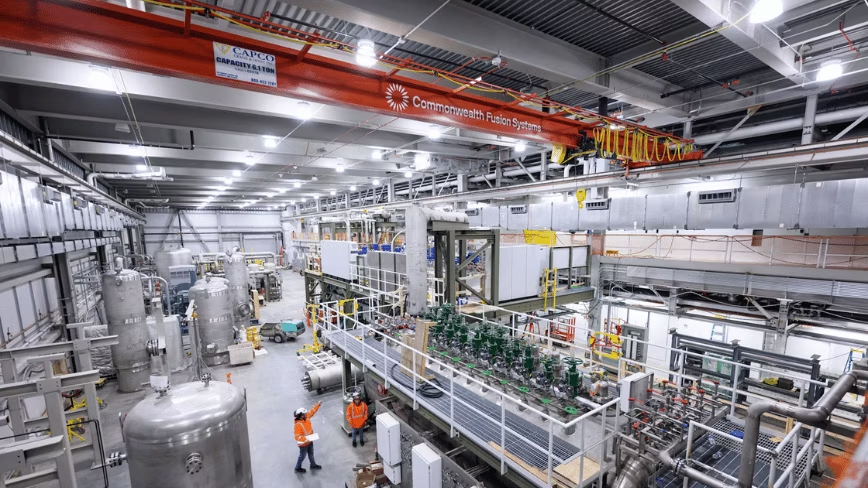
 Credit: Commonwealth Fusion
The AI boom needs colossal amounts of electricity. That has turned fusion, forever mocked as “30 years away,” into one of the hottest bets in tech. The best-funded player just raised another $1 billion.
Commonwealth Fusion Systems, based in Massachusetts, said the round takes its total to $4 billion, roughly 30% of all the money ever raised for fusion. It is the company’s biggest round since a $1.8 billion raise in 2021. The new backers are institutions: pension funds, sovereign wealth funds and infrastructure investors, which CFS declined to name.
The timing is not subtle. Tech firms are buying electricity at almost any price to feed AI data centres, and clean, round-the-clock power is scarce. CFS has already sold half the output of its first plant to Google. Fusion’s promise of limitless carbon-free energy suddenly has a rich, impatient customer.
The tell: a Moderna banker in the CFO seat
A quieter move may matter more. This week CFS hired Lorence Kim as chief financial officer. Kim ran finance at Moderna and took the biotech public in 2018. “Fusion today is where mRNA was a decade ago,” he wrote: “scientifically real, commercially yet-to-be-proven, and closer than the consensus thinks.”
TechCrunch reads the hire as a sign CFS could go public within two or three years, it reported. CFS says an IPO is not necessarily in the works. Either way, the race is on: rival General Fusion listed through a SPAC this month, and TAE Technologies is merging with Trump Media.
The science still has to work
The money is ahead of the physics. CFS builds tokamaks that use powerful magnets to squeeze plasma hot and dense enough to fuse. Its demonstration reactor, SPARC, aims to hit scientific breakeven in 2027, the point where a reaction gives off more energy than it takes to start. Only one machine, at Lawrence Livermore, has ever managed it.
In parallel, CFS is building ARC, a commercial plant in Chesterfield County, Virginia. It has applied to plug into PJM, the largest US power market, and lined up buyers: Google for 200 megawatts, and Italy’s Eni for more than $1 billion of electricity. It hopes to reach the grid in the early 2030s.
Plenty could still go wrong. Breakeven is not electricity, first-of-a-kind plants slip, and the 2030s are a long time to burn cash. But the AI data-centre boom is minting power buyers, and rival fusion startups are raising fast. CFS is betting the window to raise, and maybe to list, is open now, and it does not want to miss it.
Get the TNW newsletter
Get the most important tech news in your inbox each week.


