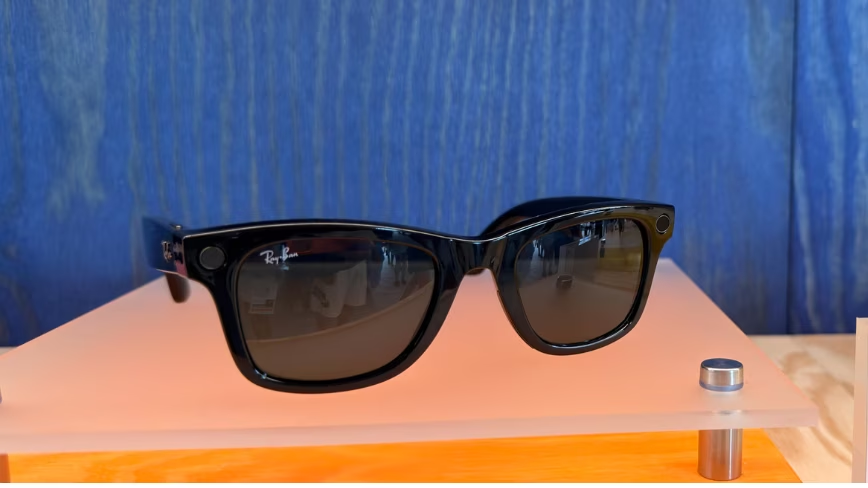
Meta Ray-Ban Smart Glasses
 Credit: TNW
Alibaba put its Qoder coding agent into smart glasses on 3 September, and Tencent put its WorkBuddy office agent into co-branded Rokid frames the day before. China’s smart glasses code of conduct, a voluntary convention issued in June, asks manufacturers for clear indicators when a camera or microphone is recording. Those rules regulate an act of recording, while the products being shipped are agents that listen continuously by design.
Alibaba’s agentic coding platform Qoder added a glasses edition on 3 September, connecting first to Qwen and Rokid frames. A developer can dispatch a coding task by speaking, without opening a phone or touching a screen.
Tencent moved the day before, putting its WorkBuddy office agent into co-branded Rokid glasses. J.D. Capelouto reported the pattern for Semafor, alongside the government’s new industry code of conduct.
What the two products actually do
These are not camera accessories. Tencent’s pairing lets a wearer instruct their desktop and cloud services by voice, with the agent tied to what the glasses can see from the wearer’s viewpoint.
Alibaba built its version around full-duplex speech, so the wearer interrupts, chases progress and adds requirements mid-task. Qoder’s glasses edition is in invited testing, with a fuller release promised at Alibaba’s Yunqi conference.
The rules were written for a camera
The code of conduct is a self-discipline convention launched in June by a research institute under the Ministry of Industry and Information Technology, with an industry alliance. It asks manufacturers to show clear indicators when a camera or microphone is active, standardise recording lights, minimise data collection and seek consent before filming.
Every one of those is a rule about an act of recording. An agent that listens continuously so it can be interrupted like a colleague is not performing an act of recording, and the wearer never pressed anything.
The convention is also voluntary. Beijing has binding instruments when it wants them, and its rules on human-like AI services forced ByteDance and Alibaba to kill custom companions outright.
Rokid sits underneath both
The same hardware maker appears in both announcements. Rokid supplies the frames for Tencent’s office agent and is among the first devices Alibaba’s coding agent supports.
Rokid is also the company whose products drew the public anger that produced the convention in the first place. It is preparing a listing, which gives it a strong commercial reason to be the compliant one.
The consumer boom the state is paying for
Chinese buyers took roughly 2.5 million smart glasses in 2025, about a sixth of global shipments. Rest of World found a rental market at around $6 a day, used for translation, navigation and cheating in exams.
Smart glasses also sit inside China’s national consumption subsidy programme. The state is discounting the device and asking the industry to police it, which are not equivalent levers.
China’s own institutions already decided
One part of the Chinese state has taken the enterprise question seriously. The military barred smart glasses and connected wearables from its facilities.
That is the same judgement Western employers are reaching. A first-person camera with an agent attached is a data exfiltration surface, whatever the indicator light is doing.
The US is going the other way
American workplaces and venues are closing the door. Cinemas, schools and federal agencies have banned Meta’s glasses, and analysts have called the devices a blind spot in US privacy law.
Meta has leaned hard on the indicator light as its answer. It disabled the cameras on thousands of pairs whose LEDs had been covered or drilled out, permanently where the light was physically removed.
Reports of Meta’s next prototypes suggest it may not light the LED for always-on ambient capture, on the reasoning that this is an AI feature rather than recording. TNW has not verified those reports, and Meta has not confirmed them.
Europe has the harder version of the question
Two regulatory systems have independently landed on the same mechanism, and the same gap is opening under both. European venues have been banning the glasses while regulators circle.
The European framing should be the workplace one. EU rules already constrain how employers monitor staff, and an agent that watches a screen from the employee’s eyeline monitors the worker and the employer’s data at once.
Nobody has ruled on whether continuous ambient sensing counts as processing that requires its own legal basis. That question is answerable now, and it decides far more than the indicator light does.
What to watch
Watch whether the convention gets rewritten around agents rather than cameras. A rule that triggers on recording will not reach a device that is always listening by design.
Watch which Chinese firms actually deploy these internally. Enterprise adoption is the claim, and a codebase reachable by voice from a pair of glasses is a security decision, not a productivity one.
Get the TNW newsletter
Get the most important tech news in your inbox each week.


