TL;DR
Cerebras CEO Andrew Feldman says work-life balance and building something extraordinary are incompatible. “It’s every waking minute.” Cerebras is valued at $49.5B. He joins Sergey Brin and Meta’s Bosworth in pushing longer hours.
Andrew Feldman told the 20VC podcast that building something extraordinary requires "every waking minute," not 30 or 40 hours a week. He runs a $49.5 billion AI chip company that had the biggest US tech IPO since Snowflake.
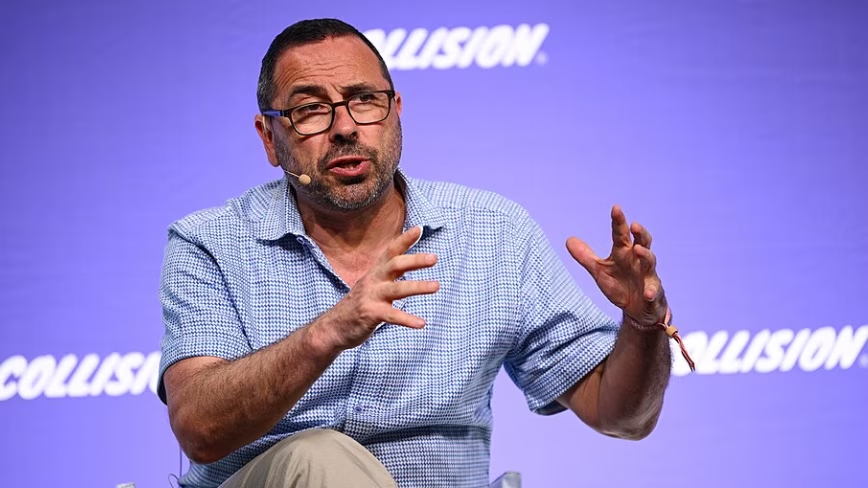
Feldman
 Credit: Collision Conf
Cerebras CEO Andrew Feldman says work-life balance and building something extraordinary are incompatible. “It’s every waking minute.” Cerebras is valued at $49.5B. He joins Sergey Brin and Meta’s Bosworth in pushing longer hours.
Andrew Feldman, cofounder and CEO of AI chip company Cerebras, says it is “mind-boggling” that people believe they can achieve greatness while working 38 hours a week. “This notion that somehow you can build something extraordinary by working 38 hours a week and having work-life balance, that is mind-boggling to me,” he said on the 20VC podcast. “It’s not true in any part of life.” The path to building something from nothing, he added, is not part-time work. “It’s every waking minute.”
Feldman runs a company now valued at roughly $49.5 billion. Cerebras raised $5.55 billion in the biggest US tech IPO since Snowflake earlier this year, and its wafer-scale AI chips compete directly with Nvidia for data centre workloads. He is not speaking from the sidelines. He acknowledged that professionals can work 40 hours and still be happy, but said those people “won’t be the ones launching the next unicorn or rolling out generation-defining products.”
The comments join a chorus from AI executives pushing the same message. Google cofounder Sergey Brin told employees to work 60 hours a week. Meta CTO Andrew Bosworth told staff that AI productivity gains should be reinvested in more work, not more time off, calling a request for extra holiday days “very dumb.” Kevin O’Leary of Shark Tank said founders should work “25 hours a day, 8 days a week.” The pattern is consistent: the executives with the most equity are telling the employees with the least to work harder.
Feldman tried to reframe the debate. “It’s not about logging hours,” he said. “It’s about being passionate and being consumed by the work.” The distinction is real but also convenient. Passion is free for the person who owns the company. For the engineer on a salary, being “consumed” by work without equity upside is a different proposition. Cerebras doubled its revenue last quarter and the stock fell anyway, which means even the passion of the founder does not always translate into returns. The question is not whether Feldman works harder than everyone else. It is whether “every waking minute” is a philosophy or a job requirement, and who gets to decide which.
Get the most important tech news in your inbox each week.


