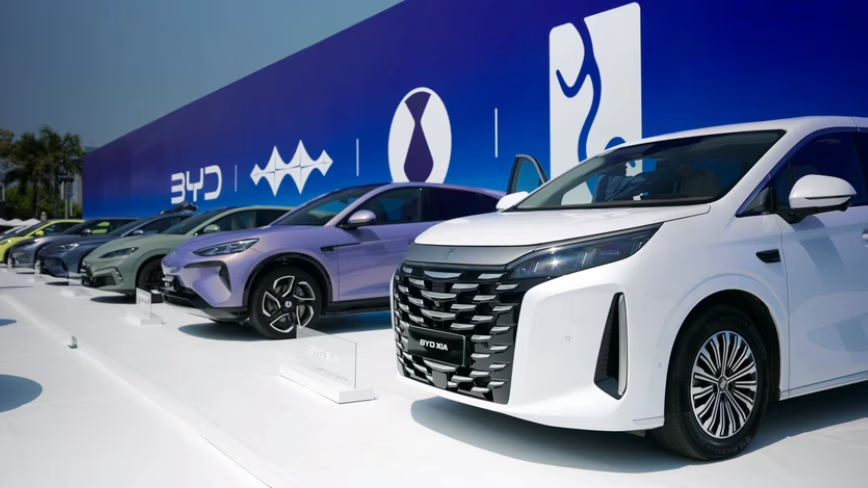
BYD Auto vehicles showcased at BYD HQ, Shenzhen, China
 Credit: iMoD Official
BYD says it drove a randomly selected Yangwang U7 for 30,000 kilometres over nine days with 350 ultra-fast charging stops, and the battery retained 98.7% of its capacity. Euro 7 will require new car types to keep 80% of original capacity after five years from 29 November.
BYD has answered the question everyone asks about ultra-fast charging by doing it 350 times to one car. Its Yangwang U7 covered 30,000 kilometres in nine days and finished with 98.7% of its battery capacity intact.
The conditions were chosen to be punishing. The car ran at 240 kph on a test track in Nanning at an average ambient temperature of 36 degrees Celsius, drawing up to 640 kilowatts at each stop.
BYD says the car was not special. It claims a random U7 came off a showroom floor rather than being prepared, which is the part an independent tester would want to check.
The result is encouraging on its own terms. Heat and fast charging are the two things that wear a pack down, and degradation is usually steepest in a battery’s early life.
What nine days cannot show you is time. Calendar ageing happens whether a car is driven or not, and no amount of track work compresses five years into a fortnight.
Europe is about to turn that into a legal requirement. Euro 7 obliges electric cars to retain 80% of their original capacity after five years or 100,000 kilometres, and 72% after eight years or 160,000.
The clock is nearly running. New car types must comply from 29 November this year, and every new car sold from the same date in 2027.
BYD is not watching this from a distance. It is building cars in Hungary, where it has rejected claims that its Szeged factory breached environmental rules.
Its charging plans are European too. It intends to build a megawatt charging network here, having pushed some mass production towards Turkey.
The constraint on this continent is not charger speed. It is getting power to the charger at all, which is why companies are selling cheaper ways to mount equipment onto buildings that already have a supply.
Nobody has explained how this gets proved. An approval granted in November has to satisfy an authority about capacity retention in 2031, which means accelerated ageing models rather than road miles.
Chinese brands are already taking record share of European registrations, and from November every new type they launch here must meet that threshold.
So a nine-day test is a marketing answer to a regulatory question. Europe is not asking for 98.7% after nine days. It is asking for 72% after eight years, in writing.
Get the TNW newsletter
Get the most important tech news in your inbox each week.


