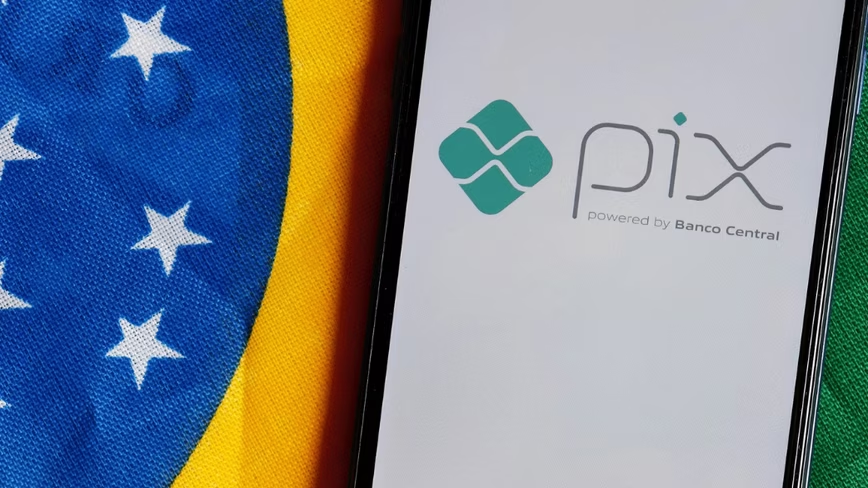
Brazil’s instant-payment system Pix has moved from a domestic success story to the centre of a trade fight with the United States, and governments elsewhere are watching how it ends.
The dispute hardened in June, when the Office of the US Trade Representative (USTR) determined that Brazil’s practices around digital trade and electronic payments were “unreasonable” and burdened US commerce.
Pix is a real-time payment network built and operated by Brazil’s central bank, which launched it in November 2020.
It lets people and businesses move money in seconds using a phone number, email address, or QR code, at no cost to individuals, and it has become one of the most closely studied examples of state-built digital payments infrastructure.
Its scale is hard to overstate. By early 2025, more than 160 million individuals had registered to use Pix, according to central-bank figures, alongside roughly 19 million businesses.
The system moved around R$35tn, or close to $6.7tn, across nearly 80 billion transactions in 2025, up from R$26.4tn the year before, according to industry trackers. Those are figures that dwarf the value routed through most private networks in the region.
Adoption has kept climbing. Pix became Brazil’s most popular online payment method in 2025, accounting for around 42% of e-commerce purchases and narrowly overtaking credit cards, with analysts projecting it could reach half of online sales by 2028.
Those numbers are part of what has drawn Washington’s attention. In its Section 301 review, USTR argued that Brazil’s central bank holds a conflict of interest by acting as both the regulator and the operator of Pix, and that mandatory participation for large banks, prominent placement in banking apps, and capped fees have disadvantaged US payment firms.
The finding formed one strand of a wider case. The investigation bundled the payments complaint with grievances over tariffs, anti-corruption enforcement, intellectual property, ethanol market access, and deforestation, according to the Congressional Research Service.
Washington has paired the determination with tariffs. A 25% duty on most Brazilian goods was set to take effect in late July, though several categories were reportedly spared and the exact timing remained fluid as talks continued.
Brazilian officials have pushed back firmly. President Luiz Inácio Lula da Silva has described Pix as “a heritage of our people and an international reference for digital public infrastructure”, while US Secretary of State Marco Rubio said Lula’s government had not negotiated in good faith.
USTR Ambassador Jamieson Greer struck a similar note, saying a year of talks had failed to resolve the issues and that “substantial differences” remained. Brazil has threatened retaliation but so far stopped short of immediate counter-tariffs.
The stakes reach well beyond bilateral trade. Analysts at the Atlantic Council have warned that treating a domestic payment system as a trade barrier sets a precedent that could touch Europe’s plans for a digital euro and other central bank digital currencies.
That concern is not hypothetical. The case appears to be the first in which USTR has treated a country’s public payment rail as an enforcement issue, and India’s UPI network drew similar scrutiny in the 2026 National Trade Estimate report.
For central banks weighing whether to build their own instant-payment rails, as several European institutions have explored, the clash is a live test of how far a government can go in offering a free public alternative to private networks. Some economists frame it as a question of monetary sovereignty.
Monica de Bolle of the Peterson Institute for International Economics wrote that the coming weeks would “reveal the contemporary limits of monetary sovereignty”, pointing to overlapping trade and security pressures on Brasília.
What happens next is unsettled. Negotiations remain open, the tariff schedule could still shift, and Brazil retains the option of formal retaliation, all while firms that route cross-border payouts through the country watch for disruption.
Get the TNW newsletter
Get the most important tech news in your inbox each week.


