TL;DR
Microsoft’s Brad Smith wrote a 3,000-word essay responding to graduates booing AI. He called it a wake-up call but offered no policy changes. Just adapt.
The Microsoft president called graduating students' rejection of AI a "powerful wake-up call for the tech sector," then spent 3,000 words explaining why they should get on board
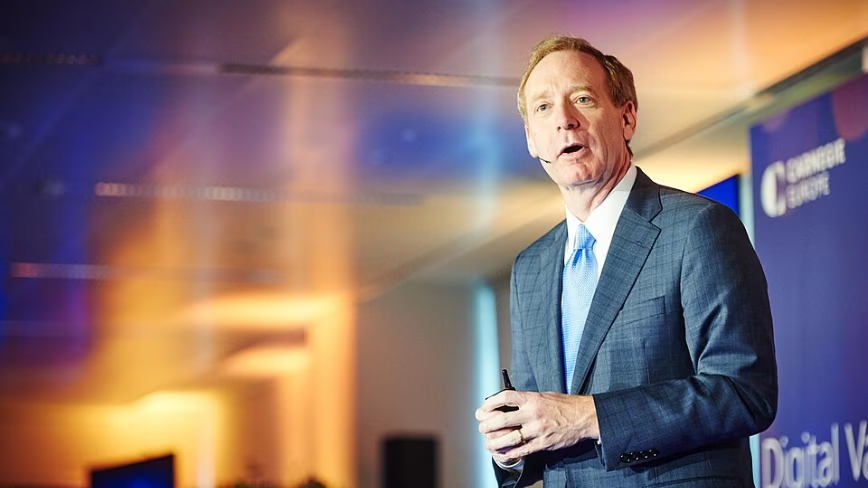
Brad
 Credit: Microsoft
Microsoft’s Brad Smith wrote a 3,000-word essay responding to graduates booing AI. He called it a wake-up call but offered no policy changes. Just adapt.
Microsoft President Brad Smith has responded to the wave of graduating students booing AI at commencement ceremonies with a 3,000-word essay that acknowledges their concerns and offers no concrete changes. Published on Microsoft’s official blog on Tuesday, the essay called the backlash a “powerful wake-up call for the tech sector.” His prescription: the graduates should adapt.
Smith cited his own experience at Princeton, where students rejected jacket designs they believed were created with AI tools. He framed the reaction alongside wider incidents: Eric Schmidt being booed at the University of Arizona, Gloria Caulfield booed at the University of Central Florida, and a college president booed after an AI system used to read graduates’ names skipped students entirely.
“People will insist on having a say in deciding when and how AI is used,” Smith wrote. He compared the moment to 1838, when cameras sparked predictions that photography would make artists obsolete. The analogy positions the booing students as the equivalent of people who feared cameras would destroy art.
Smith acknowledged the job market is difficult. He called it a “perfect storm” for the class of 2026. But his essay did not address the numbers behind the storm. Goldman Sachs estimated in April that roughly 16,000 US jobs are being lost to AI per month. ServiceNow’s CEO warned that graduate unemployment could hit 30% within two years. Another Microsoft executive said earlier this year that AI would wipe out white-collar jobs within 18 months.
“Students and graduates recognize AI’s benefits. But they want to keep AI in its proper place,” Smith wrote. He compared the rejection of AI to consumers’ preference for natural fibres over synthetic ones, framing the backlash as a matter of market taste rather than economic displacement.
His closing message to graduates: “Constant change has taught you how to adapt quickly. As AI reshapes how we work, you don’t need to unlearn decades of habits the way some of us do.” He urged them to “stand firmly and speak loudly for values that are timeless. Agency. Ambition. Dignity.”
What the essay did not contain was any commitment to slow AI deployment, protect entry-level roles, or fund retraining at scale. Meta cut 8,000 jobs the same month in an AI restructuring. Standard Chartered announced it would cut 7,800 back-office roles by 2030, specifically the entry-level positions graduates take in their first years at a bank. Big Tech’s combined AI infrastructure spending exceeds $700 billion in 2026, funded in part by converting payroll into capital expenditure.
The class of 2026 entered university the same semester ChatGPT launched. They have watched every major tech company announce layoffs and AI spending increases in the same earnings calls. The boos were not confusion about a technology cycle. They were the sound of a generation that did the arithmetic before the commencement speaker finished the speech. Smith heard it. His response was to ask them to embrace the math.
Get the most important tech news in your inbox each week.


