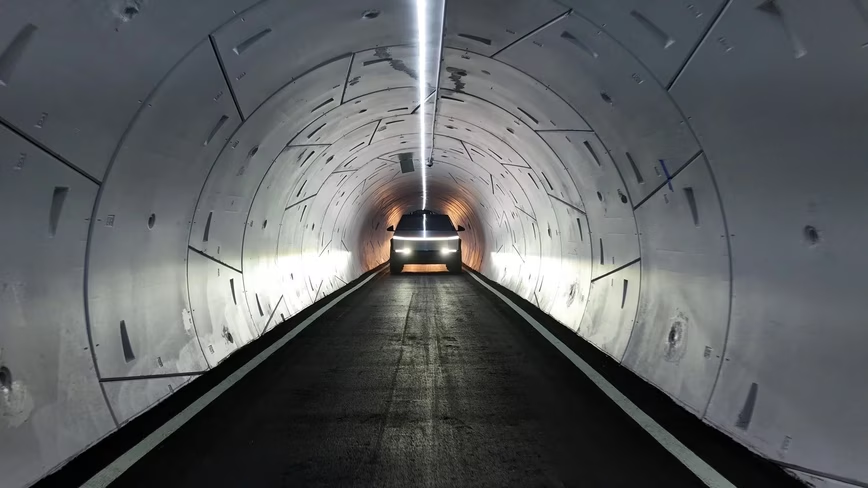
A Cybertruck in a Boring Company Loop tunnel
 Credit: The Boring Company
Elon Musk’s tunnelling company has raised $3bn at a valuation of $23bn, led by the United Arab Emirates and affiliated investment entities, four times what it was worth in 2022, and a long way from the Washington to New York hyperloop announced in 2017.
The money is earmarked for more than 150km of tunnel across the UAE, on top of the Dubai Loop contract already signed.
The company set out the round and the reasoning behind it in its own Series D announcement. Human Capital, Vy Capital, Valor Equity Partners, Sequoia Capital, Andreessen Horowitz, Temasek, Shamal Holding and Baron Capital also took part.
Proceeds go to hiring across engineering, operations and production, to Vegas Loop, Music City Loop in Nashville and Dubai Loop, and to further work on its Prufrock boring platform.
What the announcement does not mention is the term that made this round unusual. Investors were told they would have to help recruit workers or assist with business development, including introductions to officials in cities where the company wants to dig, and the company reserved the right to buy back some of their shares if they failed to supply viable candidates.
That was reported by the Wall Street Journal on 4 September, and Musk confirmed it on X with a single word: “True.”
“Defeating traffic is the ultimate boss battle. Even the most powerful humans in the world cannot defeat traffic,” says Elon Musk.
Read the two documents together, and they explain each other. The public announcement is about how fast the company can dig. The term sheet is about being allowed to.
Boring machines are not the bottleneck in this business; permits are, a gap TNW noted when the company promised a hyperloop and delivered cars in a tunnel, and a company that has priced access to municipal officials into its equity is one that knows exactly which of the two is scarce.
Whether that is wise is a question for the cities involved. An investor making introductions to officials on behalf of a company that can repurchase their shares if they do not perform is doing something that in most jurisdictions has a name and a registration requirement.
Nothing suggests anything improper has occurred, and the arrangement was disclosed by the Journal and confirmed rather than denied.
It is still a structure that turns shareholders into an unpaid government relations function under contractual pressure, and it is absent from the company’s own account of the round.
The engineering half deserves to be taken seriously, because it is the strongest case the company has made in years. Newer Prufrock machines launch and retrieve directly from a transporter, removing the launch pit, crane and civil works that normally precede a tunnel.
By August, ring building was fully autonomous, with six concrete segments of about 3,750lb each placed to millimetre precision in under a minute, monitored from a control centre in Texas.
A conveyor system is specified at up to 990 tons an hour, supporting advance rates of up to four miles a week.
There are operating numbers now too, which there were not before. Vegas Loop has carried more than four million passengers, Clark County has entitled 123 stations, and the company says it has started its 25th tunnel overall and its 14th in Las Vegas.
The Encore connector was finished in under 12 weeks and turns a 15-minute surface trip into about 55 seconds. All of these are the company’s own figures, and none are audited, but they are checkable claims rather than promises, which is a change.
Nashville is the more important proof. Music City Loop is the first hard-rock project and the first outside Nevada; tunnelling began the day the state permit was issued in February, and two machines were mining by August, with a third in assembly.
Hard rock is where tunnelling economics usually break, and a company that can do it at speed has a genuinely different product from the one that dug under a convention centre.
What is still missing is money. No revenue, no cost per kilometre, no fare or contract economics appear anywhere, and a $23bn valuation rests on the assumption that cities keep saying yes. Which brings it back to the clause.
For a European reader, the striking thing is that the 150km is being planned in the UAE, where the transport authority is both regulator and customer, and not in a jurisdiction with environmental assessment, heritage protection, and public consultation between the machine and the ground.
Get the TNW newsletter
Get the most important tech news in your inbox each week.


